Forex Leverage: What It Is, How It Works, and Why It Kills Accounts
Leverage amplifies both profits and losses in forex trading. Learn exactly how forex leverage works, the difference between notional and real exposure, how to choose the right level, and the regulatory limits by region.
Leverage is the single most misunderstood concept in retail forex trading. Beginners see it as an opportunity amplifier. Experienced traders know it’s a risk multiplier that cuts in both directions with equal force.
The difference between those two perspectives is often the difference between growing an account and blowing one.
What Is Leverage in Forex?
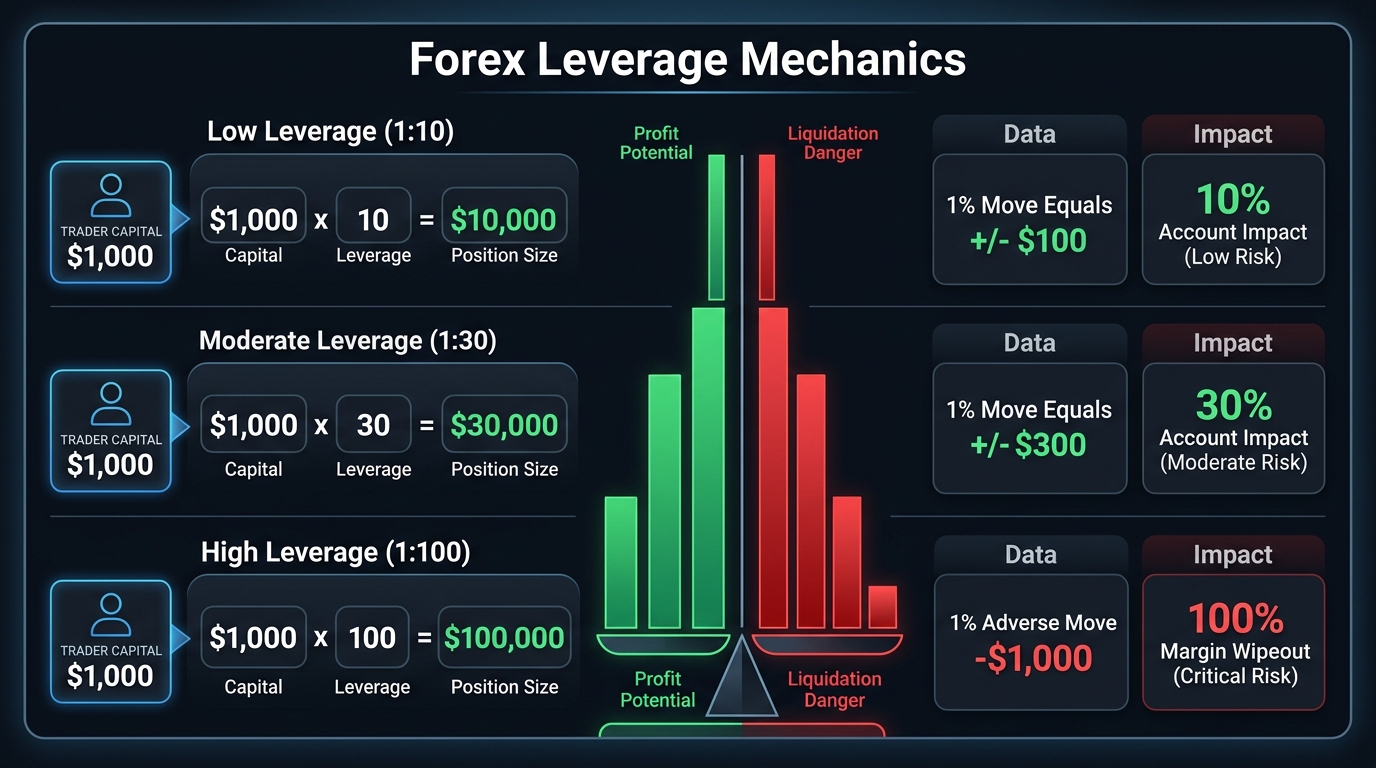
Leverage is the ratio of your actual capital to the position size you control. At 100:1 leverage, $1,000 of your own money controls $100,000 worth of currency. At 500:1, that same $1,000 controls $500,000.
The $100,000 (or $500,000) is called the notional value of the position. Your $1,000 is the margin — the deposit required to hold it. The broker lends you the rest.
The mechanics:
Notional Value = Margin × Leverage Ratio
$100,000 = $1,000 × 100:1
Or rearranged:
Required Margin = Notional Value / Leverage Ratio
$1,000 = $100,000 / 100
When price moves in your favor, the profit is calculated on the notional value — not just your margin. When price moves against you, the loss is also calculated on the notional value.
How Leverage Amplifies Gains and Losses
This is the table that should be permanently embedded in every forex trader’s memory:
Starting capital: $10,000 | Trading EUR/USD | 1 standard lot (100,000 units)
| Leverage | Required Margin | 1% Price Move (100 pips) — Gain | 1% Price Move (100 pips) — Loss |
|---|---|---|---|
| 5:1 | $20,000 (can’t use) | — | — |
| 10:1 | $10,000 | +$1,000 (+10%) | -$1,000 (-10%) |
| 20:1 | $5,000 | +$1,000 (+10%) | -$1,000 (-10%) |
| 50:1 | $2,000 | +$1,000 (+10%) | -$1,000 (-10%) |
| 100:1 | $1,000 | +$1,000 (+10%) | -$1,000 (-10%) |
| 500:1 | $200 | +$1,000 (+10%) | -$1,000 (-10%) |
Notice something important: the gain and loss in dollar terms is identical at every leverage level for the same 1 standard lot position. Leverage doesn’t change the risk of the trade — position size does. What leverage changes is the margin required to hold that position.
Where leverage becomes dangerous is when traders interpret “low required margin” as an invitation to hold larger positions than their capital can safely absorb.
The Leverage Trap: Where Traders Go Wrong
Consider two traders with identical $10,000 accounts:
Trader A: Uses 100:1 leverage to take the maximum possible position (10 standard lots = $10,000,000 notional). A 0.1% adverse move (10 pips on EUR/USD) wipes the entire account.
Trader B: Uses 100:1 leverage but sizes positions based on 1% risk per trade. With a 25-pip stop-loss, Trader B holds 0.40 lots. The leverage ratio is the same, but the actual risk exposure is $100.
Same leverage. Completely different outcomes.
The leverage ratio is not the risk. The position size is the risk. Using high leverage recklessly is dangerous. Using high leverage responsibly — meaning: correctly sizing positions based on your stop-loss distance and risk percentage — is safe.
The problem is that most retail traders who choose high leverage don’t use it responsibly. They use it to take the largest possible position, which is mathematically catastrophic.
Effective Leverage vs. Nominal Leverage
Nominal leverage is the maximum ratio your broker offers (e.g., 500:1).
Effective leverage is the actual ratio you’re using based on your open positions.
Effective Leverage = Total Notional Position Value / Account EquityExample: $10,000 account, two open positions totaling $80,000 notional value. Effective leverage = $80,000 / $10,000 = 8:1
Professional traders monitor their effective leverage constantly. Staying below 10:1 effective leverage is a common threshold for prudent risk management, regardless of what the broker’s nominal leverage allows.
Leverage Limits by Region (2026)
Regulatory bodies in different regions cap the leverage available to retail traders. These limits are set to protect retail traders from the most catastrophic use cases.
| Region | Regulatory Body | Max Leverage (Major Pairs) | Max Leverage (Minor/Exotic) |
|---|---|---|---|
| European Union | ESMA | 30:1 | 20:1 (minors), 10:1 (exotics) |
| United Kingdom | FCA | 30:1 | 20:1 (minors), 10:1 (exotics) |
| United States | CFTC/NFA | 50:1 | 20:1 |
| Australia | ASIC | 30:1 | 20:1 |
| Japan | FSA | 25:1 | 25:1 |
| International (offshore) | None or minimal | 200:1–1000:1 | 200:1–1000:1 |
Professional clients (traders who meet specific wealth and experience criteria) can often access higher leverage. The classifications vary by regulator.
Offshore brokers offer extremely high leverage (500:1 to 1000:1) and are outside strict regulatory oversight. Accessing higher leverage this way is legal in many jurisdictions but involves meaningfully higher counterparty risk.
Margin, Free Margin, and Margin Level
These three concepts are critical to understand before trading with leverage:
Margin: The deposit held by your broker as collateral for your open positions.
Free margin: The remaining amount available in your account that is not locked up as margin.
Free Margin = Account Equity - Used MarginMargin level: The ratio of equity to used margin, expressed as a percentage.
Margin Level = (Account Equity / Used Margin) × 100When margin level falls below a broker’s threshold (typically 50–100%), the broker issues a margin call — requiring you to add funds or close positions. If margin level falls below the stop-out level (typically 20–50%), the broker automatically closes your positions to protect the remaining margin.
Use the margin calculator to see how margin requirements, free margin, and margin level change based on your position size and account balance.
Choosing the Right Leverage Level
The correct leverage level is the one that allows you to use proper position sizing. Here’s how to determine it:
Step 1: Decide how many pips your stop-loss will be. For EUR/USD swing trades, 25–50 pips is typical.
Step 2: Calculate the position size that puts 1% of your account at risk at that stop distance.
Step 3: Calculate the margin required for that position size.
Step 4: Ensure your account has enough margin to hold the position with 200%+ margin level.
If the math works with 30:1 leverage, you don’t need 500:1. If the math requires a higher leverage ratio to make the minimum trade size viable, consider whether your account is adequately capitalized.
Practical leverage guidelines by experience level:
| Trader Level | Recommended Effective Leverage | Why |
|---|---|---|
| Beginner | 3:1 to 5:1 | Eliminates margin call risk; teaches position sizing discipline |
| Intermediate | 5:1 to 15:1 | Allows reasonable position sizes while maintaining capital safety |
| Advanced | Up to 30:1 | Uses full regulatory limit; requires strong risk management |
| Professional | Situational | May exceed 30:1 with specific hedging strategies and proper risk controls |
Leverage and Overnight Positions
Leveraged forex positions held overnight accrue swap charges (or earn swap income), which are based on the interest rate differential between the two currencies in the pair. At higher leverage, this daily cost compounds faster as a percentage of the actual margin.
For swing traders holding positions for several days, swap costs are a real consideration — especially on exotic pair positions where swaps can be 0.5–1% per week.
Key Takeaways
- Leverage allows you to control positions larger than your actual capital; a 100:1 ratio means $1,000 controls $100,000
- Leverage amplifies both gains and losses proportionally — a 1% adverse price move on a maximally leveraged position can wipe the entire account
- The danger is not leverage itself — it’s using leverage to take positions larger than proper position sizing would allow
- Calculate effective leverage (total notional value / equity) and keep it below 10:1 as a starting guideline
- Regulatory leverage limits vary: 30:1 in EU/UK, 50:1 in the US, 25:1 in Japan
- Understand margin, free margin, and margin level — dropping below your broker’s margin call threshold triggers forced position closures
- The correct leverage level is whichever allows you to use proper position sizing while maintaining a safe margin level

Ready to Practice This Strategy?
Test what you learned on a free, risk-free demo account before risking real money.