What Is Forex? The Foreign Exchange Market Explained
Forex is the world's largest financial market, trading $7.5 trillion per day. Learn how currency exchange works, who participates, and why it matters for retail traders.
The foreign exchange market moves more money every single day than every stock exchange on the planet combined. That’s not a marketing claim. The Bank for International Settlements (BIS) puts daily forex turnover at roughly $7.5 trillion as of 2022 — compared to the New York Stock Exchange’s $25 billion daily equity volume. By any measure, forex is the world’s largest financial market.
But size alone isn’t what makes it relevant to you. What matters is how it works, who controls it, and what that means for anyone who wants to trade currencies.
What “Forex” Actually Means
Forex is shorthand for foreign exchange — the global market where currencies are bought and sold against each other. Every time a business converts euros to pay a US supplier, every time a tourist swaps dollars at an airport kiosk, every time a central bank intervenes to defend its currency’s value, that transaction happens in the forex market.
Unlike the NYSE or London Stock Exchange, forex has no central building, no opening bell, no single governing authority. It’s a decentralized, over-the-counter (OTC) market — meaning trades happen directly between participants via electronic networks and banks, not through a central exchange. This is why it runs 24 hours a day, five days a week: when New York closes, Tokyo opens; when Tokyo winds down, London takes over.
Currency Pairs: How Forex Trades Are Structured
You never buy a currency in isolation. You always buy one currency and simultaneously sell another. This is why forex trades in currency pairs.
Take EUR/USD — the world’s most traded pair. When you buy EUR/USD, you’re buying euros and selling US dollars. The quoted price tells you how many dollars one euro costs at that moment. If EUR/USD is quoted at 1.0850, one euro buys $1.0850.
Every currency pair has two components:
- Base currency — the first one listed (EUR in EUR/USD). You’re measuring its value.
- Quote currency — the second one (USD). This is what you pay or receive.
The major pairs — EUR/USD, GBP/USD, USD/JPY, USD/CHF, AUD/USD, USD/CAD, NZD/USD — account for the majority of global forex volume. They have the tightest spreads and highest liquidity. Minor pairs and exotics exist, but they come with higher trading costs and lower liquidity.
How Exchange Rates Are Determined
Exchange rates aren’t set by any single authority. They’re the product of continuous supply and demand across global markets. If demand for the euro rises (perhaps because European economic data comes in stronger than expected), the euro’s price in dollars rises. If demand falls, the rate falls.
Several forces drive this demand at any given time:
Interest rates are the dominant long-term driver. When the US Federal Reserve raises interest rates, US dollar assets become more attractive to global investors seeking higher yields. Capital flows into dollar-denominated bonds, increasing demand for dollars, which pushes the dollar higher.
Economic data creates short-term volatility. A US jobs report beating expectations will typically strengthen the dollar within minutes of release. GDP growth figures, inflation readings, and manufacturing indexes all move currency prices — sometimes violently.
Political stability and risk sentiment matter too. In times of global uncertainty, traders tend to buy so-called “safe haven” currencies: the Swiss franc, Japanese yen, and US dollar. In calmer periods, higher-yielding currencies attract flows.
The Spot Market vs. Other Forex Instruments
When retail traders talk about “trading forex,” they’re almost always trading the spot market — an agreement to buy or sell a currency at the current price, for immediate (technically, two-day) settlement. This is what your broker’s platform shows when you see EUR/USD at 1.0850.
The forex market also includes:
- Forwards — contracts to exchange currency at a future date and locked-in rate, used mainly by corporations hedging business exposure
- Futures — standardized forward contracts traded on exchanges like the CME
- Options — the right (not obligation) to exchange at a specified rate before a set date
- Swaps — simultaneous spot purchase and forward sale of the same currency, used heavily by banks
Retail traders using brokers trade the spot market via CFDs (Contracts for Difference) or rolling spot contracts. You don’t take physical delivery of euros or yen. You profit or lose on the price movement between entry and exit.
Who Trades Forex?
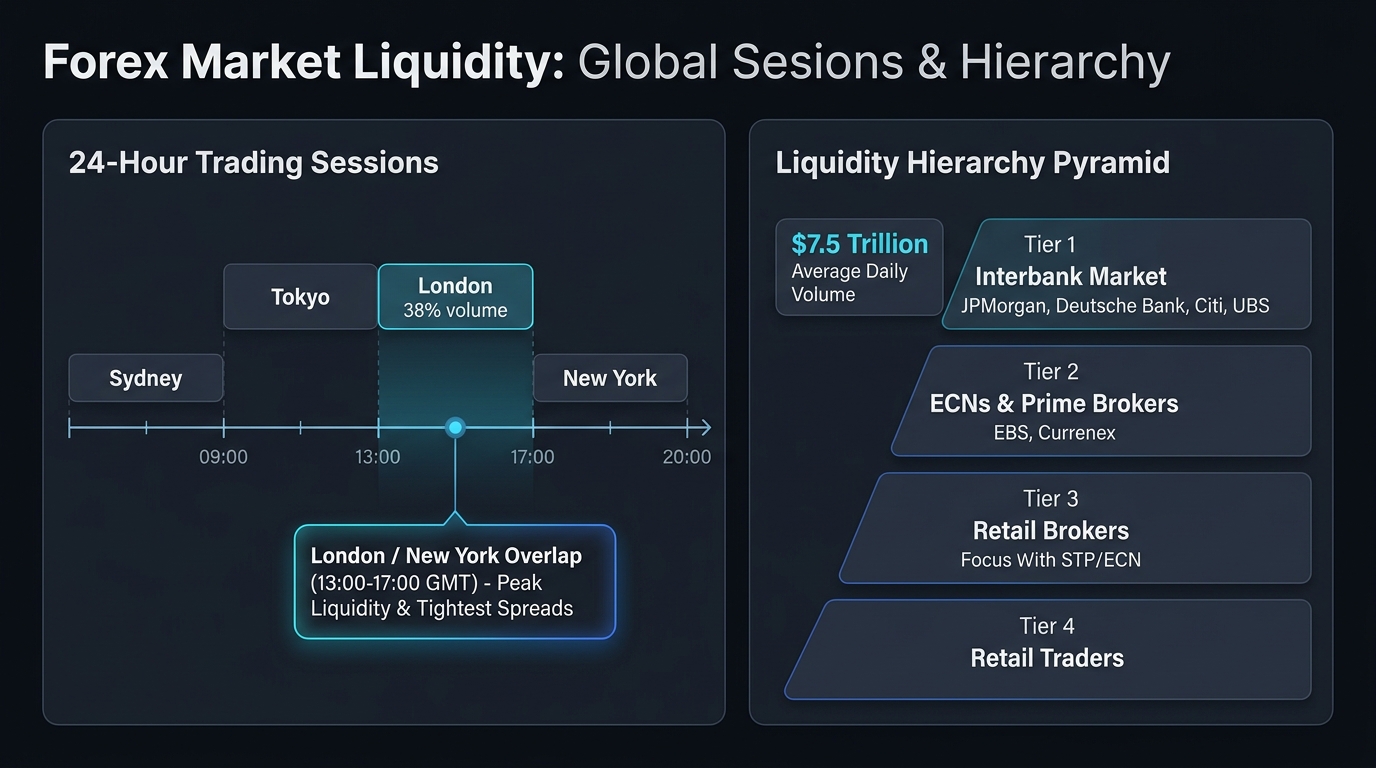
The forex market is a tiered system. At the top sits the interbank market — major international banks like Citigroup, Deutsche Bank, and JPMorgan trading enormous amounts with each other. Below that are institutional clients: hedge funds, multinational corporations, and central banks. Retail traders sit at the bottom of this hierarchy, accessing the market through brokers who in turn access the interbank market (or act as market makers themselves).
This structure has a practical implication: the price you see on your broker’s platform is derived from interbank prices, but it includes a spread — the broker’s margin. Choosing a broker with tight, transparent spreads matters more than most beginners appreciate.
Why the Forex Market Is Open 24 Hours
The forex market’s 24-hour nature follows the sun. Three major trading sessions overlap across a typical weekday:
| Session | Hours (UTC) | Key Currencies |
|---|---|---|
| Asian (Tokyo) | 00:00–09:00 | JPY, AUD, NZD |
| European (London) | 07:00–16:00 | EUR, GBP, CHF |
| North American (New York) | 12:00–21:00 | USD, CAD |
The most active trading — and the tightest spreads — occur during the London-New York overlap (12:00–16:00 UTC). More participants, more volume, more price movement. If you’re day trading, this window matters.
What This Means for You as a Retail Trader
Understanding forex as a market means understanding what you’re actually competing with. You’re not playing against a computer algorithm or a static rulebook. You’re trading against banks, institutions, and professional traders who have better information, lower costs, and decades of experience.
That’s not a reason to avoid it. It’s a reason to be disciplined, selective, and educated before placing a single live trade. The traders who survive long-term aren’t the most aggressive — they’re the most patient and the most systematic.
The next lesson covers why retail traders choose forex over other markets, and what the real advantages (and honest disadvantages) look like.
Next: Why Trade Forex? Comparing FX to Stocks and Other Markets
Related dictionary terms: Currency Pair | Spread | Liquidity | Spot Rate

Ready to Practice This Strategy?
Test what you learned on a free, risk-free demo account before risking real money.