Interest Rates and Forex: How Central Bank Decisions Drive Currency Prices
Interest rate decisions are the single most powerful driver of forex markets. Learn why interest rates move currencies, how to trade rate decisions, and how to read central bank signals before they happen.
If you could only track one fundamental factor in forex, it would be interest rates. Not GDP, not inflation directly, not employment — interest rates. Everything else feeds into them. And interest rates, more than any other single variable, determine the long-term direction of currency pairs.
This isn’t a coincidence. It’s a direct consequence of how global capital flows.
Why Interest Rates Move Currencies
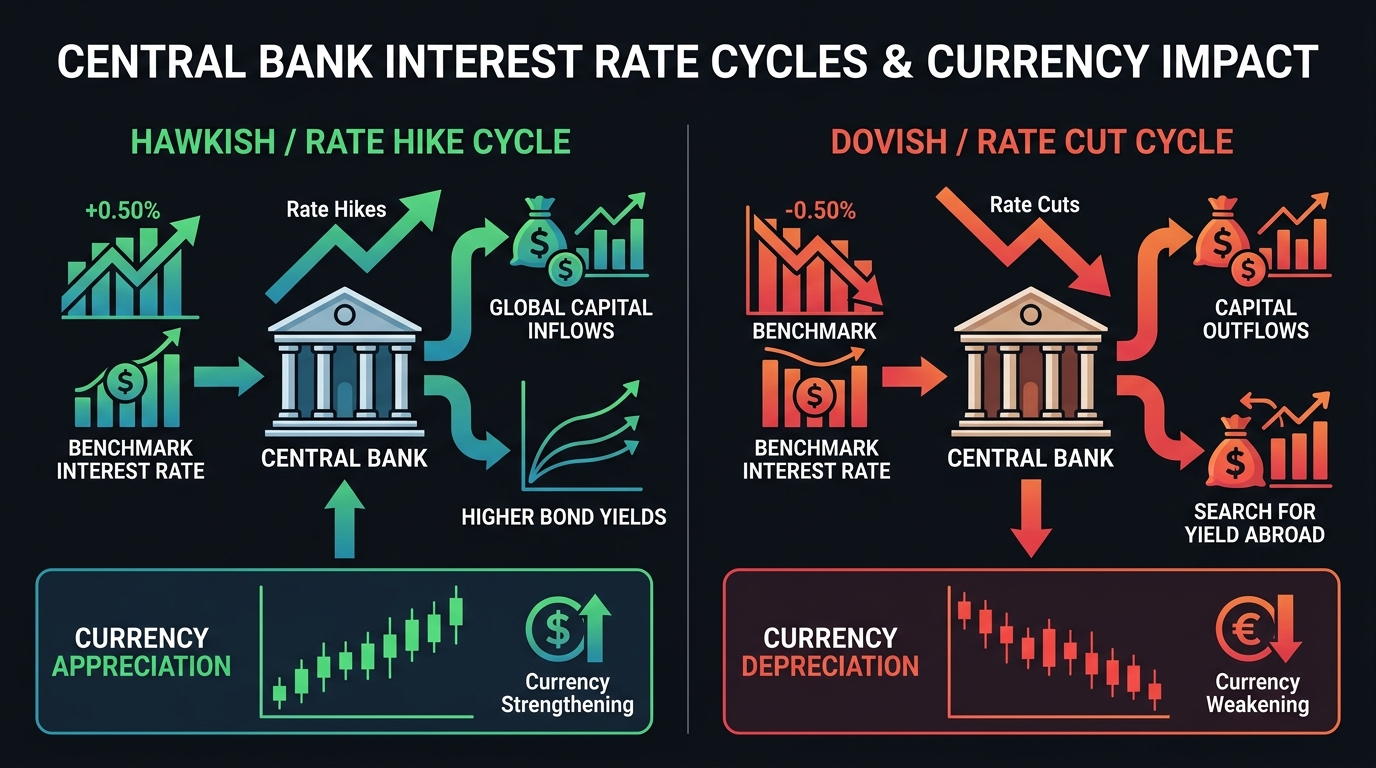
When a central bank raises its benchmark interest rate, it makes that country’s currency-denominated assets more attractive. Investors around the world move capital toward higher-yielding bonds, bank accounts, and financial instruments. To buy those assets, they first need to buy the local currency. This buying pressure appreciates the currency.
The reverse: when a central bank cuts rates, returns on local assets decline. Capital flows out in search of better yields elsewhere. Selling pressure depreciates the currency.
This relationship is formalized in Interest Rate Parity theory — the idea that the interest rate differential between two countries determines the expected movement in their exchange rate over time. In practice, reality is messier. But the directional logic holds.
Current Global Rate Environment (2026)
After the aggressive rate-hiking cycles of 2022–2024 in response to post-pandemic inflation, central banks in 2026 are navigating a complex landscape: some have begun cutting (ECB, BoE), some remain elevated (Fed), and the Bank of Japan is attempting its first meaningful rate normalization in decades.
| Central Bank | Currency | Rate (Sep 2026, approx.) | Current Policy Direction |
|---|---|---|---|
| Federal Reserve (Fed) | USD | 4.75% | Holding; selective cuts possible |
| European Central Bank | EUR | 3.25% | Cutting cycle ongoing |
| Bank of England | GBP | 4.50% | Holding with cuts expected |
| Bank of Japan | JPY | 0.25% | First rate hike cycle in 17 years |
| Reserve Bank of Australia | AUD | 4.25% | Holding |
| Reserve Bank of New Zealand | NZD | 4.00% | Cutting cycle |
| Bank of Canada | CAD | 3.75% | Cutting cycle |
| Swiss National Bank | CHF | 1.25% | Cutting |
The key dynamic: The Fed-BoJ differential (4.75% vs. 0.25%) remains the widest among major pairs. USD/JPY has been one of the most traded pairs globally precisely because of this structural differential and Japan’s gradual normalization path.
The Rate Differential and Currency Pairs
The rate differential between two countries acts as the gravitational pull on a currency pair over the medium-to-long term. Pairs with wider differentials tend to exhibit clearer directional bias.
Rate differential impact by pair (approximate, Sep 2026):
| Pair | High-Rate Currency | Low-Rate Currency | Differential | Bias |
|---|---|---|---|---|
| USD/JPY | USD (4.75%) | JPY (0.25%) | 4.50% | Long USD |
| GBP/JPY | GBP (4.50%) | JPY (0.25%) | 4.25% | Long GBP |
| AUD/JPY | AUD (4.25%) | JPY (0.25%) | 4.00% | Long AUD |
| USD/CHF | USD (4.75%) | CHF (1.25%) | 3.50% | Long USD |
| EUR/JPY | EUR (3.25%) | JPY (0.25%) | 3.00% | Long EUR |
| EUR/USD | EUR (3.25%) | USD (4.75%) | -1.50% | Long USD |
Note: EUR/USD differential actually favors USD, which is one factor behind USD strength despite the ECB’s recovery.
How to Trade a Rate Decision
Central bank rate decisions are scheduled in advance. They are the most significant calendar events for forex traders. Three components matter:
1. The rate decision itself: Does the bank raise, hold, or cut?
2. The statement and forward guidance: The decision tells you what they did. The statement tells you what they might do next. Markets frequently move more on the guidance than the decision itself.
3. The press conference: The central bank governor’s tone, word choice, and responses to journalist questions provide real-time forward guidance interpretation. Minutes matter.
The “Buy the Rumor, Sell the Fact” Pattern
A pattern that repeats around rate decisions:
- In the weeks before a widely expected rate change, the currency moves in the anticipated direction as traders position
- The decision is announced — the change occurs exactly as expected
- The currency reverses, often sharply, because the expected move was already priced in
Example: The Fed signals a 25bp hike clearly for two months. EUR/USD declines as USD strengthens. The hike is announced. EUR/USD rallies because there’s nothing left to price in, and some traders take profits.
Traders who buy after the Fed confirms the hike (when it seems most obvious to do so) are often the ones buying at the top of the USD move.
Reading Central Bank Language
Central banks communicate through specific vocabulary. Learning to read these signals before markets fully price them gives traders a significant information advantage:
| Bank Language | What It Signals |
|---|---|
| “Data dependent” | Open to both cuts and hikes; watching incoming data |
| “Higher for longer” | Rates will stay elevated for an extended period |
| “Gradual normalization” | Rate cuts or hikes will be slow and measured |
| “Restrictive policy” | Current rates are above neutral; bias toward eventual cuts |
| “Remain vigilant on inflation” | No rate cuts imminent despite other factors |
| “Balance of risks” shifting | A change in direction is being considered |
| Forward guidance removed | High uncertainty; significant volatility risk around meetings |
The Fed, ECB, BoE, and RBA all publish minutes, speeches, and meeting statements. These are primary sources — not summaries from news outlets — for understanding the current policy stance.
The Rate Hike Cycle: What to Expect
A central bank rate hike cycle follows a predictable arc:
- Preparation phase: Signals of potential hikes through speeches and statements. Currency begins to strengthen.
- First hike: Significant move. The “first hike” is typically the most impactful because it confirms the cycle.
- Mid-cycle hikes: Market is pricing them in advance; each individual hike produces smaller moves.
- Peak rate: Central bank signals it’s done hiking. Currency often peaks here or shortly after.
- Holding phase: Rate stays flat. The differential is locked in. Carry traders enter.
- First cut: Signals the beginning of the end for the currency’s strength. Can produce significant depreciation.
- Cutting cycle: Mirrors the hike cycle in reverse; currency gradually weakens.
Knowing where a given central bank sits in this cycle helps calibrate medium-term directional bias.
Interest Rates and Inflation: The Connection
Interest rates and inflation are inseparable. Central banks set rates primarily in response to inflation:
- Inflation rising: Bank raises rates to cool borrowing, spending, and money supply growth
- Inflation falling toward target: Bank can afford to cut rates to stimulate growth
- Inflation at target (typically 2%): Bank holds rates at the level it considers “neutral”
In 2022–2024, the Fed raised rates from 0.25% to 5.25–5.50% specifically because CPI reached 9.1% in June 2022 — the highest in 40 years. Watching inflation data (CPI, PCE) gives you advance notice of central bank policy direction.
Read the full lesson on inflation indicators to understand how to track this data.
Practical Application: Building a Rate-Based View
Every Sunday (or before the trading week), run this analysis:
- List the upcoming central bank events: What meetings, speeches, or data releases are scheduled?
- Note the current rate and direction: Is this bank hiking, holding, or cutting?
- Identify the pair most affected: Which pairs involve this currency?
- Assess the differential: Is it widening (supportive of the currency) or narrowing (weakening)?
- Build a bias: This is not a signal to trade — it’s a directional framework that helps filter your technical setups
A strong rate differential that’s widening, combined with a technical uptrend, is a high-confidence long setup for the higher-yield currency.
Key Takeaways
- Interest rates are the single most powerful driver of long-term currency direction; higher rates attract capital inflows that appreciate the currency
- The rate differential between two countries provides the directional bias for their currency pair
- In 2026, the most notable differential is USD/JPY (4.75% vs. 0.25%) as the BoJ begins normalizing rates for the first time in 17 years
- Three components matter at each rate decision: the rate change itself, the forward guidance statement, and the press conference tone
- “Buy the rumor, sell the fact” is real — currencies often peak or trough at the moment the anticipated decision is confirmed
- Learn central bank vocabulary: “higher for longer,” “data dependent,” “restrictive” — these signal policy direction before formal announcements
- Track where each major central bank sits in the hike/hold/cut cycle to calibrate your medium-term directional bias
Next: Inflation Indicators | Role of Central Banks
Related strategies: Carry Trade | News Trading

Ready to Practice This Strategy?
Test what you learned on a free, risk-free demo account before risking real money.