


Three Wave - ABC Pattern
Compared to Impulsive waves, "corrective waves" are harder to spot.
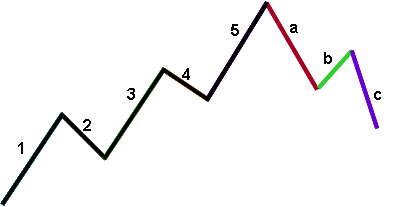
Wave A
This is usually at the end of the 5-wave pattern and fundamental news is typically still positive. Many analysts see this as a mild correction and buy in hoping for a bull run continuation. Again new and inexperienced traders are more likely to fall in to this trap.
Features of Wave-A is an increase in currency pair volume and higher volatility (in the options markets).
Wave B
In most cases this is the last effort by those traders who believe it's a ongoing bull run. The last puff of upward movement before the price goes down again. You can see that wave-B forms the right shoulder of the "head and shoulder" patter.
Volumes are lower again and fundamental factors are no longer supporting the technical.
Wave C
By this time everyone knows there is no further momentum in the currency pair. There is mass selling and the bear has a strong grip on the downward trend.


- Elliot Wave theory
- Five Wave pattern
- Three Wave - ABC Pattern

1. Introduction
2. Support & resistance
- Support and Resistance levels
- Methods to establish support and
resistance? - Trading trend lines and channels
3. Chart patterns
4. Fibonacci
5. Moving averages
- Moving averages
- SMA
- EMA
- SMA versus EMA
- Popular moving average time periods
- Moving averages crossover trading
6. Pivot points
- Pivot points trading
- Range bound trading
- Breakout trades with Pivot points
- Using Pivot points to determine market
sentiment
7. Trading with Elliot Wave theory
Forex Educational Articles & News

There are many factors that affect exchange rates of currencies. However some are more important in currency trading than others. These are; Interest and Inflation rates, Trade balance, Currency market speculation, Foreign investment and Central bank market intervention. Learn how to use these factors in your forex tra ...


 Copyright 2011 forexbite.com


