Alternate account
An alternate account is a secondary or co-owned banking or brokerage account designated to handle operational contingencies, backup liquidity sweeps, or transaction execution when primary facilities are restricted or partitioned.
What Is an Alternate Account?
An alternate account is a secondary or auxiliary financial account maintained alongside a primary deposit, settlement, or brokerage facility. In commercial banking and treasury management, alternate accounts serve as failover conduits to ensure liquidity continuity during technical outages, bank insolvencies, counterparty freezes, or automated clearing bottlenecks. In retail banking, the term often describes a joint account or secondary facility where multiple authorized signers possess independent operational authority without requiring unanimous sign-off for daily disbursements.
Institutional treasury desks treat alternate accounts as fundamental operational risk controls. By maintaining secondary accounts across diversified financial institutions, corporations ensure payroll processing, vendor payments, and foreign exchange hedging can proceed unimpeded if their primary depository encounters solvency or infrastructure disruptions.
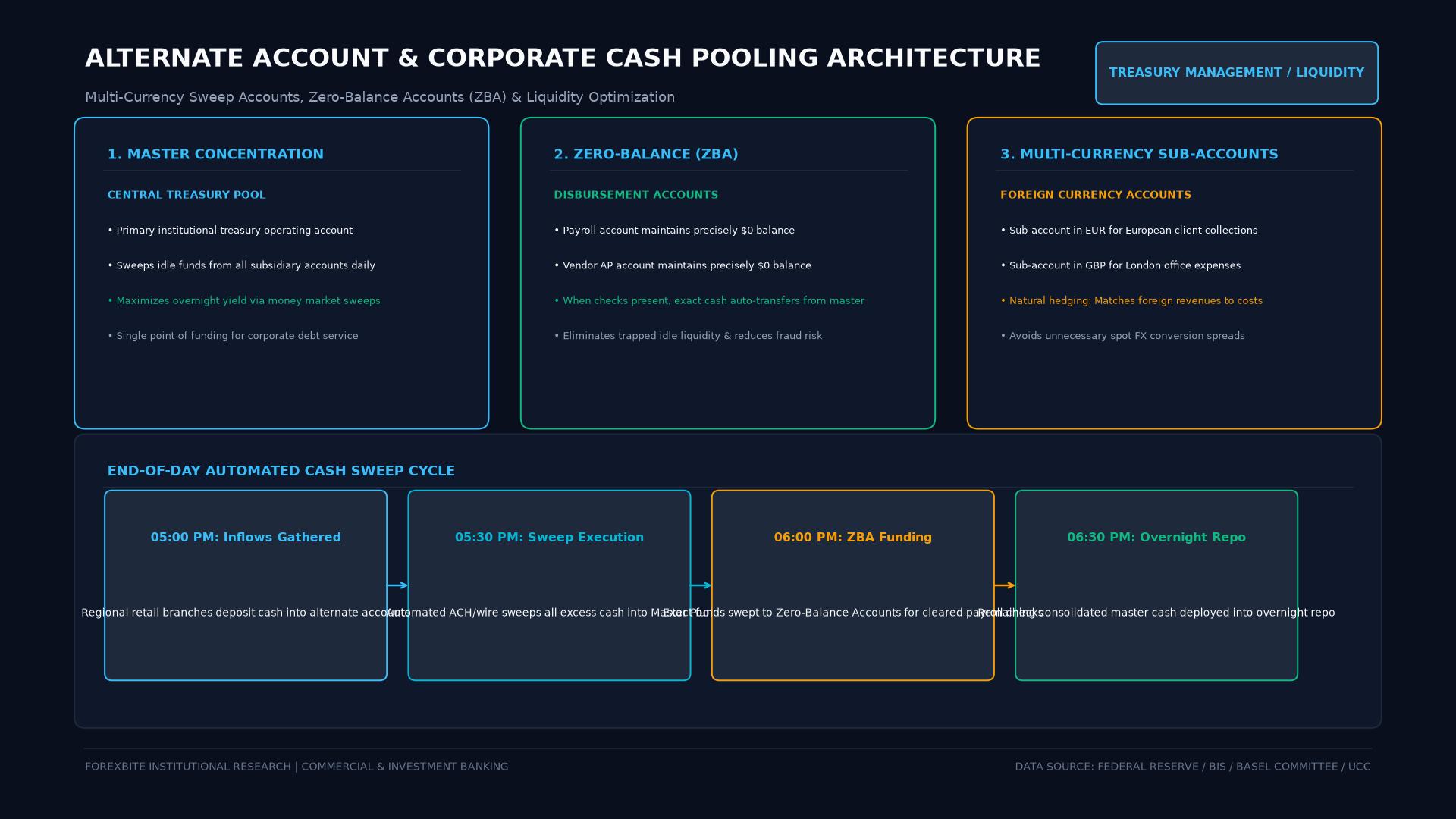 Figure: Dual-custody corporate treasury setup: primary operational sweeping, secondary contingency liquidity, and automatic business continuity failover.
Operating Mechanics and Legal Structures
The legal standing of an alternate account depends entirely on its account agreement, signature card mandates, and organizational resolutions filed with the depository institution.
1. Corporate Treasury Redundancy (Multi-Bank Strategy)
Following the collapse of Silicon Valley Bank (SVB) and Signature Bank in 2023, institutional risk guidelines increasingly mandate multi-banking frameworks. A mid-market enterprise maintaining its payroll and working capital in a single bank faces severe counterparty concentration risk.
By operating an active alternate account at a systemically important financial institution (G-SIB), corporate treasurers can execute instant intra-day wires, diversify FDIC uninsured deposit exposure, and maintain redundant connectivity to payment rails like Fedwire, CHIPS, and SEPA.
2. Retail and Private Banking Mandates
In individual and private wealth management, an alternate account typically takes one of three legal forms:
- Joint Tenancy with Right of Survivorship (JTWROS): Each account holder possesses full access to deposit, invest, or withdraw funds independently. Upon the death of one holder, full legal ownership transfers automatically to the surviving owner outside of probate.
- Tenants in Common (TIC): Co-owners hold fractional, severable interests without automatic survivorship rights. Ownership percentages are transferred according to estate planning instruments.
- Convenience or Agent Accounts: An alternate signer is granted authorized agency powers to manage day-to-day transactions on behalf of the principal owner (such as an aging relative), but acquires zero ownership equity in the funds.
Technical Features: Zero-Balance and Target Sweep Systems
Modern enterprise alternate accounts frequently integrate with cash concentration software via automated sweeping mechanisms:
| Account Type | Primary Function | Balance Mechanism | Typical Vehicle |
|---|---|---|---|
| Operating Account | Daily vendor disbursements and payroll | Funded on demand; targeted buffer | Commercial checking |
| Alternate Sweep Account | Liquidity preservation and yield optimization | Excess cash swept out daily at cut-off | Institutional Money Market Fund (MMF) |
| Zero-Balance Account (ZBA) | Controlled disbursement to specific divisions | Maintains exactly $0.00 until checks clear | Subsidiary checking |
| Escrow Alternate Account | Segregation of third-party transaction funds | Restricted draws; legal release triggers | Trust custody deposit |
              ZERO-BALANCE ACCOUNT (ZBA) DISBURSEMENT CYCLE
+------------------------------------------------------------------------+
| 09:00 AM: ZBA Balance = $0.00                                          |
| 11:30 AM: Vendor presents valid clearing check for $450,000            |
| 11:31 AM: Depository software detects negative intra-day position      |
| 11:32 AM: Automated sweep transfers $450,000 from Alternate Account    |
| 05:00 PM: Check settles; ZBA returns to $0.00 balance                  |
+------------------------------------------------------------------------+
Compliance and Regulatory Oversight
Because multiple authorized parties or multi-layered account frameworks can be exploited to obscure beneficial ownership, alternate accounts face stringent anti-money laundering (AML) and know-your-customer (KYC) requirements:
- FinCEN Customer Due Diligence (CDD) Rule: Under US federal regulations, financial institutions must identify and verify the identity of all beneficial owners holding $25%$ or more equity in any corporate entity opening an alternate account, as well as one individual with significant managerial control.
- Signature Card Mandates: Corporate bylaws must explicitly state whether alternate signers can act unilaterally (“any one to sign”) or require dual authorization (“two to sign”) for transactions exceeding specified monetary thresholds.
- Internal Revenue Service (IRS) Form W-9 / W-8BEN Reporting: Alternate accounts must establish a single primary Taxpayer Identification Number (TIN) or Social Security Number (SSN) for annual Form 1099 interest reporting, preventing fragmented tax liabilities.
Key Risks and Management Controls
Operating alternate accounts creates distinct exposures that require strict administrative procedures:
- Unauthorized Commingling of Funds: In corporate subsidiaries, routing transactions through an alternate parent account can breach internal controls, compromise transfer pricing documentation, and jeopardize corporate veil protections in legal disputes.
- Idle Capital Drag: Storing excess liquidity in non-interest-bearing alternate accounts to satisfy backup requirements imposes an opportunity cost during high interest rate regimes.
- Stale Authorization Credentials: When officers leave an enterprise or a personal relationship dissolves, failure to immediately revoke alternate signing authority exposes the principal entity to fraudulent withdrawals or wire diversions.
- Dormancy and Escheatment: Inactive alternate accounts that show no customer-initiated transaction activity for statutory periods (typically three to five years) risk state escheatment, where funds are transferred to state unclaimed property divisions.
Frequently Asked Questions
Can an authorized alternate signer withdraw funds without the primary owner’s knowledge?
On standard joint retail accounts or corporate accounts designated as “severally authorized,” an alternate signer has full legal power to withdraw or transfer any portion of the account balance without notifying or obtaining consent from other account parties.
How does an alternate account differ from a power of attorney?
An alternate joint account holder has immediate ownership property rights or direct contractual authority with the financial institution. In contrast, an agent operating under a Power of Attorney (POA) possesses fiduciary authority to act on behalf of the primary owner without holding any personal ownership claim over the underlying capital.
Why do institutional forex traders use alternate settlement accounts?
Forex brokers and institutional prop desks maintain alternate bank accounts in multiple currency jurisdictions (such as New York for USD, Frankfurt for EUR, and London for GBP). This multi-account structure eliminates cross-border wire delays, mitigates intermediary correspondent bank fees, and allows rapid margin rebalancing during localized market disruptions.
Ready to trade forex?
Open a free demo account with a regulated broker. Practice with virtual funds before risking real money.