News Trading Strategy: How to Trade Major Economic Events in Forex
News trading captures the price spikes that occur during major economic releases. Learn which events move markets, how to trade before and after the release, the spike-and-fade technique, and how to manage the risks.
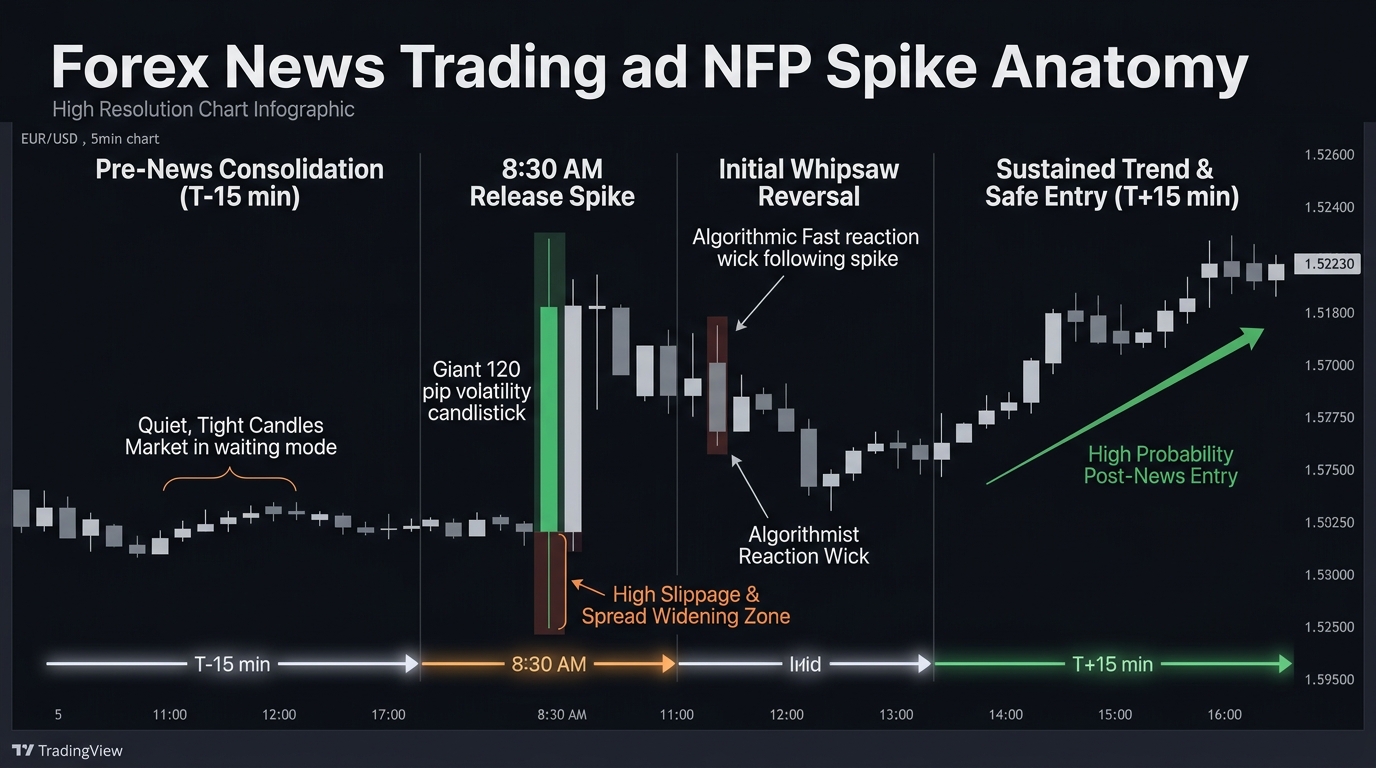
The NFP report drops at 8:30am EST on the first Friday of every month. In the 30 seconds that follow, EUR/USD can move 50–150 pips in either direction — sometimes reversing violently multiple times before settling into a direction. Traders who attempt to profit from this volatility are news traders.
It is one of the highest-risk, highest-reward approaches in forex. The execution window is measured in seconds. Slippage is guaranteed during major releases. And the direction is genuinely unpredictable — even when you know exactly what the number is going to be.
This lesson explains how to approach news trading rationally, which events actually move markets, and two distinct strategies that produce different risk profiles.
Why News Moves Forex Markets
Currency prices reflect the collective expectation of future economic conditions. When a major data release deviates significantly from those expectations, traders rapidly reprice — creating the price spikes that news traders target.
The mechanism:
- Before a release, traders are positioned based on their expectation of the outcome
- The actual number is released and compared against the consensus forecast
- If the actual significantly beats or misses the forecast, positions are rapidly adjusted
- Algorithms execute simultaneously, creating a sharp directional move
- Secondary reactions occur as humans reinterpret the data, often reversing the initial move
This is why you sometimes see an excellent economic number produce a currency decline: the market had already priced in the good news, or there was a negative revision to a prior reading embedded in the same report.
The Most Market-Moving Events in 2026
| Event | Currency Affected | Release Frequency | Market Impact |
|---|---|---|---|
| Non-Farm Payrolls (NFP) | USD (all pairs) | Monthly (1st Friday) | ★★★★★ |
| Fed Interest Rate Decision + Press Conference | USD | 8x per year | ★★★★★ |
| CPI (Consumer Price Index) | USD (US CPI) | Monthly | ★★★★☆ |
| ECB Rate Decision + Press Conference | EUR | 8x per year | ★★★★☆ |
| Bank of England Rate Decision | GBP | 8x per year | ★★★★☆ |
| Bank of Japan Rate Decision | JPY | 8x per year | ★★★★☆ |
| GDP (Advance Reading) | USD, EUR, GBP | Quarterly | ★★★☆☆ |
| Retail Sales | USD, GBP, AUD | Monthly | ★★★☆☆ |
| PMI (Purchasing Managers’ Index) | USD, EUR, GBP | Monthly | ★★★☆☆ |
| Employment Change (ADP, UK, AU) | USD, GBP, AUD | Monthly | ★★★☆☆ |
| PPI (Producer Price Index) | USD | Monthly | ★★☆☆☆ |
The impact level depends heavily on the current macro environment. In 2022–2024, CPI data moved markets almost as violently as NFP because inflation was the dominant market theme. In 2026, with rates at multi-year highs, central bank rate decisions and forward guidance carry the most weight.
Where to track releases: Use an economic calendar. Check the ForexBite economic calendar or major providers before each week begins. Note the date, time, consensus forecast, and previous reading for every high-impact event.
Strategy 1: Pre-News Fade (Trade the Expectation)
This strategy trades the price movement that occurs in the hours before a major release. Traders positioning ahead of an event drive price in the direction of their expectation. You trade that positioning move, then exit before the actual release.
| Step | Action |
|---|---|
| 1. Identify the event | NFP, CPI, rate decision — any event rated high-impact |
| 2. Note consensus forecast | The market’s expected number |
| 3. Monitor price | Watch for directional movement on 1H chart in the 6–12 hours before release |
| 4. Enter with trend | If price is trending up in the pre-news period, go long |
| 5. Set tight stop | Below the most recent swing low |
| 6. Exit before release | Close the position 5–10 minutes before the release time |
Advantage: You avoid the spike entirely. The move you’re capturing is slower, more manageable, and less affected by slippage.
Risk: If news leaks early (which does happen, rarely), or if the pre-news positioning is itself a false move, you lose. Also requires enough pre-release price movement to offer a viable entry.
Strategy 2: Post-News Trade (Trade the Reaction)
This strategy waits for the spike and the initial chaos to pass, then enters in the direction the market ultimately decides to move.
| Step | Action |
|---|---|
| 1. Wait through the release | Do not enter during the spike — let the dust settle |
| 2. Wait for direction | Give the market 5–15 minutes to establish a clear direction on the 5-minute chart |
| 3. Entry signal | A 5-minute candle close that breaks and holds above/below the spike high/low |
| 4. Enter with direction | Buy if market is clearly moving up; sell if clearly moving down |
| 5. Stop-loss | Below the post-release consolidation low (for longs) |
| 6. Target | Previous key resistance or 2x risk distance |
| 7. Time limit | If no clear direction within 30 minutes, skip the trade |
Advantage: You trade with confirmed direction, avoiding the initial whipsaw. Slippage is lower once the initial spike settles.
Risk: The best move is often the first one. Entering 15 minutes after the release means you’ve missed a significant portion of the move. The trade can also reverse as secondary reactions occur.
The Spike-and-Fade Technique
Some experienced news traders exploit the tendency for markets to overshoot on the initial spike and then reverse.
This works best when:
- The data is within a moderate range of consensus (not a massive beat/miss)
- The initial spike is exceptionally large (more than 2x the average range of recent candles)
- Price hits a major resistance/support level at the apex of the spike
In these conditions, fading (trading against) the spike direction — entering at the spike extreme with a stop just beyond — can produce quick profits as the market corrects the overshoot.
This is the most difficult execution in news trading. The spike high/low is often only visible in retrospect. It requires experience to distinguish an overshoot from the beginning of a sustained move.
Only use this technique after significant screen time on news events. Getting it wrong means entering precisely at the worst price in the worst direction.
Risk Management for News Trading
News trading has specific risk considerations that don’t apply to most other strategies:
Slippage is guaranteed. During high-impact releases, liquidity temporarily vanishes. Market orders fill at prices significantly worse than expected. Stop-losses become market orders at the next available price, which may be 5–30 pips away from the trigger level. Plan for this explicitly.
Spread widening. Most brokers widen spreads dramatically in the seconds before and during major releases. A 1-pip spread can temporarily become 10–20 pips. This affects both entry fill quality and stop-loss execution.
Limit orders vs. market orders. Using limit orders reduces slippage risk on entries but may result in a missed trade if the order isn’t filled. Market orders guarantee entry but at worse-than-expected prices.
| Risk Parameter | Recommendation |
|---|---|
| Risk per news trade | 0.5–1% (lower than normal — slippage amplifies actual risk) |
| Position size | Reduce by 50% vs. normal position sizes |
| Stop-loss distance | Wider than normal — account for likely slippage |
| Pre-release halt | Stop all open trades 15 minutes before a high-impact event |
| Recovery | Never revenge-trade after a bad news fill |
What Not to Trade During News
News releases also affect your existing non-news positions. If you hold a EUR/USD long and the ECB drops a surprise rate cut, your trade is caught in the spike regardless of its original thesis.
Best practices:
- Close or reduce all positions in affected pairs 15–30 minutes before a scheduled high-impact release
- If you don’t close, move stops to a level you’re comfortable with if the worst-case move occurs
- Never hold full-sized positions through central bank meetings without a plan
Pairs Best Suited for News Trading
| Event | Best Pair to Trade |
|---|---|
| US NFP / CPI / FOMC | EUR/USD, GBP/USD, USD/JPY |
| ECB decision | EUR/USD, EUR/GBP, EUR/JPY |
| BoE decision | GBP/USD, EUR/GBP |
| BoJ decision | USD/JPY, EUR/JPY |
| Canadian data | USD/CAD |
| Australian data | AUD/USD |
Key Takeaways
- News trading captures volatility surrounding major economic releases, especially NFP, CPI, and central bank decisions
- The most important events in 2026 are FOMC, ECB, and BoJ rate decisions — all three have moved markets significantly with surprise guidance
- Two main strategies: pre-news fade (trade the positioning move, exit before release) and post-news trade (wait for direction to establish, then enter)
- Slippage during news events is not optional — it is a structural cost. Size positions accordingly (0.5% risk maximum during news trades)
- Spread widening occurs in the seconds before and during releases; factor this into profitability calculations
- Existing positions should be managed (reduced or closed) before high-impact events that affect those pairs
- News trading is not beginner territory. Master lower-volatility setups first.
Related strategies: Carry Trade | Forex Gap Strategy
Related lessons: Fundamental Analysis Basics | How to Read an Economic Calendar
Tools: Position Size Calculator
Risk Disclosure & Testing
Past performance of any trading strategy is not indicative of future results. Always backtest and forward test this strategy on a free demo account before committing real financial capital.
Practice This Strategy on a Live Demo
Choose an ECN broker with tight spreads and fast execution for strategy backtesting.