Alternate payee
An alternate payee is a spouse, former spouse, child, or other dependent of a retirement plan participant who is recognized under a Qualified Domestic Relations Order (QDRO) as having the legal right to receive all or a portion of the participant's retirement plan benefits.
What Is an Alternate Payee?
An alternate payee is an individual recognized by a court judgment, decree, or approved property settlement order as holding a lawful right to receive all or a portion of the benefits payable under another person’s qualified retirement plan. Defined formally under federal statutory frameworks, the alternate payee must be a spouse, former spouse, child, or legal dependent of the primary plan participant.
Under ordinary circumstances, the Employee Retirement Income Security Act of 1974 (ERISA) strictly forbids plan participants from assigning, selling, pledging, or alienating their qualified retirement assets to third parties. The establishment of an alternate payee through a Qualified Domestic Relations Order (QDRO) represents one of the few statutory exceptions to ERISA’s anti-alienation provisions, enabling the equitable distribution of marital property and the enforcement of child support obligations.
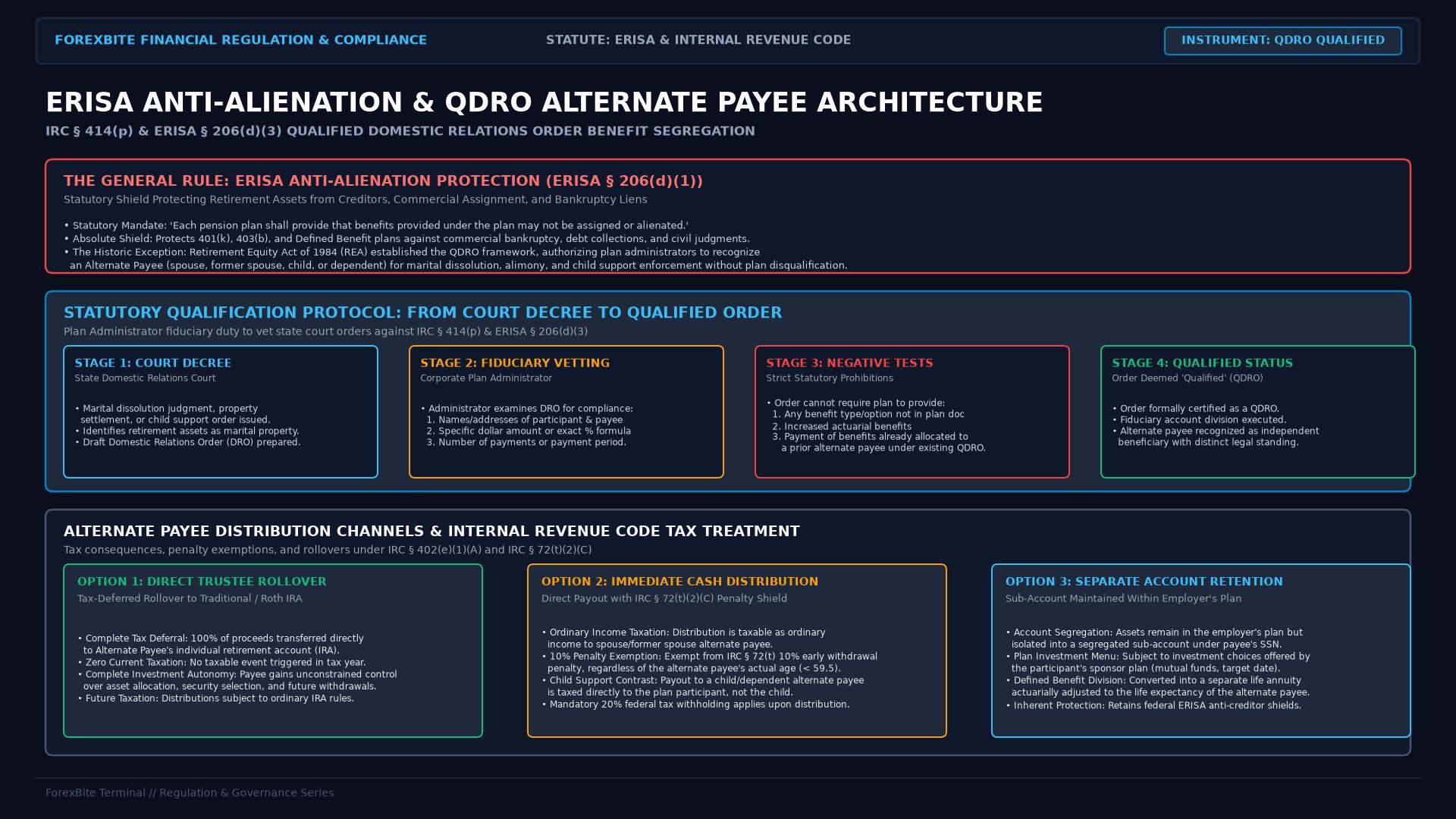 Figure: The statutory framework governing Alternate Payees under ERISA and IRC § 414(p), illustrating the domestic relations decree validation workflow and tax-deferred rollover channels.
Statutory Authority and Legal Foundation
The alternate payee designation is governed by two interlocking pieces of federal legislation:
- ERISA Section 206(d)(3): Authorizes retirement plan administrators to disburse funds to an individual other than the participant, provided the court order satisfies strict qualification standards.
- Internal Revenue Code (IRC) Section 414(p): Establishes the tax conditions, definitions, and distribution rules that prevent immediate tax disqualification of the underlying corporate trust.
Mandatory Elements of a Valid QDRO
For a domestic relations order to confer alternate payee status, the document submitted to the plan administrator must explicitly contain:
- The full legal name and last known mailing address of the participant and the alternate payee.
- The precise dollar amount or percentage of benefits to be distributed to the alternate payee (or the exact mathematical formula used to determine the payout).
- The exact number of payments or payment period to which the order applies.
- The official name of each retirement or pension plan to which the decree pertains.
A QDRO cannot require a retirement plan to provide any type or form of benefit, or any payment option, not otherwise offered under the written terms of the plan document.
Methods of Benefit Division
Plan administrators process payouts to alternate payees through two structural frameworks:
| Feature | Separate Interest Approach | Shared Payment Approach |
|---|---|---|
| Mechanics | Splits the participant’s benefit into two independent accounts | Directs a portion of each recurring benefit payment to the alternate payee |
| Timing of Payout | Alternate payee can elect distribution immediately or at earliest retirement age | Payments begin only when the primary participant actually commences retirement |
| Impact of Participant’s Death | Payout continues uninterrupted based on alternate payee’s lifespan | Payments typically cease upon the participant’s death unless survivor annuities apply |
| Typical Account Vehicle | Defined Contribution plans: 401(k), 403(b), 457(b) | Traditional Defined Benefit pension plans with fixed monthly annuities |
              SEPARATE INTEREST DIVISION (DEFINED CONTRIBUTION)
+-----------------------------------------------------------------------+
| Total 401(k) Balance: $1,000,000                                      |
| Court-Ordered QDRO Split: 50% to Former Spouse (Alternate Payee)      |
+-----------------------------------------------------------------------+
                                  |
            Execution by Qualified Plan Administrator
                                  v
+-----------------------------------+-----------------------------------+
| Primary Participant Account       | Alternate Payee Sub-Account       |
| Balance: $500,000                 | Balance: $500,000                 |
| Continues normal plan trajectory  | Can roll over directly to IRA     |
+-----------------------------------+-----------------------------------+
Taxation and Distribution Options for Alternate Payees
The tax consequences of receiving funds as an alternate payee vary depending on family relationship and the distribution pathway selected:
1. Spousal Alternate Payees
When the alternate payee is a spouse or former spouse, they assume full income tax liability for the distributions received. The payout is not taxable to the original employee participant. Spouses have several options:
- Direct Rollover to an IRA: Transferring the proceeds directly into a traditional Individual Retirement Account preserves tax-deferred compounding, triggering zero immediate tax liability.
- Direct Cash Distribution: If the former spouse elects an immediate cash lump-sum distribution, the payout is taxed as ordinary income.
- Exemption from Early Withdrawal Penalty: Under IRC Section 72(t)(2)(C), distributions paid to an alternate payee pursuant to a QDRO are entirely exempt from the standard $10%$ IRS early withdrawal penalty, even if the recipient is under age $59\frac{1}{2}$. However, once funds are rolled over into the alternate payee’s personal IRA, subsequent withdrawals lose this special QDRO exemption.
2. Non-Spousal Alternate Payees (Children or Dependents)
When an alternate payee is a child or legal dependent receiving benefits for child support, the tax treatment diverges sharply. Under IRC rules, the distribution is taxable to the plan participant, not to the child. The plan issues Form 1099-R reporting the taxable income under the participant’s Social Security Number.
Practical Pitfalls in Alternate Payee Administration
- Failure to Pre-Approve Draft QDROs: Submitting a finalized divorce decree without prior review by the company’s plan administrator often leads to rejection. If the plan language does not support the drafted payout terms, legal counsel must spend additional time and expenses securing an amended state court order.
- Market Fluctuations During Review: Because plan administrator compliance reviews can require 60 to 90 days, specifying a fixed dollar amount rather than a percentage can disadvantage one party if the underlying market declines or rallies substantially before segregation.
- Outstanding Participant Loans: If the participant has an outstanding 401(k) loan balance of $40,000 against a $200,000 total balance, the QDRO must state whether the division applies to the net account ($160,000) or gross assets, preventing post-decree litigation.
Frequently Asked Questions
Can an alternate payee roll funds into a Roth IRA?
Yes. An alternate payee who is a spouse or former spouse can elect a direct rollover into a Roth IRA. This transfer is treated as a taxable Roth conversion, meaning the alternate payee must report the full taxable amount as ordinary income in the year of conversion, after which future qualified growth is tax-free.
What happens if the alternate payee dies before receiving the distribution?
If a Separate Interest QDRO was finalized and approved by the plan administrator, the alternate payee’s awarded benefit becomes part of their personal estate and is distributed to their designated beneficiaries. Under a Shared Payment approach, benefits generally extinguish unless a qualified joint and survivor annuity was formally established.
Does an alternate payee status apply to non-ERISA retirement plans?
Governmental retirement plans, military pensions, and municipal employee systems are exempt from ERISA. While they do not use standard ERISA QDROs, similar division orders (such as Court Orders Acceptable for Processing, or COAPs, under the Federal Employees Retirement System) achieve equivalent alternate payee rights.
Ready to trade forex?
Open a free demo account with a regulated broker. Practice with virtual funds before risking real money.