Alternative asset
An alternative asset is any non-traditional investment outside standard public equities, fixed income securities, or cash equivalents, including private equity, private credit, hedge funds, real assets, and commodities.
What Is an Alternative Asset?
An alternative asset is any financial or real asset that falls outside the conventional categories of public equities, fixed income bonds, and cash equivalents. Alternative investments encompass a diverse spectrum of institutional vehicles, including private equity (venture capital and leveraged buyouts), private credit (direct lending and mezzanine financing), real assets (commercial real estate, infrastructure, timberland, and commodities), and absolute-return hedge funds.
Historically accessible almost exclusively to sovereign wealth funds, university endowments, and ultra-high-net-worth family offices, alternative assets are pursued for two structural characteristics: low correlation to public market volatility and the potential to harvest an illiquidity premium.
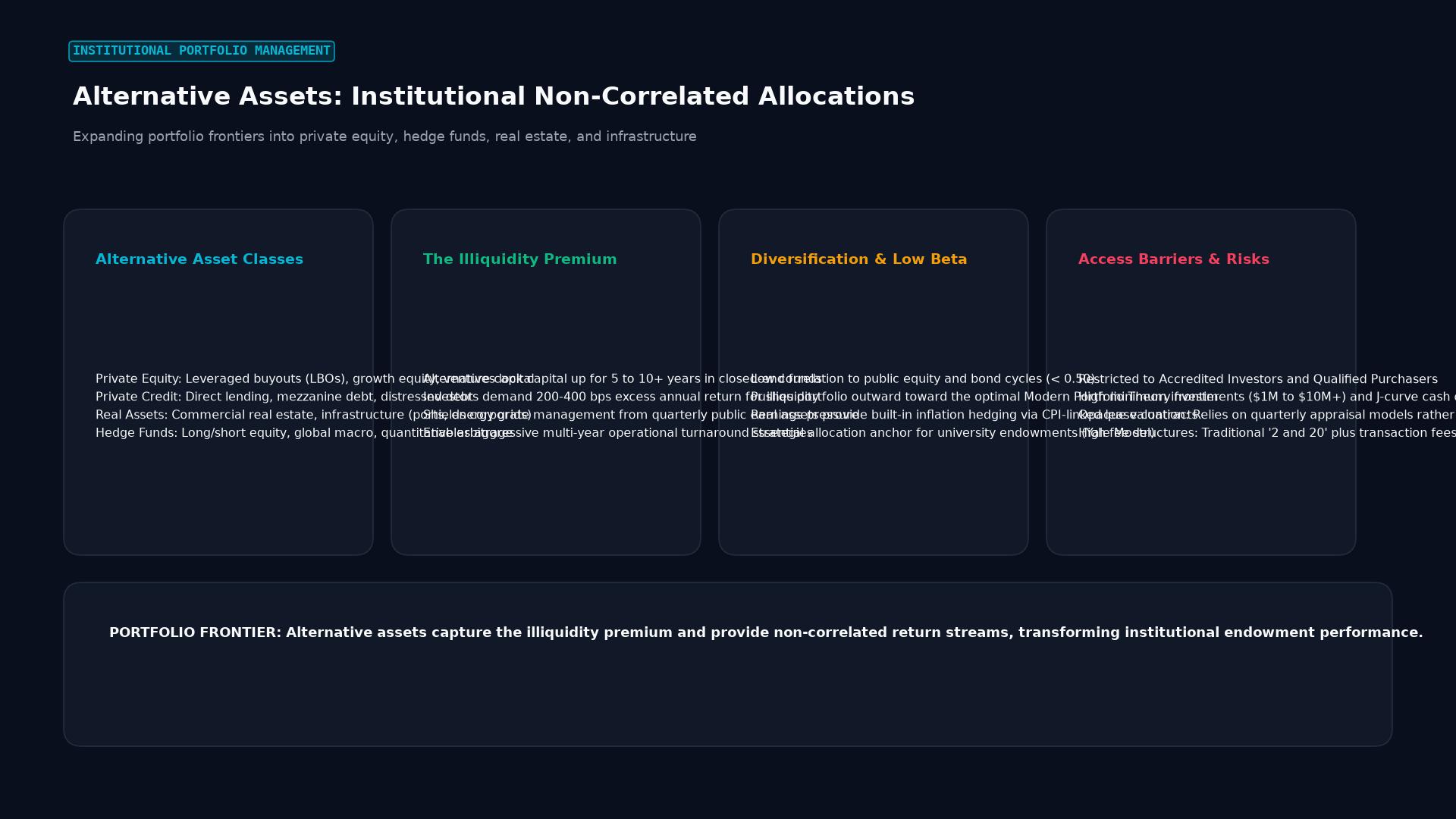 Figure: Expanding portfolio frontiers into private equity, hedge funds, real estate, and infrastructure
Primary Categories of Alternative Assets
Institutional allocators categorize alternatives across five core operational pillars:
1. Private Equity (PE)
Private equity managers deploy capital directly into operating companies that are not listed on public stock exchanges. Sub-segments include:
- Venture Capital (VC): Early-stage seed, Series A, and growth equity financing for high-risk, high-growth technology and biotechnology startups.
- Leveraged Buyouts (LBO): Acquiring mature, cash-generating enterprises utilizing a combination of equity and substantial debt leverage, optimizing operations, and exiting after three to seven years via an initial public offering (IPO) or trade sale.
2. Private Debt and Direct Lending
Following the 2008 financial crisis and Basel III regulatory tightening on commercial bank balance sheets, private debt emerged as a major asset class. Non-bank direct lenders provide senior secured loans, unitranche debt, and mezzanine financing directly to mid-market corporations. These floating-rate loans offer investors yield spreads above benchmark rates with robust covenant protections.
3. Real Assets and Infrastructure
Investments in physical, tangible assets that generate stable, inflation-linked cash flows:
- Commercial Real Estate (CRE): Industrial logistics hubs, data centers, multifamily housing, and healthcare facilities.
- Infrastructure: Essential civil assets such as toll roads, airports, cellular towers, renewable energy grids, and water treatment utilities.
4. Hedge Funds
Private investment partnerships employing non-traditional trading strategies across global markets. Core styles include long/short equity, global macro, multi-strategy, merger arbitrage, and quantitative algorithmic volatility harvesting. Unlike mutual funds, hedge funds routinely use leverage, short selling, and complex derivative overlays.
5. Commodities, Collectibles, and Niche Assets
Tangible stores of value including physical gold, agricultural futures, rare art, fine wine, and litigation finance claims.
The J-Curve Effect and Private Fund Lifecycles
Unlike public stocks where capital is invested and quoted immediately, closed-end alternative asset funds operate on an extended multi-year cycle characterized by the J-Curve.
                 THE PRIVATE EQUITY J-CURVE LIFECYCLE
Net Cash Flow /
Cumulative Return
      ^
      |                                              Harvest Phase
      |                                           (Exits, Multiples)
      |                                              +-------+
$0.00 +---------------------------------------------/--------+---> Time (Years)
      |  Investment / Capital Call Phase           /  Years 5 - 10
      |  (Management Fees & Setup Costs)          /
      |      \                                   /
      |       \                                 /
      |        +-------------------------------+
      |             Trough / Valley of Death
      v                   Years 1 - 3
In the initial years, net cumulative returns dip into negative territory because:
- Capital is drawn down gradually through capital calls as deals are negotiated.
- Full contractual management fees are levied on committed capital from day one.
- Acquired businesses incur restructuring expenses before operational efficiencies materialize. In years four through ten, portfolio companies are scaled and liquidated through trade sales or IPOs, distributing capital back to investors and driving performance sharply upward.
Comparative Matrix: Traditional vs. Alternative Assets
| Dimension | Public Equities (Traditional) | Private Equity / Debt (Alternative) | Hedge Funds (Alternative) |
|---|---|---|---|
| Liquidity Profile | Daily settlement (T+1) | Illiquid; 7 to 10 year lockups | Monthly / Quarterly with notice |
| Pricing Transparency | Continuous real-time quotes | Periodic quarterly appraisal | Periodic Net Asset Value (NAV) |
| Information Access | Strict SEC fair disclosure (Reg FD) | Asymmetric; proprietary data access | Confidential proprietary models |
| Fee Architecture | Low (0.05% to 0.75% flat) | 2% management / 20% carried interest | 2% management / 20% incentive |
| Investor Qualification | Open to all retail participants | Accredited / Qualified Purchaser | Accredited / Qualified Purchaser |
Capital Structure and Distribution Waterfalls
Alternative investment funds are organized as Limited Partnerships (LPs) where institutional investors serve as Limited Partners and the asset manager acts as the General Partner (GP).
Cash distributions follow a contractual distribution waterfall:
- Return of Capital: 100% of proceeds flow to LPs until they have recouped all contributed capital across realized investments.
- Preferred Return (Hurdle Rate): LPs receive a cumulative annual return (typically 6% to 8%) before the GP can participate in profits.
- GP Catch-Up: The GP receives a disproportionate share of distributions until they have captured their agreed profit split.
- Carried Interest Split: Subsequent net gains are divided according to the contractual ratio (typically 80% to LPs, 20% to the GP as carried interest).
Institutional Risks and Operational Pitfalls
- Valuation Lag and Volatility Laundering: Because alternative assets lack public exchange pricing, their valuations rely on quarterly discounted cash flow models or comparable EBITDA multiples. Critics note this creates an artificial appearance of stability (“smoothed volatility”), obscuring true underlying drawdowns.
- The Denominator Effect: When public equity markets decline sharply, alternative assets maintain their reported book values. This causes private allocations to automatically exceed institutional mandate limits, forcing pension boards to halt new commitments or sell private fund stakes at deep secondary discounts.
- Capital Call Default Risk: Investors must maintain liquid cash buffers to fund capital calls on short notice. Failing to meet a capital call can result in severe statutory penalties, including forfeiture of previously accumulated fund equity.
Frequently Asked Questions
What is the illiquidity premium in alternative assets?
The illiquidity premium is the excess return that investors demand for locking up their capital in assets that cannot be quickly converted into cash without substantial price discounts. Over historical multi-decade periods, private equity has targeted a 300 to 500 basis point return premium over public equity benchmarks to compensate for this constraint.
How are retail investors gaining access to alternative assets?
Traditionally limited to institutions, alternatives are increasingly available to individual accredited investors through interval funds, non-traded business development companies (BDCs), private real estate investment trusts (REITs), and specialized feeder funds that aggregate smaller tickets into premier private equity vintages.
Why do macroeconomic forex traders monitor private debt and alternatives?
Cross-border private capital flows directly impact foreign exchange exchange rates. When multi-billion-dollar sovereign wealth funds allocate capital to foreign infrastructure projects or real estate developments, these long-term unhedged currency inflows provide sustained structural support for the destination nation’s currency.
Ready to trade forex?
Open a free demo account with a regulated broker. Practice with virtual funds before risking real money.