American Depositary Share
An American Depositary Share (ADS) is a US dollar-denominated equity share of a foreign corporation available for trading on American exchanges, representing ownership of underlying ordinary shares held in custody by a depositary bank.
What Is an American Depositary Share (ADS)?
An American Depositary Share (ADS) is a US dollar-denominated equity share of a foreign-based corporation that trades on United States stock exchanges, including the New York Stock Exchange (NYSE) and NASDAQ. An ADS represents ownership of a specified number of underlying ordinary shares held in custody by an international depositary bank in the foreign company’s home country.
Investors frequently use the terms ADS and ADR (American Depositary Receipt) interchangeably, but they represent distinct legal concepts:
- American Depositary Receipt (ADR): The negotiable legal certificate issued by a US depositary bank representing ownership.
- American Depositary Share (ADS): The actual underlying financial share that trades, clears, and settles on the domestic US exchange.
Through ADSs, US institutional and retail investors can trade major international companies (such as Taiwan Semiconductor Manufacturing Co., Alibaba, AstraZeneca, and Toyota) without maintaining international brokerage accounts, navigating overseas settlement regimes, or executing manual foreign currency conversions.
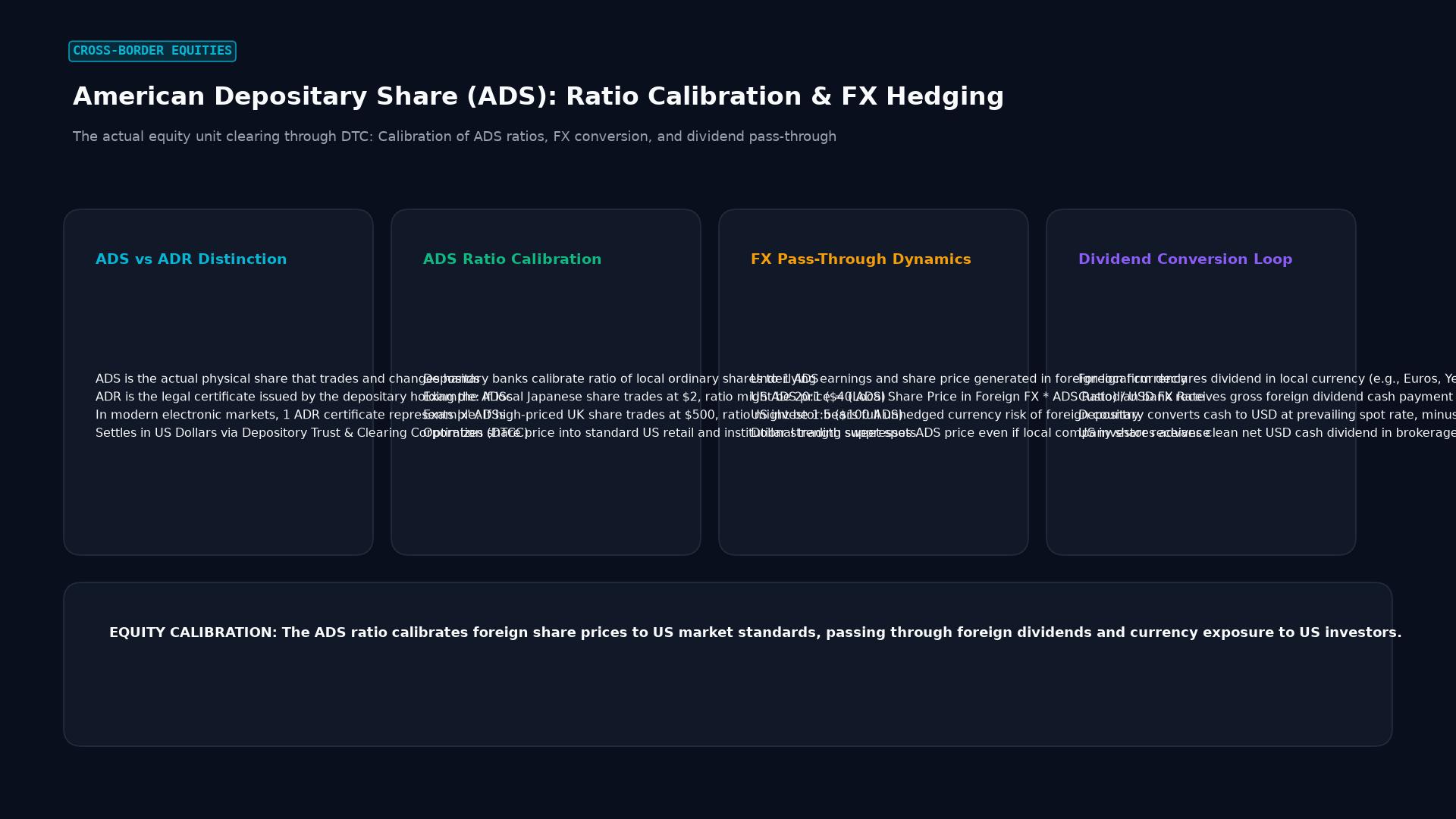 Figure: The actual equity unit clearing through DTC: Calibration of ADS ratios, FX conversion, and dividend pass-through
ADS Ratios and Share Mechanics
An ADS does not always equal exactly one foreign ordinary share. The depositary bank establishes an ADS-to-ordinary-share ratio to ensure the security trades at an attractive price point for US market participants (typically between $20 and $100 per share):
- Fractional Ratios: If a foreign company’s domestic shares trade at an exceptionally high price in their local currency, one ADS might represent a fraction of an ordinary share (for example, 1 ADS = 0.25 ordinary shares).
- Multiple Ratios: If local ordinary shares trade at a low nominal unit price (such as 25 Hong Kong dollars), one ADS might bundle several ordinary shares together (for example, 1 ADS = 10 ordinary shares).
Example: Valuation and Arbitrage
If Company XYZ trades in London at $£10.00$ per share, the GBP/USD exchange rate is $1.30$, and the ADS ratio is set at $1\text{ ADS} = 2\text{ Ordinary Shares}$:
$$\text{Equivalent US Dollar Value} = 2 \times (£10.00 \times 1.30) = $26.00\text{ per ADS}$$
Specialized arbitrage trading desks continuously monitor the relationship between the foreign ordinary share price, the spot currency exchange rate, and the US ADS price. If discrepancies arise, arbitrageurs buy the undervalued leg, instruct the depositary to cancel or issue ADSs, and sell the overvalued leg, maintaining near-perfect pricing parity across time zones.
The Four Levels of Depositary Programs
The US Securities and Exchange Commission (SEC) categorizes foreign depositary share structures across four primary regulatory tiers:
| Tier | Trading Venue | SEC Registration | Accounting Standard | Capital Raising Ability |
|---|---|---|---|---|
| Level I | Over-the-Counter (OTC) | Form F-6; exempt under Rule 12g3-2(b) | Home country GAAP | No (Trading existing shares only) |
| Level II | Major Exchanges (NYSE, NASDAQ) | Form F-6 and full Form 20-F annual filing | US GAAP or IFRS | No (Listing existing shares only) |
| Level III | Major Exchanges (NYSE, NASDAQ) | Full Form F-1 / F-3 Prospectus + Form 20-F | US GAAP or IFRS | Yes (Public IPO or secondary offering) |
| Rule 144A | Private PORTAL System | Private placement memorandum; exempt | Home country GAAP | Yes (Qualified Institutional Buyers only) |
Level III programs represent the highest tier, requiring the foreign corporation to meet strict SEC disclosure standards, submit to Sarbanes-Oxley internal control audits, and publish audited financial statements conforming to International Financial Reporting Standards (IFRS) or US GAAP.
Currency Risk and Dividend Distribution
Although an ADS is quoted and traded in US dollars, it does not eliminate currency risk.
The fundamental value of the foreign company remains anchored in its domestic operating currency:
- Exchange Rate Pass-Through: If the Japanese yen weakens by $10%$ against the US dollar while Toyota’s domestic Tokyo share price remains flat, the US-traded ADS will immediately drop by approximately $10%$ in dollar terms to maintain arbitrage equilibrium.
- Dividend Conversion: When the foreign corporation declares a dividend in euros, pounds, or yen, the local custodian collects the distribution and passes the funds to the US depositary bank. The depositary converts the cash into US dollars at prevailing wholesale spot rates and distributes the proceeds directly to ADS holders, after subtracting a modest depositary processing fee.
               ADS DIVIDEND DISTRIBUTION & TAX WATERFALL
+-----------------------------------------------------------------------+
| Foreign Corporation declares dividend: €1.00 per ordinary share       |
+-----------------------------------------------------------------------+
                                  │
                                  ▼
+-----------------------------------------------------------------------+
| Foreign Government deducts statutory withholding tax (e.g., 15% - 25%)|
+-----------------------------------------------------------------------+
                                  │
                                  ▼
+-----------------------------------------------------------------------+
| Local Custodian receives net euros and transmits to US Depositary     |
+-----------------------------------------------------------------------+
                                  │
                                  ▼
+-----------------------------------------------------------------------+
| US Depositary converts EUR to USD at spot rate; deducts fee ($0.01-$0.03) |
+-----------------------------------------------------------------------+
                                  │
                                  ▼
+-----------------------------------------------------------------------+
| US Investor receives net USD cash distribution into brokerage account |
+-----------------------------------------------------------------------+
Investor Risks and Operational Costs
- Foreign Withholding Taxes: Foreign jurisdictions levy statutory dividend withholding taxes ranging from $15%$ to $35%$. While US investors can often claim a Foreign Tax Credit via IRS Form 1116, reclaiming excessive withheld taxes from foreign revenue agencies can be operationally burdensome.
- Depositary Custody Fees: Most depositary banks (such as BNY Mellon or Citibank) charge annual custody or pass-through servicing fees, typically ranging from $$0.01$ to $$0.05$ per ADS. These fees are automatically deducted from dividend payouts or charged directly to the brokerage account.
- Geopolitical and Sanction Exposures: Geopolitical tensions or regulatory disputes can result in forced de-listings. For example, during 2021–2022, several foreign state-owned enterprises and Russian depositary receipts were frozen, delisted, or made illiquid, leaving ADS holders unable to convert their shares or access underlying equity value.
Frequently Asked Questions
Can an ADS holder convert their shares into the foreign ordinary stock?
Yes. An investor can instruct their broker to cancel their ADSs through the depositary bank and deliver the underlying physical ordinary shares to an overseas brokerage account. This process is known as an ADS cancellation or issuance, and depositaries typically charge a fee (around $$0.05$ per share) for the transaction.
What is an unsponsored ADS?
An unsponsored ADS is established by a US depositary bank in response to high domestic investor demand without the formal cooperation, participation, or financial sponsorship of the foreign company itself. Unsponsored programs trade exclusively over-the-counter (OTC) and carry minimal regulatory reporting from the issuer.
Why do foreign companies issue ADSs instead of listing their ordinary shares directly?
Directly listing foreign ordinary shares on US exchanges requires establishing a US share registry, clearing trades through DTCC under US corporate laws, and conforming to domestic legal corporate governance frameworks. Establishing an ADS program allows international enterprises to access deep US capital pools while retaining their existing domestic corporate charter and home-market share registries.
Ready to trade forex?
Open a free demo account with a regulated broker. Practice with virtual funds before risking real money.