American Stock Exchange
The American Stock Exchange (AMEX), now operating as NYSE American, is a major US securities exchange historically renowned for launching the modern exchange-traded fund (ETF) market and specializing in small-to-mid-cap equities and options trading.
What Is the American Stock Exchange (AMEX)?
The American Stock Exchange (AMEX), officially rebranded as NYSE American, is an American securities exchange based in New York City. Throughout the 20th and early 21st centuries, AMEX served as the primary domestic rival to the New York Stock Exchange (NYSE), providing a prominent trading floor for emerging industrial firms, resource explorers, small-to-mid-cap companies, and equity options.
AMEX holds a defining place in financial market history as the birthplace of modern indexation. In January 1993, AMEX created and launched the world’s first modern exchange-traded fund: the Standard & Poor’s Depositary Receipt (SPDR S&P 500 ETF, ticker SPY). This single innovation transformed global asset management, ushering in the trillion-dollar passive investment industry.
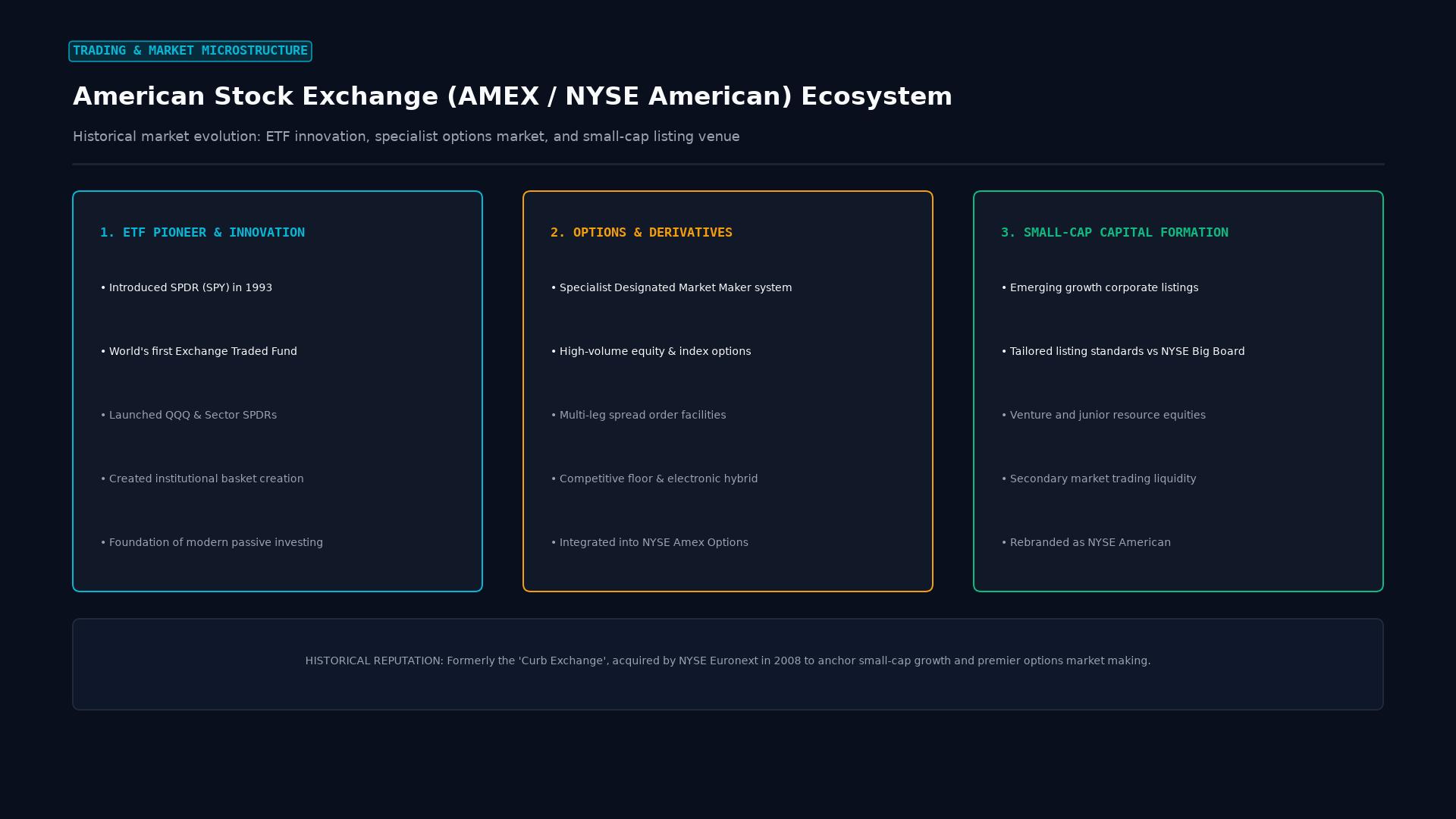 Figure: The historical and modern trading ecosystem of AMEX: pioneer in ETF issuance (SPY), specialist options market making, and emerging small-cap capital formation.
The Curb Market Heritage
The origins of AMEX trace back to the late 18th and 19th centuries, when traders who could not afford or qualify for a seat on the formal New York Stock & Exchange Board congregated outdoors on the curbs of Manhattan’s financial district.
Traders wore brightly colored hats, operated amidst street traffic, and received trading orders from clerks leaning out of multi-story office building windows using complex physical hand signals. This informal market specialized in volatile, unlisted securities: early canal companies, mining ventures, emerging oil drillers, and industrial manufacturers.
In 1921, the outdoor traders organized as the New York Curb Market Association and moved inside a new trading building at 86 Trinity Place in lower Manhattan. In 1953, the institution officially adopted the name American Stock Exchange, solidifying its position as the second-largest equity exchange in the United States by trading volume.
Pioneering the ETF and Derivatives Era
During the 1970s and 1980s, facing stiff competition from the newly formed automated NASDAQ quotation system, AMEX aggressively diversified into equity derivatives and novel structured products.
1. The Equity Options Floor
In 1975, AMEX launched its options trading floor, competing directly with the Chicago Board Options Exchange (CBOE). The exchange developed sophisticated multi-class equity option products, serving as a critical market-making venue for institutional hedging.
2. The Birth of SPY and Modern ETFs
Following the 1987 “Black Monday” crash, institutional reports highlighted the need for a single, tradable basket security that could allow market participants to trade the entire market index simultaneously.
Led by innovative exchange executives Nathan Most and Steven Bloom, AMEX engineered the first exchange-traded fund structure:
- January 22, 1993: Launch of SPY (SPDR S&P 500 ETF Trust).
- 1995: Launch of the MidCap SPDR (MDY).
- 1998: Launch of the Select Sector SPDRs, segmenting the S&P 500 into discrete industrial sectors.
- 1999: Launch of the Nasdaq-100 tracking stock (QQQ), initially listed and traded on the AMEX floor before later transitioning to NASDAQ.
Acquisition and Rebranding as NYSE American
In 1998, the National Association of Securities Dealers (NASD, the parent of NASDAQ) acquired AMEX, attempting to merge floor trading with automated screen-based systems. The cultural and technical mismatch led to a membership buyout in 2004, returning AMEX to independent status.
In January 2008, NYSE Euronext purchased the American Stock Exchange for approximately $260 million in stock. Following the acquisition, the physical trading floor at Trinity Place was permanently closed, and operations were consolidated into the historic NYSE trading floor at 11 Wall Street.
Today, operating under Intercontinental Exchange (ICE) ownership, the venue is officially designated NYSE American:
| Operational Feature | NYSE (Main Board) | NYSE American |
|---|---|---|
| Primary Target Market | Mega-cap and large-cap enterprises | Small-cap, micro-cap, and emerging growth |
| Listing Standards | Strict; $100M+ market cap, rigorous operating history | Tailored for growth companies with lower market cap thresholds |
| Market Maker Model | Designated Market Makers (DMMs) | Electronic DMMs with Floor Broker participation |
| Execution Microstructure | Pure low-latency direct matching | Hybrid matching with optional 350-microsecond delay peg orders |
Microstructure: The Discretionary Peg and Speed Bumps
To protect small-cap companies from aggressive high-frequency trading (HFT) latency arbitrage, NYSE American introduced innovative order types:
           NYSE AMERICAN DISCRETIONARY PEG PROTECTION ARCHITECTURE
+------------------------------------------------------------------------+
| Inbound Market Order arrives to execute against resting liquidity       |
+------------------------------------------------------------------------+
                                    │
                                    ▼
+------------------------------------------------------------------------+
| 350-Microsecond Intentional Delay Buffer (Discretionary Peg Orders)    |
| - Evaluates whether broader market NBBO is in a state of unstable flux |
| - Allows institutional pegged orders to re-price to protective levels  |
+------------------------------------------------------------------------+
                                    │
                                    ▼
+------------------------------------------------------------------------+
| Fair Execution: Prevents predatory latency arbitrage on small-cap caps |
+------------------------------------------------------------------------+
This intentional structural speed bump allows institutional liquidity providers to maintain tighter bid-ask spreads for smaller, less liquid stocks without the fear of being “picked off” by millisecond latency arbitrageurs operating from external data centers.
Frequently Asked Questions
What ticker symbols historically indicated an AMEX listing?
Historically, AMEX-listed stocks traded with one, two, or three-letter ticker symbols (such as standard NYSE listings), whereas NASDAQ securities traded under four or five-letter symbols. Today, symbol mobility rules allow companies to retain their original ticker symbol regardless of which underlying exchange venue hosts their primary listing.
Does the physical AMEX trading floor still exist?
The original AMEX building at 86 Trinity Place was decommissioned and sold for redevelopment. However, designated NYSE American floor brokers and options market makers still operate physical trading posts inside the main NYSE trading room at 11 Wall Street in Manhattan.
What are the primary listing criteria for NYSE American?
NYSE American offers four flexible financial listing standards designed for growing companies. These include routes based on market value of public float ($15 million to $20 million), operating history, or total assets and shareholders’ equity, allowing early-stage biotech and resource firms to access public capital markets earlier than the NYSE main board permits.
Ready to trade forex?
Open a free demo account with a regulated broker. Practice with virtual funds before risking real money.