American-style option
An American-style option is a financial derivative contract granting the holder the right, but not the obligation, to buy or sell the underlying asset at a specified strike price at any time up to and including the expiration date.
What Is an American-Style Option?
An American-style option is a standardized derivative contract that gives the buyer the right, but not the obligation, to exercise their option at any point during the life of the contract up to and including the final expiration date. This early exercise feature distinguishes American options from European-style options, which can be exercised exclusively on their designated expiration date.
In the United States, virtually all exchange-traded options on individual public equities and exchange-traded funds (ETFs) cleared by the Options Clearing Corporation (OCC) are American-style. Because the continuous exercise feature provides holders with maximum operational flexibility, an American option is always worth equal to or more than an otherwise identical European option on the same underlying asset.
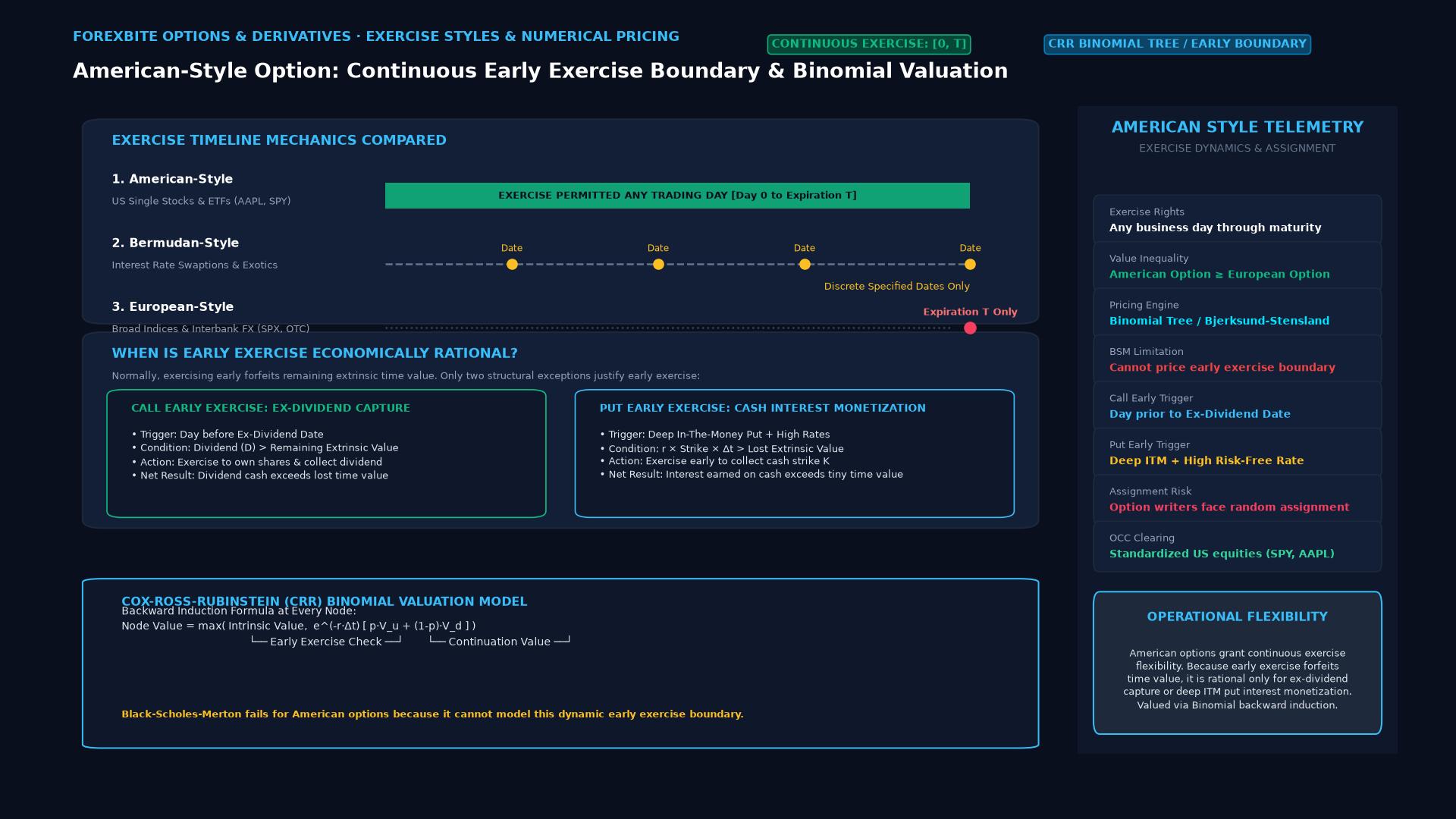
Early Exercise Dynamics: When Is Early Exercise Rational?
Under standard market conditions, an option holder surrenders the option’s remaining extrinsic value (time value) if they exercise early. In most cases, an investor seeking to monetize an in-the-money (ITM) option achieves a higher net payout by selling the contract in the open market rather than exercising it.
However, two structural exceptions make early exercise financially optimal:
1. American Call Options: The Ex-Dividend Capture
For an American call option, early exercise is rational only immediately prior to an ex-dividend date on a dividend-paying stock. Because an option contract does not receive dividend cash distributions, the underlying stock price drops by approximately the dividend amount when the market opens on the ex-dividend date.
A call holder will exercise on the day before the ex-dividend date if:
$$\text{Dividend Amount } (D) > \text{Remaining Extrinsic Value} + \text{Interest on Strike Capital}$$
By exercising early, the trader takes delivery of physical shares before the market closes, captures the dividend payment, and surrenders a negligible amount of time value.
2. American Put Options: Deep-in-the-Money Capital Monetization
For an American put option, early exercise can be optimal when the contract is deep in the money and interest rates are positive. When an investor exercises a put, they sell the underlying asset and immediately receive the strike price in cash ($K$).
Holding the put to expiration postpones receiving this cash, forfeiting the risk-free interest the cash could earn:
$$r \times K \times \Delta t > \text{Remaining Put Extrinsic Value}$$
If the interest earned on the strike proceeds exceeds the residual extrinsic value of the put, immediate exercise is the economically rational decision.
Mathematical Valuation: Why Black-Scholes Fails
The celebrated Black-Scholes-Merton (BSM) formula provides an exact closed-form solution for pricing European options. However, BSM cannot price American options because it assumes exercise occurs only at maturity ($T$), unable to account for the continuous boundary of early exercise decisions.
Institutional desks price American-style options using discrete numerical models:
1. The Cox-Ross-Rubinstein (CRR) Binomial Tree
The binomial model discretizes time into $n$ distinct steps, modeling price movement upward by factor $u$ or downward by factor $d$. Valuation proceeds backward from maturity:
               BINOMIAL BACKWARD INDUCTION TREE
Step 0                  Step 1                  Step 2 (Maturity)
                                                   Node [S_uu]
                                                  /
                                     Node [S_u]  <
                                    /             \
                      Node [S_0]   <               Node [S_ud]
                                    \             /
                                     Node [S_d]  <
                                                  \
                                                   Node [S_dd]
At every individual node, the model evaluates the Early Exercise Condition:
$$\text{Node Value} = \max \left( \text{Intrinsic Value}, e^{-r \Delta t} \left[ p V_u + (1-p) V_d \right] \right)$$
Where:
- $\text{Intrinsic Value} = \max(S - K, 0)$ for a call, or $\max(K - S, 0)$ for a put.
- $e^{-r \Delta t} \left[ p V_u + (1-p) V_d \right]$ represents the continuation value of holding the option unexercised.
2. Analytical Approximations (Bjerksund-Stensland)
For high-frequency algorithmic pricing where generating multi-step binomial trees consumes excessive computational latency, quantitative desks use the Bjerksund-Stensland (1993/2002) or Barone-Adesi and Whaley (1987) models. These formulas approximate the early exercise price trigger boundary, calculating accurate prices in microsecond runtimes.
Assignment Risk for Option Sellers
Traders who sell (write) American-style options face assignment risk. At any moment prior to expiration, the counterparty can exercise the contract, forcing the option seller to fulfill the terms:
| Short Position | Action Required Upon Assignment | Primary Risk Trigger |
|---|---|---|
| Short Call | Must sell shares at the strike price (delivers physical stock) | Ex-dividend date approaching on deep ITM calls |
| Short Put | Must buy shares at the strike price (requires cash outlay) | Deep ITM puts during elevated interest rate environments |
              OCC RANDOMIZED ASSIGNMENT CLEARING FLOW
+-----------------------------------------------------------------------+
| 04:00 PM: Option Buyer submits exercise notice to clearing broker     |
+-----------------------------------------------------------------------+
                                   │
                                   ▼
+-----------------------------------------------------------------------+
| Options Clearing Corporation (OCC) pools all daily exercise notices   |
+-----------------------------------------------------------------------+
                                   │
                                   ▼
+-----------------------------------------------------------------------+
| OCC randomly assigns exercise obligations across clearing broker firms|
+-----------------------------------------------------------------------+
                                   │
                                   ▼
+-----------------------------------------------------------------------+
| Broker assigns obligations to short option accounts (FIFO or Random)  |
| - Trader wakes up with short stock position or debit cash balance     |
+-----------------------------------------------------------------------+
Market Conventions: American vs. European by Asset Class
Traders must not confuse geographical nomenclature with contract terms. The designation refers strictly to exercise mechanics, not where the asset is traded:
| Asset Class | Typical Exercise Style | Settlement Type | Prominent Examples |
|---|---|---|---|
| US Single Stocks | American | Physical Delivery of Stock | Apple (AAPL), Tesla (TSLA) |
| US Sector ETFs | American | Physical Delivery of Shares | SPY, QQQ, IWM, XLF |
| Broad Market Indices | European | Cash Settled in USD | S&P 500 Index (SPX), NDX, VIX |
| Exchange-Traded FX | American | Physical Currency Delivery | CME Currency Futures Options |
| Institutional OTC FX | European | Cash Settled / Physical FX | Interbank EUR/USD, USD/JPY Options |
Frequently Asked Questions
Why do index options use European style while stock options use American style?
Broad market indices (like the S&P 500 SPX) represent an abstract basket of 500 stocks. Physical delivery of 500 discrete share lots upon exercise would trigger catastrophic settlement and transfer costs. European-style cash settlement eliminates delivery friction, simplifying institutional portfolio hedging.
Can an out-of-the-money (OTM) American option be exercised?
Yes. Legally, the holder of an American option has the contractual right to exercise at any time, even if the option is out of the money. While doing so is economically irrational (as buying or selling on the open market yields a superior price), brokers will process the instruction if formally submitted.
What is dividend risk for short call spread sellers?
In a short call credit spread (selling a lower-strike call and buying a higher-strike call), the short call may be assigned the day before an ex-dividend date while the long call remains unexercised. The trader is assigned a short stock position and becomes legally obligated to pay the full cash dividend to the share lender out of their own account.
Ready to trade forex?
Open a free demo account with a regulated broker. Practice with virtual funds before risking real money.