AMEX
AMEX is the financial acronym for the American Stock Exchange, a historic New York equities and options marketplace that now operates as NYSE American under Intercontinental Exchange (ICE).
What Does the Acronym AMEX Stand For?
In securities trading and financial terminology, the acronym AMEX primarily stands for the American Stock Exchange, the historic Manhattan equities and options exchange that operated independently from 1921 until its acquisition by NYSE Euronext in 2008. Today, the venue operates as NYSE American within the technology infrastructure of Intercontinental Exchange (ICE).
In consumer finance and corporate credit, “Amex” is also the universal colloquial abbreviation for the American Express Company (NYSE ticker: AXP), the multinational banking and payment card services corporation. In institutional capital markets, however, AMEX refers specifically to the trading exchange that pioneered modern exchange-traded funds (ETFs) and small-cap capital formation.
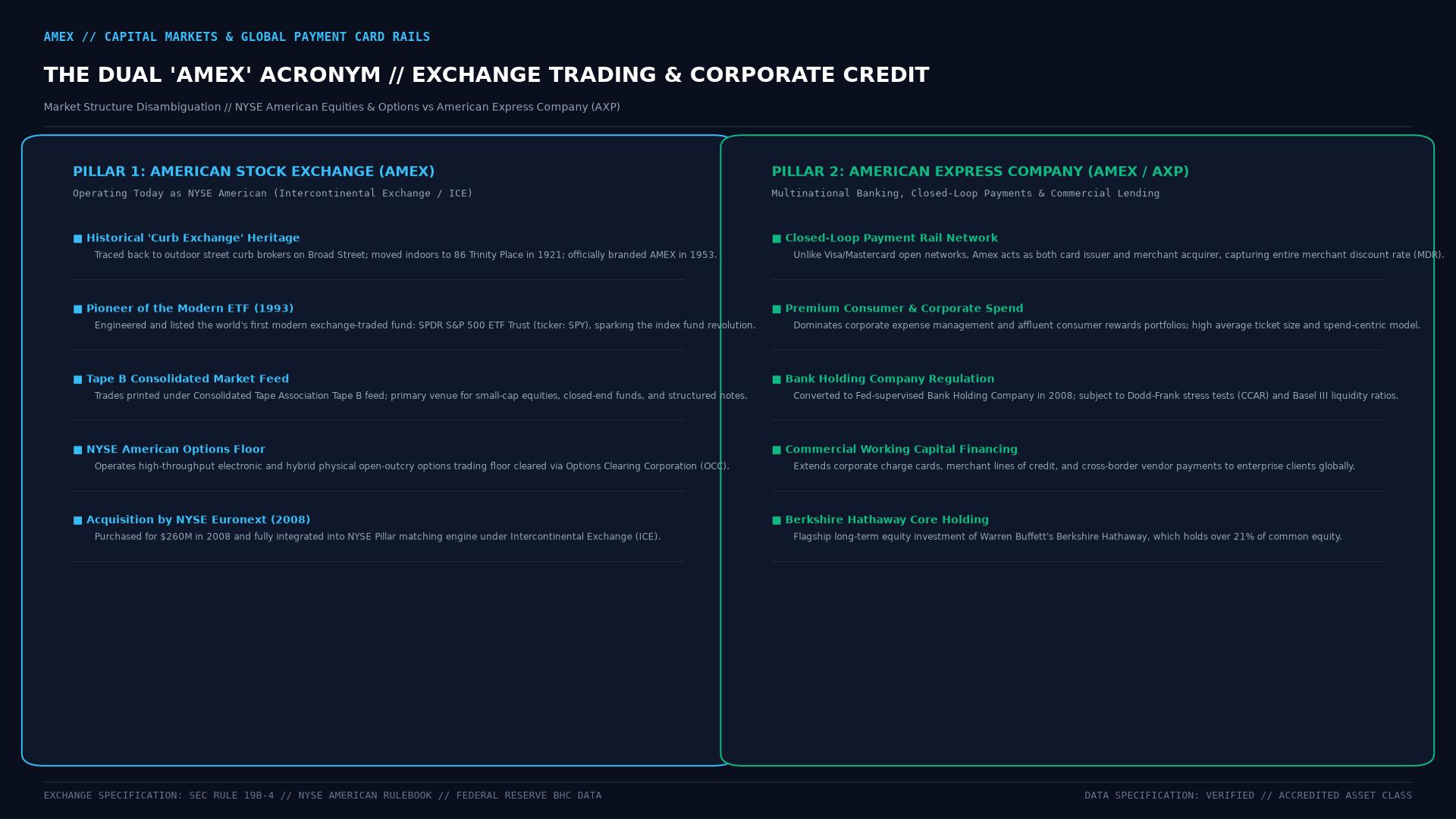 Figure: The dual financial meanings of the AMEX acronym: the historic American Stock Exchange (operating today as NYSE American under ICE) vs. the multinational payments corporation American Express Company (NYSE: AXP).
Historical Context: From the Curb to Electronic ICE Pillar
The American Stock Exchange originally earned the moniker “The Curb” because brokers conducted trading outdoors on the streets of lower Manhattan before constructing their indoor facility at 86 Trinity Place in 1921.
Key milestones that established the AMEX acronym in institutional market structure include:
- 1953: The exchange formally adopts the name American Stock Exchange (AMEX).
- 1975: Launch of the AMEX Options Floor, which introduced listed equity options clearing through the newly formed Options Clearing Corporation (OCC).
- 1993: AMEX revolutionizes global asset management by listing the world’s first modern ETF, the SPDR S&P 500 ETF Trust (ticker: SPY).
- 2008: NYSE Euronext acquires AMEX for $260 million, migrating trading desks to 11 Wall Street.
- 2017: Intercontinental Exchange rebrands the equity division as NYSE American, migrating trading to the high-throughput Pillar electronic matching architecture.
AMEX in the National Market System: Tape B and Consolidated Feeds
Under the Securities Exchange Act of 1934 and SEC Regulation NMS, trades and quotations across all registered US exchanges are consolidated into real-time public data feeds operated by the Consolidated Tape Association (CTA):
| Consolidated Tape | Primary Listing Exchange Covered | Types of Securities |
|---|---|---|
| Tape A | New York Stock Exchange (NYSE) | Large-cap industrial and financial corporations |
| Tape B | NYSE American (AMEX) and regional venues | Small-cap equities, ETFs, structured notes, closed-end funds |
| Tape C | NASDAQ | Technology, biotechnology, and growth equities |
Market data terminals (such as Bloomberg, FactSet, or Refinitiv) historically designated AMEX quotes with the exchange identifier code “A”. Even today, institutional trade routing algorithms identify Tape B market data fees and exchange rebates based on the legacy AMEX regulatory footprint.
                  REGULATION NMS CONSOLIDATED TAPE FLOW
+---------------------------+       +---------------------------+
| NYSE American (AMEX) Data |       | NYSE Main Board (Tape A)  |
+---------------------------+       +---------------------------+
              │                                   │
              ▼                                   ▼
+---------------------------------------------------------------+
| Consolidated Tape Association (CTA) / Securities Information   |
| Processor (SIP) Network - Broadcasts Real-Time NBBO to Desks  |
+---------------------------------------------------------------+
AMEX Options Market Structure
In addition to cash equities, the AMEX acronym designates NYSE American Options, one of the most active multi-list options venues in the world.
Key characteristics of the NYSE American Options exchange include:
- Customer Priority Model: Orders submitted by retail public customers receive strict price-time priority over institutional broker-dealer and proprietary market-maker quotes.
- Complex Order Book (COB): Sophisticated algorithmic order execution for multi-leg strategies, including vertical spreads, iron condors, straddles, and calendar spreads, executing as single net-debit or net-credit packages.
- Specialist and Floor Broker Hybrid: Combines automated electronic execution with active physical open-outcry trading pits on the NYSE trading floor, accommodating large-block institutional hedging.
NYSE American Listing Tiers vs. NASDAQ
For corporate issuers seeking a public listing, the modern NYSE American platform (formerly AMEX) competes directly with the NASDAQ Capital Market:
| Metric | NYSE American | NASDAQ Capital Market |
|---|---|---|
| Target Company Profile | Emerging growth, natural resources, biotech | Technology startups, early-stage growth |
| Minimum Public Float Value | $15 million to $20 million | $5 million to $15 million |
| Minimum Bid Price | $2.00 to $3.00 (depending on standard) | $4.00 ($2.00 to $3.00 with exceptions) |
| Market Maker Support | Electronic Designated Market Maker (DMM) | Competing electronic market makers |
| Corporate Governance | Independent audit, compensation committees | Independent board, audit committees |
Pitfalls and Misconceptions
- Confusing AMEX with American Express (AXP): Placing an order for “AMEX” on a retail trading platform is impossible because AMEX is an exchange identifier, not an active ticker symbol. To invest in the American Express Company, traders must enter the ticker AXP.
- Assuming Lower Regulatory Rigor: Although NYSE American maintains lower financial capitalization hurdles than the NYSE Main Board, listed issuers remain fully subject to federal securities statutes, including SEC periodic reporting (Forms 10-K and 10-Q) and Sarbanes-Oxley accounting compliance.
- Overlooking Liquidity Differences: Small-cap equities listed on NYSE American typically carry wider bid-ask spreads and lower daily trading volume than mega-cap NYSE or NASDAQ-100 names. Executing large market orders on these names without limit price controls can cause substantial execution slippage.
Frequently Asked Questions
Is the American Stock Exchange still in operation?
Yes, but not under its original independent corporate entity. It operates as NYSE American, a fully integrated subsidiary exchange of the New York Stock Exchange and Intercontinental Exchange (ICE), trading emerging growth equities, exchange-traded funds, and equity options.
What happened to the SPDR ETF (SPY) after AMEX was acquired?
When NYSE Euronext purchased AMEX in 2008, all exchange-traded funds listed on AMEX, including the iconic SPY, were migrated onto NYSE Arca and NYSE American platforms, where they continue to trade as the world’s most liquid investment vehicles.
What is the fee structure on the modern NYSE American exchange?
NYSE American uses a differentiated fee schedule. For equities, it features maker-taker pricing models combined with discretionary peg order types designed to protect small-cap resting orders from predatory high-frequency trading latency arbitrage.
Ready to trade forex?
Open a free demo account with a regulated broker. Practice with virtual funds before risking real money.