Amortization method
An amortization method is a structured mathematical technique or accounting procedure used to systematically retire a debt obligation through periodic installments or write down the carrying cost of an intangible asset over time.
What Is an Amortization Method?
An amortization method is an established mathematical framework or accounting protocol used to allocate financial liabilities or asset values across successive operating periods. In debt management and corporate finance, it determines how periodic debt service payments are split between interest expense and principal reduction. In corporate financial accounting, it governs how the capitalized acquisition cost of finite-lived intangible assets (such as patents, software, and trade names) is recognized as an operating expense over their useful economic lives.
In retirement planning, the term also refers to a specific distribution formula authorized by the Internal Revenue Service (IRS) under Section 72(t), allowing taxpayers to take penalty-free early withdrawals from qualified retirement plans prior to reaching age $59\frac{1}{2}$.
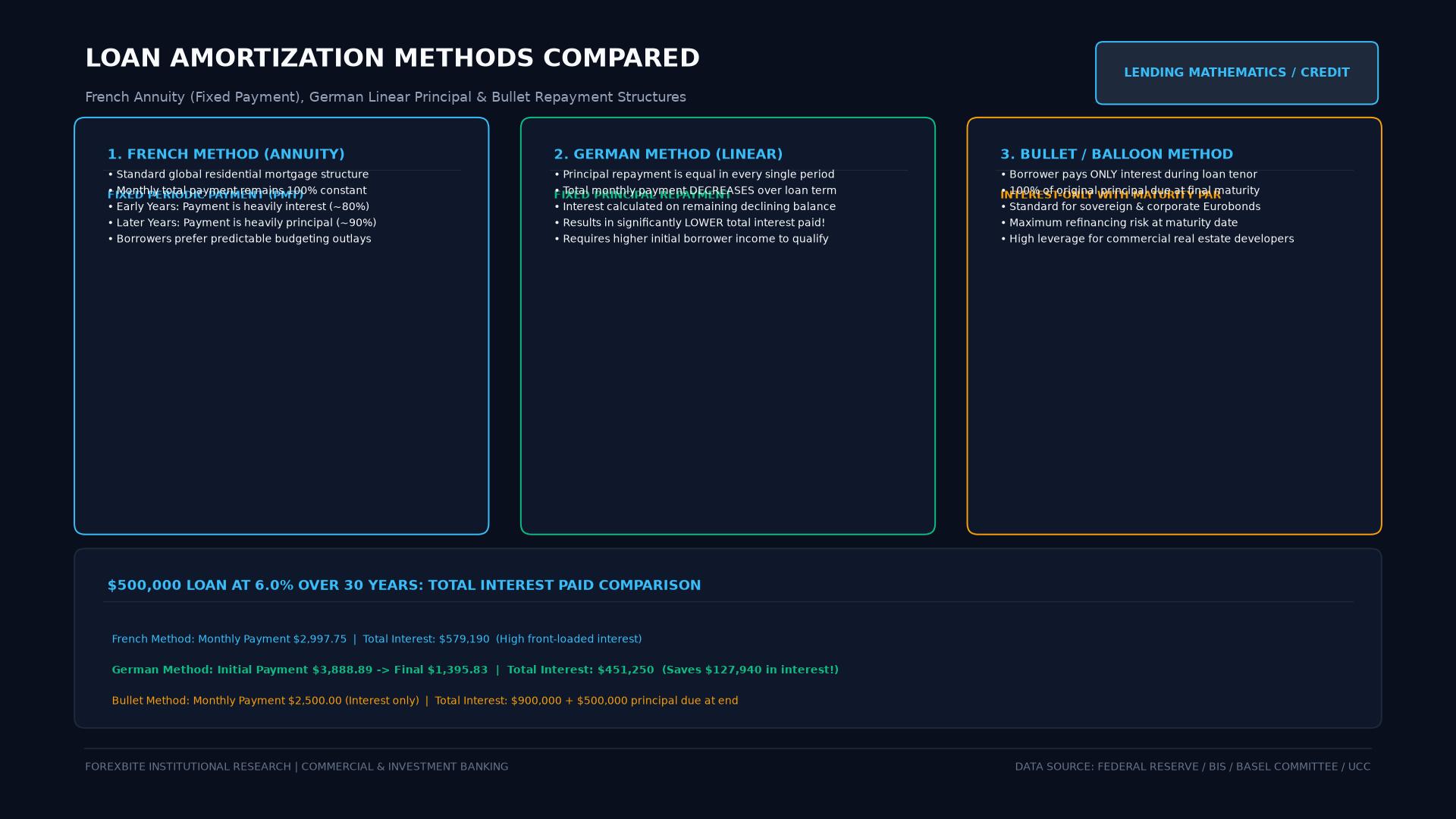 Figure: Mathematical comparison of debt amortization models: straight-line vs effective interest rate method, showing interest vs principal allocation over term.
Debt Amortization Methods: Structural Frameworks
Lenders, commercial borrowers, and bond issuers structure loan facilities using distinct repayment algorithms:
1. The Effective Interest Rate Method (Constant Payment)
Required under US GAAP (ASC 310 / ASC 835) and IFRS 9, the effective interest method maintains a constant periodic payment throughout the loan life, but the internal composition shifts dynamically:
- Periodic Interest Expense: Calculated as the beginning carrying balance multiplied by the contractual periodic interest rate: $$\text{Interest Expense}t = \text{Principal Balance}{t-1} \times r$$
- Principal Reduction: The remainder of the fixed payment is applied to retire principal: $$\text{Principal Repayment}_t = \text{Total Payment} - \text{Interest Expense}_t$$
In the early years of a 30-year mortgage or term loan, interest consumes the vast majority of each payment. As the principal balance declines, the interest charge shrinks, accelerating principal reduction in later years.
2. Constant Principal Amortization (Declining Payment)
Under this method, the borrower repays an identical dollar amount of principal in every payment period, while paying accrued interest on the remaining unpaid balance:
- Total cash outflow is highest in month one and steadily decreases each month.
- This structure reduces total lifetime interest expense compared to the constant payment method because principal balance drops faster in early stages.
3. Negative Amortization
Occurs when the contractual periodic payment is capped at an amount less than the actual accrued interest. The unpaid accrued interest is capitalized: added directly to the loan principal:
$$\text{Ending Balance}t = \text{Beginning Balance}{t-1} + (\text{Accrued Interest}_t - \text{Cash Payment}_t)$$
Popularized during the pre-2008 era in “Option ARM” mortgages, negative amortization creates compounding debt expansion, significantly increasing default risk if asset values decline.
Comparative Debt Payment Trajectories
The following matrix contrasts payment dynamics across common commercial lending amortization structures:
| Amortization Method | Monthly Payment Amount | Lifetime Interest Cost | Principal Paydown Speed | Primary Application |
|---|---|---|---|---|
| Effective Interest (Fixed) | Constant throughout | Moderate to High | Back-loaded (Accelerates late) | Residential mortgages, consumer auto loans |
| Constant Principal | Declining every period | Low | Linear (Fastest early paydown) | Commercial bank term loans, equipment financing |
| Balloon Amortization | Low (Amortized over 25 yrs) | Moderate | Partial (Unpaid lump-sum balance) | Commercial real estate loans (e.g., 5-year balloon) |
| Interest-Only (IO) | Minimal (Zero principal) | Highest | Zero until maturity date | Construction bridge loans, leveraged buyout debt |
           PAYMENT COMPOSITION: EFFECTIVE INTEREST METHOD
Payment $
   ^
   |  [================== Total Fixed Payment ==================]
   |  | INTEREST EXPENSE (Dominates early)                       |
   |  | \                                                        |
   |  |  \                                                       |
   |  |   \                                                      |
   |  |    \                 PRINCIPAL REDUCTION (Dominates late)|
   |  |     \               /                                    |
   |  +----------------------------------------------------------+
   0  Year 1               Year 15                             Year 30
Intangible Asset Amortization in Corporate Accounting
Under ASC 350 (Intangibles: Goodwill and Other) and IAS 38, corporations must amortize finite-lived intangible assets using an amortization method that reflects the pattern in which economic benefits are consumed:
- Straight-Line Method: The default accounting convention when the specific consumption pattern cannot be reliably determined: $$\text{Annual Amortization Expense} = \frac{\text{Capitalized Cost} - \text{Residual Value}}{\text{Useful Economic Life (Years)}}$$
- Units-of-Production Method: Ties asset cost allocation directly to operational output, commonly used for acquired software licenses, mineral extraction rights, or entertainment distribution rights: $$\text{Periodic Amortization} = (\text{Cost} - \text{Residual Value}) \times \left( \frac{\text{Units Produced in Period}}{\text{Total Expected Units}} \right)$$
Note: Under both US GAAP and IFRS, indefinite-lived intangible assets (such as goodwill and perpetual brand licenses) are never amortized. Instead, they are tested annually for asset impairment.
The IRS Section 72(t) Retirement Amortization Method
Under Internal Revenue Code Section 72(t), individuals under age $59\frac{1}{2}$ can access their IRA or 401(k) retirement funds without paying the standard $10%$ early distribution penalty by establishing a Substantially Equal Periodic Payment (SEPP) schedule.
The IRS recognizes three distinct calculation methods:
- Required Minimum Distribution (RMD) Method: Divides the account balance each year by the taxpayer’s life expectancy factor from IRS tables (payments fluctuate annually).
- Fixed Annuitization Method: Divides the account balance by an annuity factor derived from an IRS mortality table and reasonable interest rate.
- Fixed Amortization Method: Calculates a level annual payment by amortizing the account balance over the taxpayer’s life expectancy at a statutory interest rate (capped at $120%$ of the federal mid-term rate).
The fixed amortization method yields the highest annual payout of the three methods, providing maximum liquidity for early retirees while locking the recipient into mandatory annual distributions for at least five consecutive years or until reaching age $59\frac{1}{2}$, whichever is longer.
Frequently Asked Questions
Can a borrower change their loan amortization method midway through the term?
Generally, no. The amortization method is an embedded contractual covenant in the original promissory note. To alter the amortization method (for example, switching from an adjustable-rate mortgage with negative amortization to a fixed 15-year constant payment loan), the borrower must execute a formal loan modification or refinance the debt facility.
How does the effective interest method apply to zero-coupon bonds?
Zero-coupon bonds issue at a deep discount and pay zero periodic cash interest. Under the effective interest method, the bond’s carrying value is accreted upward each period by multiplying the beginning book value by the original yield-to-maturity (YTM). The issuer recognizes this non-cash interest expense on its income statement, while the investor reports it as taxable phantom interest.
What happens if an intangible asset’s useful life changes?
If an enterprise re-evaluates an intangible asset (such as discovering that patent protection will expire three years earlier than planned), the change is treated prospectively as a change in accounting estimate under ASC 250. The remaining unamortized carrying value is amortized over the revised remaining useful life, without restating prior historical earnings.
Ready to trade forex?
Open a free demo account with a regulated broker. Practice with virtual funds before risking real money.