Amortization of premium
Amortization of premium is the accounting and tax process of writing down the excess purchase price of a bond bought above its face value over its remaining term, offsetting annual taxable interest income.
What Is Amortization of Premium?
Amortization of premium is the systematic financial and tax process of reducing the carrying value of a debt security purchased at a price higher than its face (par) value over the remainder of its term to maturity. When market interest rates decline below a bond’s stated coupon rate, investors pay a premium to acquire the higher income stream. Because the bond issuer will redeem the security at exactly par value ($100%$ of face value) upon maturity, the initial premium paid must be written down across each holding period.
Under financial accounting standards (US GAAP and IFRS) and tax regulations (such as Internal Revenue Code Section 171 in the United States), amortizing the bond premium prevents distorted financial statements. It directly offsets the high nominal coupon payments received each year, ensuring the investor’s reported income accurately reflects the true underlying Yield to Maturity (YTM).
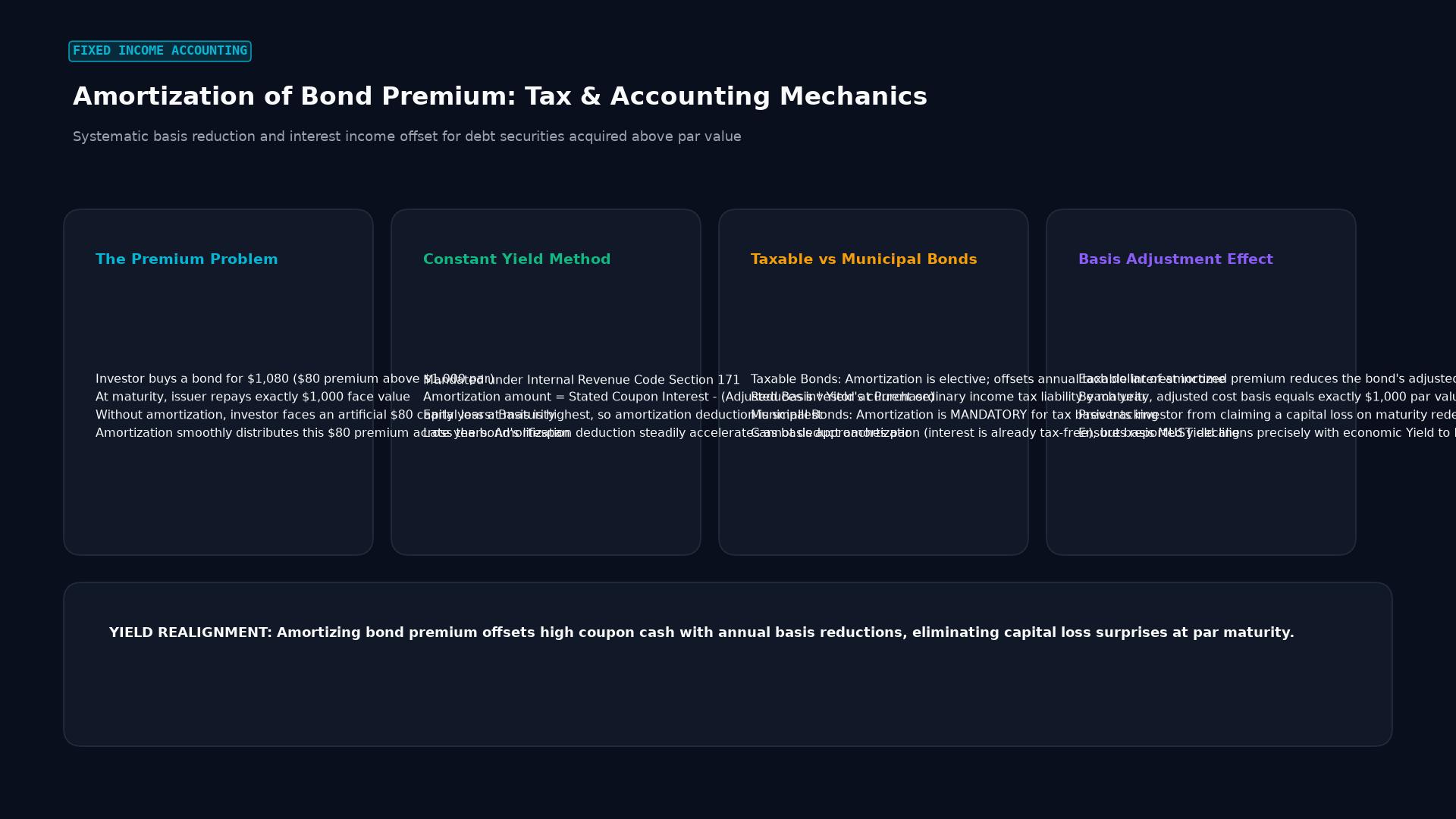 Figure: Systematic basis reduction and interest income offset for debt securities acquired above par value
Tax Rules: Taxable vs. Tax-Exempt Bonds
The tax consequences of bond premium amortization depend heavily on the classification of the underlying debt security under IRC Section 171:
| Bond Classification | Amortization Status | Impact on Annual Income | Impact on Tax Basis | Capital Loss at Maturity? |
|---|---|---|---|---|
| Taxable Bonds (Treasuries, Corporate Debt) | Elective (Taxpayer chooses whether to amortize) | Deductible; directly offsets taxable coupon income | Basis reduced annually by amortized amount | No (Basis equals par at maturity) |
| Tax-Exempt Bonds (State & Municipal Debt) | Mandatory (Required under federal law) | Non-deductible (Coupon is already tax-free) | Basis reduced annually by amortized amount | No (Statute prevents artificial capital loss) |
| Taxable (Without § 171 Election) | No amortization | Full nominal coupon taxed each year | Basis remains at original purchase price | Yes (Large capital loss booked at redemption) |
1. The IRC § 171 Election for Taxable Bonds
For taxable corporate bonds or US Treasuries, making the Section 171 election is generally advantageous. Instead of reporting the full inflated coupon as ordinary income and waiting years to claim a deferred capital loss at maturity, the investor uses the amortized premium to reduce current ordinary income dollar-for-dollar every year.
Caution: Once an investor elects to amortize bond premium under Section 171, the election is irrevocable without IRS consent and applies to all taxable premium bonds currently held and acquired in all future tax years.
2. Mandatory Amortization for Municipal Bonds
For tax-exempt municipal bonds, federal law mandates premium amortization to close a historical tax loophole. Because municipal coupon interest is exempt from federal income tax, investors are not permitted to deduct the amortized premium against other income. However, they must still write down their adjusted tax basis each year. Without this mandatory basis adjustment, municipal bond investors could receive tax-free interest and subsequently claim an artificial capital loss when the bond matures at par.
Calculation Methods: Constant Yield vs. Straight-Line
Tax codes and accounting frameworks specify two mathematical methods for determining periodic premium amortization:
1. The Constant Yield Method (Effective Interest Method)
Mandated by the IRS and US GAAP for corporate financial reporting, the Constant Yield Method calculates amortization based on the bond’s economic yield to maturity:
$$\text{Premium Amortization}_t = \text{Coupon Cash Received}t - \left( \text{Beginning Adjusted Basis}{t-1} \times \text{Yield to Maturity} \right)$$
Numerical Walkthrough
Consider a taxable corporate bond purchased for $1,044.52 with 3 years to maturity, a face value of $1,000, an annual coupon of 6.0% ($60.00 cash per year), and an annual Yield to Maturity of 4.40%:
-
Year 1:
- Cash Coupon = $$60.00$
- True Economic Interest = $$1,044.52 \times 4.40% = $45.96$
- Amortized Premium = $$60.00 - $45.96 = $14.04$
- Taxable Net Interest Reported = $$45.96$
- Ending Tax Basis = $$1,044.52 - $14.04 = $1,030.48$
-
Year 2:
- True Economic Interest = $$1,030.48 \times 4.40% = $45.34$
- Amortized Premium = $$60.00 - $45.34 = $14.66$
- Ending Tax Basis = $$1,030.48 - $14.66 = $1,015.82$
-
Year 3 (Maturity):
- True Economic Interest = $$1,015.82 \times 4.40% = $44.18$
- Amortized Premium = $$60.00 - $44.18 = $15.82$
- Ending Tax Basis = $$1,015.82 - $15.82 = \mathbf{$1,000.00}$ (Matches redemption payout exactly).
2. The Straight-Line Method
Under the straight-line method, total premium is divided equally across remaining payment periods:
$$\text{Annual Amortization} = \frac{\text{Purchase Price} - \text{Par Value}}{\text{Years to Maturity}} = \frac{$1,044.52 - $1,000}{3} = $14.84\text{ per year}$$
While simple, the straight-line method slightly understates interest in early years and overstates it in later years. The IRS permits straight-line amortization only in limited retail circumstances or when the difference from the constant yield method is immaterial.
Callable Bonds: The Yield-to-Worst Rule
When an investor purchases a callable bond at a premium, amortizing to the final maturity date creates severe reinvestment risk. If the issuer exercises its call option early at par, the investor would be forced to write off the remaining unamortized premium immediately as an unexpected loss.
To resolve this, tax regulations and market convention enforce the Yield-to-Worst (YTW) standard:
- If a premium bond has an upcoming call date at a specified call price, the amortization schedule must be calculated to the earliest call date, assuming redemption occurs at the call price, whenever this assumption produces a lower yield than holding the bond to maturity.
Frequently Asked Questions
How is amortized bond premium reported on IRS tax returns?
For individuals who elect Section 171 amortization on taxable bonds, the annual amortized premium is reported on IRS Form 1040, Schedule B (Interest and Ordinary Dividends). The taxpayer lists the full coupon received from the 1099-INT, subtracts the amortizable bond premium as a designated line-item deduction, and carries the net interest into taxable income.
What is the opposite of premium amortization?
The opposite process is the accretion of discount. When a bond is purchased below par value (at a discount), the carrying value is systematically increased over time until it reaches par at maturity, recognizing the accrued discount as taxable interest or capital gain.
Why do institutional investors buy bonds at a premium?
Institutional allocators frequently buy premium bonds because they offer higher cash flow yields and have lower duration than par or discount bonds with identical maturities. Lower duration makes premium bonds less sensitive to future benchmark interest rate spikes.
Ready to trade forex?
Open a free demo account with a regulated broker. Practice with virtual funds before risking real money.