Amortization schedule
An amortization schedule is an itemized financial ledger detailing each periodic payment on an installment loan, displaying the exact allocation between interest expense and principal reduction alongside the remaining loan balance.
What Is an Amortization Schedule?
An amortization schedule is a comprehensive, chronological financial table detailing every scheduled periodic payment on an amortizing loan facility. For each installment throughout the borrowing life, the schedule breaks down the total payment amount into its two constituent parts: the interest expense charged by the lender and the principal repayment applied to reduce the outstanding loan balance. It also displays the running ending balance remaining after each payment settles.
Amortization schedules serve as the foundational underwriting document for consumer mortgages, commercial term loans, vehicle financing, and municipal bond sinking funds. They provide borrowers and credit underwriters with an exact roadmap of debt reduction, total interest liabilities, and loan payoff timing.
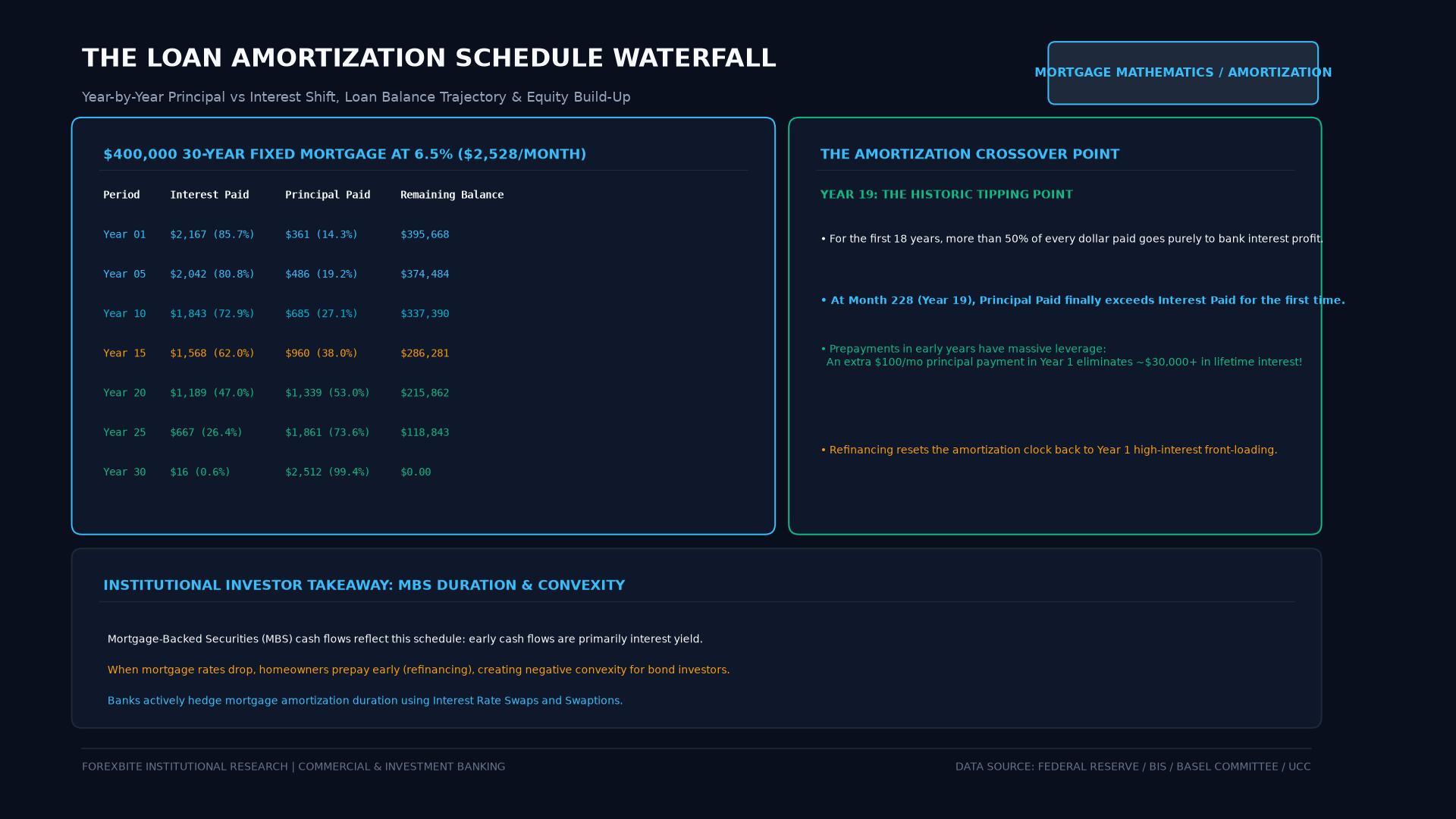 Figure: Amortization waterfall over time: shifting composition from front-loaded interest to accelerating principal reduction and equity accumulation.
Mathematical Formulation of Level Monthly Payments
To construct a fixed-rate amortization schedule, financial institutions determine the level periodic payment ($PMT$) using the standard ordinary annuity formula:
$$PMT = P \times \frac{r(1 + r)^n}{(1 + r)^n - 1}$$
Where:
- $PMT$ = Equal periodic payment amount.
- $P$ = Original loan principal borrowed.
- $r$ = Periodic interest rate (nominal annual interest rate divided by the number of payment periods per year, e.g., $\text{Annual Rate} / 12$).
- $n$ = Total number of scheduled payments ($years \times 12$).
Recursive Balance Calculation
Once $PMT$ is established, each line of the amortization schedule is generated sequentially using the following recursive formulas:
- Periodic Interest Charge: $$\text{Interest}t = \text{Balance}{t-1} \times r$$
- Principal Repayment: $$\text{Principal}_t = PMT - \text{Interest}_t$$
- Ending Loan Balance: $$\text{Balance}t = \text{Balance}{t-1} - \text{Principal}_t$$
Because the ending balance drops with each payment, the interest portion in the subsequent period is lower, leaving a progressively larger share of the fixed monthly payment to pay down principal.
Anatomy of a 30-Year Mortgage Schedule
Consider a $400,000 fixed-rate residential mortgage with a 5.0% annual interest rate across a 360-month (30-year) term. The fixed monthly payment is calculated as $2,147.29:
| Period | Beginning Balance | Payment | Interest Portion | Principal Portion | Ending Balance |
|---|---|---|---|---|---|
| Month 1 | $400,000.00 | $2,147.29 | $1,666.67 (77.6%) | $480.62 (22.4%) | $399,519.38 |
| Month 12 | $394,624.11 | $2,147.29 | $1,644.27 (76.6%) | $503.02 (23.4%) | $394,121.09 |
| Month 120 (Yr 10) | $332,674.34 | $2,147.29 | $1,386.14 (64.5%) | $761.15 (35.5%) | $331,913.19 |
| Month 186 (Yr 15.5) | $257,543.20 | $2,147.29 | $1,073.10 (49.9%) | $1,074.19 (50.1%) | $256,469.01 |
| Month 240 (Yr 20) | $193,522.61 | $2,147.29 | $806.34 (37.5%) | $1,340.95 (62.5%) | $192,181.66 |
| Month 360 (Yr 30) | $2,138.38 | $2,147.29 | $8.91 (0.4%) | $2,138.38 (99.6%) | $0.00 |
              INTEREST VS. PRINCIPAL CROSSOVER POINT
Payment Allocation ($)
   ^
$2,147 +---------------------------------------------------------------+
       | INTEREST EXPENSE                     PRINCIPAL REPAYMENT      |
       | \                                                     /       |
       |  \                                                   /        |
       |   \                                                 /         |
       |    \                                               /          |
$1,074 +-----\------------------ CROSSOVER POINT ----------/-----------+
       |      \                  (Month 186)              /            |
       |       \                                         /             |
       |        \                                       /              |
       |         \                                     /               |
$0.00  +---------------------------------------------------------------+
       Month 1                  Month 186                     Month 360
Notice the Crossover Point: For more than 15 years, the majority of every dollar paid goes directly to interest. Only around Month 186 does the principal portion permanently surpass the interest portion.
Impact of Early and Accelerated Principal Prepayments
An amortization schedule assumes strictly minimum contractual payments. When a borrower makes additional principal payments, the effects are non-linear:
- Immediate Compounding Reduction: Extra principal paid directly reduces the outstanding balance ($P$). In the next month, the interest charge ($P \times r$) is permanently lower.
- Shortening the Loan Term: Because the monthly payment remains fixed at the contractual amount, the dollar savings in interest automatically translate into greater principal reduction every subsequent month, shaving years off the loan lifecycle.
- Bi-Weekly Payment Schedules: By paying half the monthly payment every two weeks, the borrower makes 26 half-payments per year (equivalent to 13 full monthly payments). On a 30-year mortgage, this single extra payment each year typically cuts the effective payoff term down to approximately 24 years, saving tens of thousands in cumulative interest.
Amortization Schedules in Securitization and MBS Trading
In institutional bond markets, amortization schedules are central to trading Mortgage-Backed Securities (MBS) issued by Fannie Mae, Freddie Mac, and Ginnie Mae.
Because underlying residential homeowners frequently refinance, move, or prepay their mortgages, the actual cash flows of an MBS pool diverge from static amortization schedules:
- Constant Prepayment Rate (CPR): An annualized measure of early loan prepayments within a pool.
- Single Monthly Mortality (SMM): The percentage of outstanding loan balance prepaid in a single month above the scheduled amortization.
- Extension Risk: When interest rates rise, mortgage holders stop refinancing. The expected amortization schedule extends, trapping MBS investors in below-market yields.
- Contraction Risk: When rates fall, homeowners refinance en masse. Principal is returned prematurely, forcing MBS investors to reinvest capital at lower prevailing interest rates.
Frequently Asked Questions
Can an amortization schedule have changing interest rates?
Yes. On an Adjustable-Rate Mortgage (ARM) or floating-rate commercial loan, the amortization schedule is recalculated each time the benchmark rate resets (e.g., SOFR + margin). The monthly payment is re-benchmarked across the remaining number of periods to ensure the loan still amortizes to zero by the contractual maturity date.
What is a balloon amortization schedule?
A balloon schedule calculates monthly payments based on a long amortization period (such as 25 or 30 years) to keep cash obligations manageable, but establishes a maturity date after a much shorter period (such as 5 or 10 years). At maturity, the entire unamortized remaining principal balance must be paid as a single lump-sum “balloon” payment or refinanced into a new facility.
How do lenders handle rounding discrepancies on the final payment?
Because periodic interest calculations involve multi-digit decimal rounding, the final scheduled payment on an amortization schedule is almost always adjusted by a few cents (or dollars) to ensure the ending loan balance reaches exactly $0.00.
Ready to trade forex?
Open a free demo account with a regulated broker. Practice with virtual funds before risking real money.