Amortization term
An amortization term is the total period of time required to fully liquidate a debt obligation, including all principal and accrued interest, through scheduled periodic installment payments.
What Is an Amortization Term?
The amortization term is the total projected timeframe over which a borrower is scheduled to make periodic installment payments to reduce a debt balance to exactly zero. Measured in months or years, the amortization term dictates the mathematical size of each monthly payment, the speed at which equity is built, and the total cumulative interest paid over the life of the borrowing facility.
In consumer finance, the amortization term commonly matches the actual duration of the loan contract, such as in standard 15-year or 30-year fixed-rate residential mortgages. In commercial banking and real estate syndications, however, the amortization term is frequently decoupled from the loan maturity term, creating structured debt facilities with balloon repayment obligations.
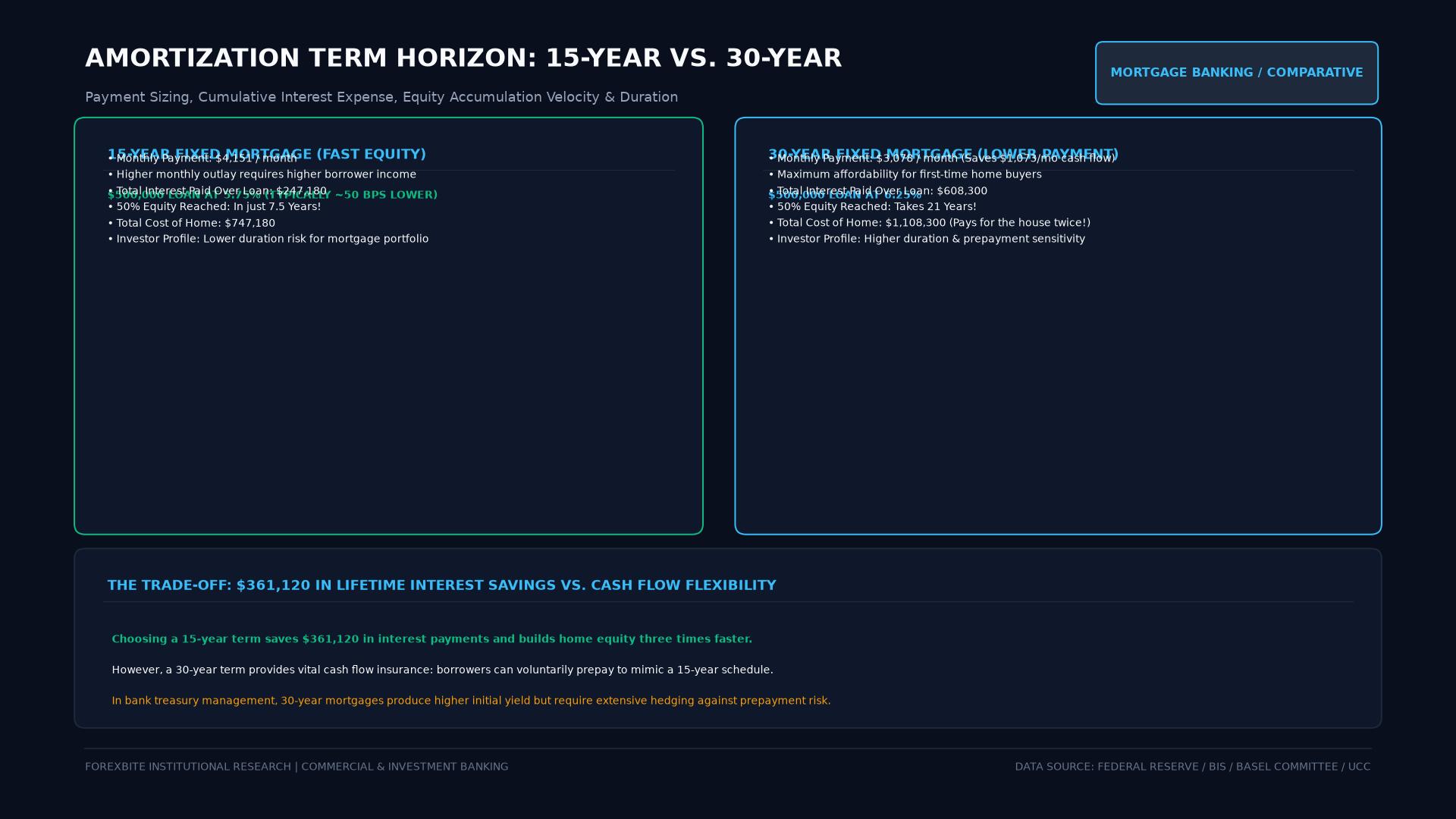 Figure: Capital cost and monthly payment trade-off analysis comparing 15-year accelerated amortization with 30-year standard mortgage structures.
Amortization Term vs. Loan Maturity Term: The Critical Distinction
Failing to distinguish between the amortization term and the maturity term is a frequent source of financial confusion for corporate borrowers:
- Amortization Term: The theoretical schedule used to calculate the level periodic debt service payment. For example, a 25-year amortization term spreads the repayment burden over 300 equal monthly periods, keeping monthly cash outflows modest.
- Loan Maturity Term (Maturity Date): The legally binding contractual date on which the entire remaining unpaid principal balance becomes immediately due and payable.
Commercial Real Estate Balloon Example
A commercial lender issues a $5,000,000 loan to an industrial property owner:
- Amortization Term: 25 Years (300 Months).
- Maturity Term: 10 Years (120 Months).
- Interest Rate: 6.0%.
Under this facility, the borrower pays $32,215.07 each month for 10 years, identical to the payments on a full 25-year loan. However, at Month 120, the borrower has paid down only a fraction of the principal. The remaining balance of approximately $3,840,000 must be paid in full as a single balloon payment, typically satisfied by refinancing with a new commercial mortgage or selling the property.
Consumer Debt: 15-Year vs. 30-Year Mortgage Amortization Terms
The choice of amortization term in residential lending represents a fundamental economic trade-off between monthly liquidity and lifetime wealth preservation.
Consider a $500,000 mortgage at prevailing historical market rates:
| Underwriting Metric | 15-Year Amortization Term (5.5%) | 30-Year Amortization Term (6.0%) | Variance / Impact |
|---|---|---|---|
| Monthly Payment (P&I) | $4,085.34 | $2,997.75 | 30-year is $1,087.59 cheaper/mo |
| Total Lifetime Payments | $735,361.20 | $1,079,190.00 | 15-year saves $343,828.80 |
| Total Cumulative Interest | $235,361.20 | $579,190.00 | 15-year cuts interest by 59.4% |
| Equity Built in Year 5 | $126,200 (25.2%) | $33,800 (6.8%) | 15-year builds equity 3.7x faster |
| Underwriting DTI Required | Higher income threshold | Lower income threshold | 30-year allows easier qualification |
               LIFETIME INTEREST ACCUMULATION BY TERM
Total Interest Paid ($)
   ^
$600k +                                              +-----------------+
      |                                              | 30-Year: $579k  |
$450k +                                              +-----------------+
      |                                                      /
$300k +                              +-----------------+    /
      |                              | 15-Year: $235k  |   /
$150k +                              +-----------------+  /
      |                                      /           /
$0.00 +----------------------------------------------------------------+
      0                            15 Years            30 Years
While the 30-year amortization term lowers monthly required cash outflow by $26.6%$, expanding debt service over an additional 15 years results in more than double the cumulative interest expense.
Impact on Commercial Underwriting and DSCR
In corporate finance and commercial banking, lenders utilize the amortization term as a variable structuring tool to manage credit risk and ensure compliance with the Debt Service Coverage Ratio (DSCR):
$$\text{DSCR} = \frac{\text{Net Operating Income (NOI)}}{\text{Annual Debt Service}}$$
Commercial lenders typically require a minimum DSCR of $1.25\times$ to $1.35\times$:
- If a commercial borrower’s projected NOI is $350,000 and annual debt service under a 15-year amortization schedule is $320,000, the DSCR is only $1.09\times$ (loan application rejected).
- By extending the amortization term to 25 or 30 years, the annual debt service drops to $240,000. The DSCR rises to $1.46\times$, allowing the lender to approve the loan within credit committee risk limits.
Loan Recasting vs. Term Refinancing
When a borrower makes a substantial lump-sum principal reduction (such as paying $50,000 into a $300,000 balance), the amortization term can be adjusted in two distinct ways:
- Amortization Acceleration (Term Reduction): The borrower continues making the original contractual monthly payment. Because the balance is smaller, more of each payment goes to principal, and the effective amortization term naturally contracts from 30 years down to 22 years.
- Loan Recasting (Payment Reduction): For a nominal administrative fee (typically $250 to $500), the lender re-calculates the monthly payment based on the original remaining amortization term and the new, lower balance. The monthly payment drops permanently, but the scheduled payoff date remains unchanged.
Frequently Asked Questions
Can an amortization term be extended without refinancing?
During severe financial distress, borrowers can request a loan modification under a forbearance or workout agreement. Lenders may agree to extend the amortization term (for example, from remaining 20 years back out to a fresh 40-year schedule) to reduce monthly payments and prevent foreclosure default.
What is a negative amortization term?
If an adjustable-rate loan allows payments that do not cover accruing interest, the loan balance expands rather than contracts. Under negative amortization, the theoretical amortization term becomes infinite unless the contract contains a mandatory “recast trigger” that forces payments upward after the balance reaches a set limit (such as $115%$ of original principal).
Why do European residential mortgages often have shorter amortization terms than US loans?
The US 30-year fixed-rate mortgage is a global anomaly made possible by government-sponsored enterprises (Fannie Mae and Freddie Mac) that purchase and securitize 30-year paper with federal backstops. In Europe, where banks retain mortgages on their balance sheets or issue covered bonds, amortization terms are frequently shorter (15 to 25 years) or utilize variable-rate pricing to limit bank duration risk.
Ready to trade forex?
Open a free demo account with a regulated broker. Practice with virtual funds before risking real money.