Amortization
Amortization is the dual financial process of systematically extinguishing a debt obligation through scheduled periodic installments, and expensing the capitalized cost of finite-lived intangible assets over their useful economic lifespans.
What Is Amortization?
In modern finance and corporate accounting, amortization carries two fundamental meanings depending on whether it applies to liabilities on a balance sheet or assets on an income statement:
- In Debt Financing: Amortization is the systematic reduction of a loan or financial liability through regular, scheduled installment payments that cover both accrued interest and a portion of the principal balance until the debt is extinguished.
- In Corporate Financial Accounting: Amortization is the non-cash expensing of the acquisition cost of finite-lived intangible assets (such as patents, software, customer contracts, and licensing agreements) over their estimated useful economic lives, conforming to the matching principle.
Both applications reflect the core economic objective of spreading a significant financial value across multiple future accounting periods rather than absorbing the entire impact at inception.
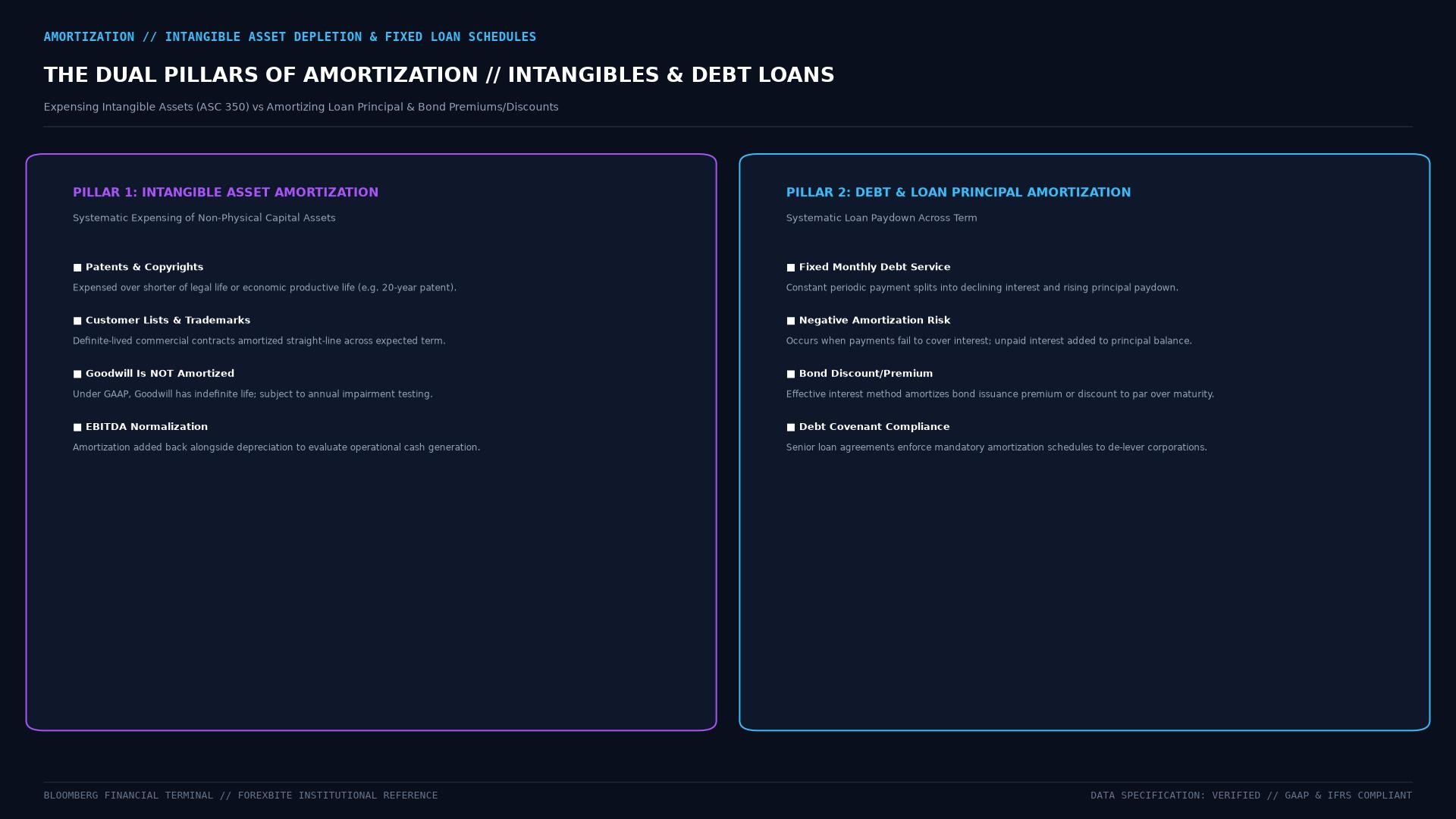 Figure: Dual frameworks of amortization: corporate intangible asset amortization (patents, customer lists) alongside banking debt service amortization showing the shifting balance between interest and principal repayment.
Amortization vs. Depreciation vs. Depletion
To understand financial statements, analysts distinguish between the three primary methods of capital asset cost allocation:
| Accounting Term | Target Asset Class | Typical Examples | Primary Standard (US GAAP) |
|---|---|---|---|
| Amortization | Non-physical (Intangible) assets with finite lives | Patents, software licenses, customer lists, franchises | ASC 350 / ASC 340 |
| Depreciation | Physical (Tangible) fixed assets with wear-and-tear | Machinery, vehicles, office buildings, manufacturing plants | ASC 360 |
| Depletion | Exhaustible natural resource reserves | Crude oil reservoirs, timber tracts, copper mines, quarries | ASC 932 |
Indefinite-lived intangible assets (such as purchased Goodwill or perpetual trademarks) are an exception: under standard US GAAP and IFRS, they are never amortized. Instead, they must be tested at least annually for impairment.
Accounting for Intangible Amortization (ASC 350 & IAS 38)
When a corporation acquires another company or purchases intellectual property, capitalized intangible assets are recorded on the balance sheet.
Under the accrual matching principle, the revenues generated by these assets must be matched against their acquisition costs over time:
$$\text{Annual Amortization Expense} = \frac{\text{Historical Capitalized Cost} - \text{Residual Value}}{\text{Useful Economic Life (Years)}}$$
Example: Patent Cost Allocation
A biotechnology firm acquires a commercial patent for $12,000,000 with an estimated remaining legal and economic lifespan of 10 years and zero residual value:
- Annual Amortization: $$12,000,000 / 10 = $1,200,000\text{ per year}$.
- Income Statement Impact: Operating expenses increase by $$1,200,000$ annually as non-cash amortization expense, reducing operating income (EBIT).
- Balance Sheet Impact: The asset’s net carrying value is reduced by $$1,200,000$ each year via accumulated amortization until the book value reaches zero.
                     BALANCE SHEET VALUE OVER 10 YEARS
Carrying Value ($)
   ^
$12M +  [Initial Capitalization: $12,000,000]
     |   \
 $9M +    \
     |     \  $1,200,000 Annual Non-Cash Amortization Charge
 $6M +      \
     |       \
 $3M +        \
     |         \
 $0  +----------+==================================== [End of Year 10: $0.00]
     0        Year 2.5       Year 5.0       Year 7.5       Year 10
Tax Amortization: Section 197 Intangibles
In corporate taxation, accounting rules diverge sharply from financial reporting. Under Internal Revenue Code Section 197, the IRS mandates a strict 15-year straight-line tax amortization schedule for virtually all acquired intangible assets, regardless of their actual economic lifespan.
Section 197 intangibles include:
- Goodwill and going concern value.
- Workforce in place (assembled personnel).
- Business books, records, operating systems, and technical information.
- Customer-based and supplier-based intangibles.
- Licenses, permits, covenants not to compete, and franchises.
Because financial accounting often amortizes intangibles over 3 to 7 years while the tax code enforces 15 years, this divergence generates substantial Deferred Tax Assets (DTAs) and Deferred Tax Liabilities (DTLs) under ASC 740.
Amortization in Valuation: The Role of EBITDA
Because accounting amortization is a non-cash charge that reflects historical acquisition accounting rather than current operational cash burn, corporate finance analysts routinely add it back to operating earnings:
$$\text{EBITDA} = \text{Operating Income (EBIT)} + \text{Depreciation} + \text{Amortization}$$
Why Wall Street Tracks EBITDA and Free Cash Flow
- Comparing Leveraged Buyouts (LBOs): In corporate mergers, a company that buys several competitors accumulates massive intangible amortization charges, depressing reported GAAP net income. Adding back amortization normalizes cash generation, enabling like-for-like operational comparisons against competitors that grew organically.
- Debt Service Capacity: Because non-cash amortization does not drain cash from the corporate treasury, credit rating agencies and commercial lenders use EBITDA to calculate leverage ratios (such as $\text{Total Debt} / \text{EBITDA}$) to assess true debt servicing capacity.
Frequently Asked Questions
Is loan amortization the same as intangible asset amortization?
No. Loan amortization involves actual cash outflow each month to pay down bank debt and satisfy interest obligations. Intangible asset amortization is an internal accounting entry on the income statement that allocates past capital expenditures across time without any cash leaving the business.
Why is goodwill not amortized under US GAAP?
Goodwill represents the premium paid for an acquired enterprise above the fair value of its identifiable net assets. Because goodwill is presumed to have an indefinite useful life that does not automatically deteriorate on a predictable schedule, standard US GAAP (ASC 350) and IFRS (IAS 36) forbid straight-line amortization for public companies, requiring annual impairment testing instead.
How does amortization affect corporate cash flows?
On the GAAP Statement of Cash Flows, amortization is added back to Net Income in the Cash Flows from Operating Activities section. Because it was subtracted to compute net income but required zero cash outlay during the current period, adding it back reveals the true operational cash generated by the business.
Ready to trade forex?
Open a free demo account with a regulated broker. Practice with virtual funds before risking real money.