Amortized value
Amortized value, also known as amortized cost, is the balance sheet carrying value of a debt security or financial asset, calculated as its initial acquisition price adjusted for accumulated amortization, accretion, and credit impairments.
What Is Amortized Value?
Amortized value (frequently designated as amortized cost in global accounting frameworks) is the balance sheet carrying amount at which a debt instrument or financial asset is measured. Under both US GAAP (ASC 320 / ASC 326) and International Financial Reporting Standards (IFRS 9), the amortized value equals the initial acquisition cost of the security, adjusted for cumulative principal repayments, plus or minus the cumulative amortization of any purchase discount or premium, and reduced by any write-downs for expected credit losses.
Unlike assets held at fair market value (where daily market price fluctuations are recorded immediately in earnings or equity), debt securities held at amortized value remain insulated from temporary secondary market volatility, reflecting the assumption that the holder intends to collect all contractual cash flows through maturity.
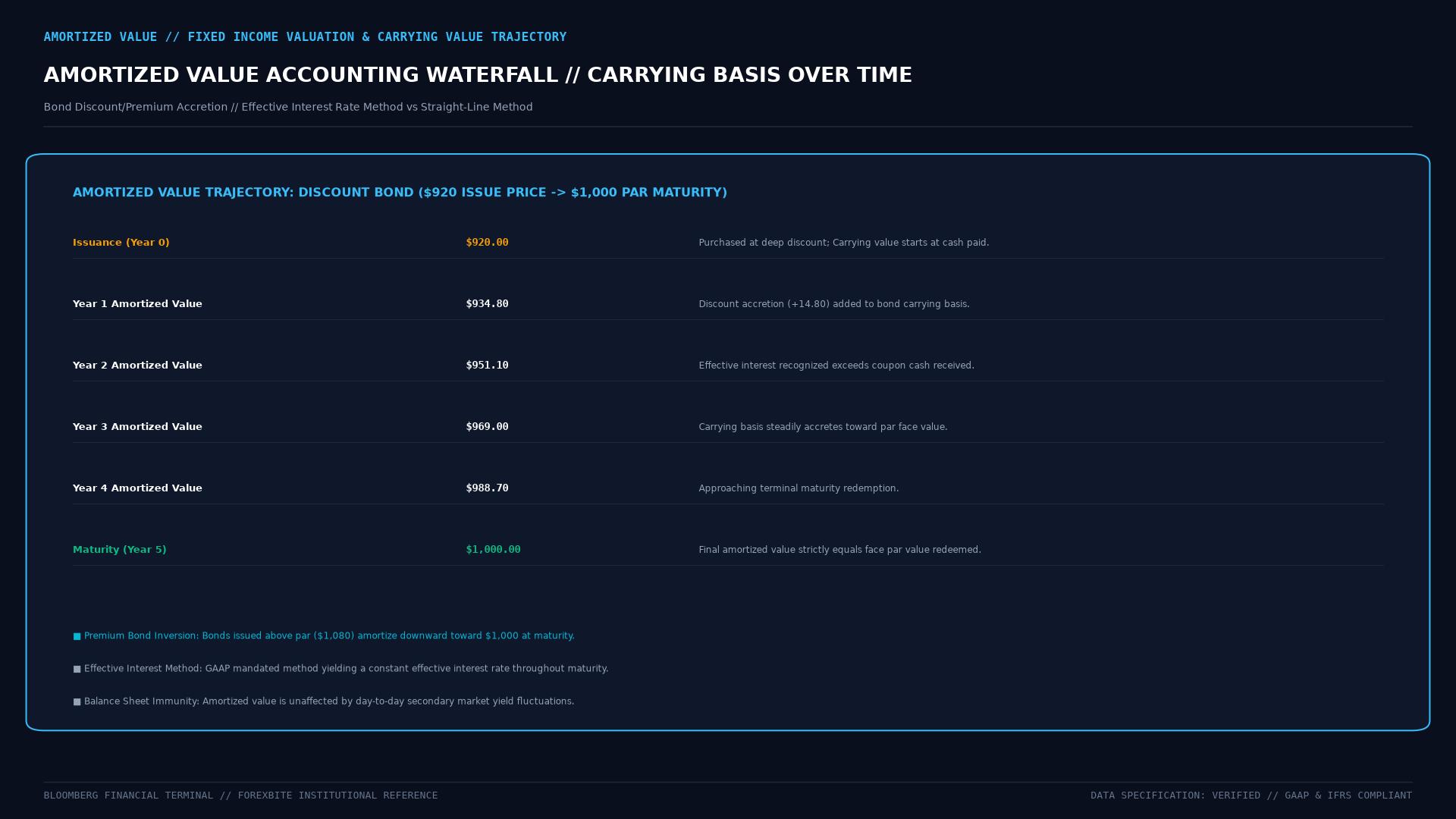 Figure: Divergence between Amortized Value (carrying balance based on effective interest rate) and Fair Market Value (discounted cash flow based on prevailing yields) across interest rate cycles.
Accounting Standards: When Is Amortized Value Applied?
Under IFRS 9, a debt instrument can be classified and measured at amortized cost only if it satisfies two strict statutory hurdles:
- The Business Model Test: The financial asset is held within an institutional business model whose objective is strictly to hold financial assets in order to collect contractual cash flows (rather than trading for short-term capital gains).
- The SPPI Test (Solely Payments of Principal and Interest): The contractual terms of the asset give rise on specified dates to cash flows that represent solely payments of principal and interest on the principal amount outstanding.
In US GAAP, debt securities designated as Held-to-Maturity (HTM) are measured at amortized cost, provided the reporting enterprise possesses both the positive intent and the financial ability to hold those securities until redemption.
Amortized Value vs. Fair Value: The Banking Sector Divergence
The difference between amortized value and fair market value is one of the most critical structural dynamics in commercial banking risk management:
| Balance Sheet Classification | Balance Sheet Valuation | Unrealized Price Gains / Losses | Capital Adequacy Impact |
|---|---|---|---|
| Held-to-Maturity (HTM) | Amortized Value (Cost) | Disclosed in footnotes only; not booked | Zero impact on regulatory equity |
| Available-for-Sale (AFS) | Fair Market Value | Flow into Accumulated Other Comprehensive Income (AOCI) | Direct impact on tangible book value |
| Trading Portfolio | Fair Market Value | Flow directly into Net Income (P&L) | Immediate daily capital volatility |
              AMORTIZED VALUE VS. FAIR VALUE DURING RATE SURGES
Asset Value ($)
    ^
$100 +==================== AMORTIZED VALUE (Stable Book Value) ============+
     |                                                                     |
 $90 +                     \                                               |
     |                      \                                              |
 $80 +                       \   UNREALIZED DURATION LOSS                  |
     |                        \  (Footnote Disclosures)                    |
 $70 +                         +-------- FAIR MARKET VALUE ----------------+
     +---------------------------------------------------------------------+
     0                         Central Bank Hikes Rates (+500 bps)
The 2023 Regional Banking Crisis Case Study
When the Federal Reserve raised benchmark interest rates by more than 500 basis points between 2022 and 2023, the fair market value of long-dated US Treasury and mortgage-backed securities plunged by $20%$ to $35%$.
Because banks like Silicon Valley Bank (SVB) held hundreds of billions in these bonds classified as Held-to-Maturity at amortized value, their balance sheets reported pristine capital adequacy ratios. However, when sudden depositor runs forced SVB to sell these HTM securities before maturity to raise immediate cash, the bank had to reclassify the bonds at fair market value, crystallizing massive realized losses that instantly wiped out its regulatory equity.
Calculating Amortized Value Using the Effective Interest Method
Under standard accounting protocols, amortized value is calculated using the effective interest method rather than straight-line approximations.
Consider a corporate bond with a face value of $100,000, a stated coupon of 4.0% ($4,000 paid annually), purchased at a discount for $95,000 with 3 years to maturity. The internal Yield to Maturity (effective interest rate) is 5.88%:
-
Year 1:
- Beginning Amortized Value = $$95,000$
- Effective Interest Earned = $$95,000 \times 5.88% = $5,586$
- Coupon Cash Collected = $$4,000$
- Discount Accretion = $$5,586 - $4,000 = $1,586$
- Ending Amortized Value = $$95,000 + $1,586 = \mathbf{$96,586}$
-
Year 2:
- Beginning Amortized Value = $$96,586$
- Effective Interest Earned = $$96,586 \times 5.88% = $5,679$
- Coupon Cash Collected = $$4,000$
- Discount Accretion = $$5,679 - $4,000 = $1,679$
- Ending Amortized Value = $$96,586 + $1,679 = \mathbf{$98,265}$
-
Year 3 (Maturity):
- Effective Interest Earned = $$98,265 \times 5.88% = $5,778$ (adjusted for rounding)
- Discount Accretion = $$5,778 - $4,000 = $1,735$
- Final Amortized Value = $$98,265 + $1,735 = \mathbf{$100,000}$ (Exactly equal to maturity face value).
Impairment Adjustments: CECL and IFRS 9 Expected Losses
Amortized value does not ignore credit deterioration. Under the Current Expected Credit Losses (CECL / ASC 326) standard and IFRS 9:
- Institutions must estimate lifetime or 12-month expected credit losses on debt portfolios.
- An allowance for credit losses is booked as a contra-asset account.
- The net carrying amount reported on the balance sheet reflects the net amortized value: $$\text{Net Amortized Value} = \text{Gross Amortized Cost} - \text{Credit Loss Allowance}$$
If a corporate borrower enters bankruptcy or experiences a significant credit downgrade, the lender writes down the amortized value to the present value of expected recoverable future cash flows, recognizing an immediate impairment charge on the income statement.
Frequently Asked Questions
Can an equity stock be carried at amortized value?
No. Equity shares do not have contractual cash flows or a fixed maturity date, and thus fail the SPPI test under IFRS 9. Equities must be measured at fair market value through profit and loss (FVTPL) or fair value through other comprehensive income (FVTOCI).
What is the “tainting rule” in Held-to-Maturity accounting?
Under US GAAP, if an institution sells more than an immaterial amount of Held-to-Maturity debt securities prior to maturity (without meeting specific statutory emergency exceptions), the HTM portfolio is considered “tainted.” The bank is legally barred from classifying any debt at amortized value for the subsequent two fiscal years, forcing all securities to be marked to market.
How does amortized value affect financial ratio analysis?
Financial analysts examine the footnotes of bank disclosures to compare amortized value with fair market value. If fair market value is substantially lower than amortized value across the HTM portfolio, the bank’s true economic solvency is lower than its reported book equity suggests, signaling latent liquidity vulnerability.
Ready to trade forex?
Open a free demo account with a regulated broker. Practice with virtual funds before risking real money.