Amortized
Amortized is an accounting and financial descriptor applied to any loan, capital expenditure, or intangible asset whose historical monetary balance has been systematically reduced over successive operating periods.
What Does Amortized Mean in Finance?
In banking, corporate accounting, and securities valuation, amortized is a descriptive adjective designating any financial asset, liability, or deferred expenditure whose initial monetary balance has been incrementally expensed, reduced, or liquidated across pre-determined accounting intervals.
When a loan is described as fully amortized, it signifies that scheduled installment payments have retired both principal and interest down to a zero balance. In corporate financial statements, when an intangible asset or debt issuance cost is described as amortized, it indicates that a portion of that historical capital outlay has already been charged against past revenues on the income statement, leaving a diminished net carrying balance on the corporate balance sheet.
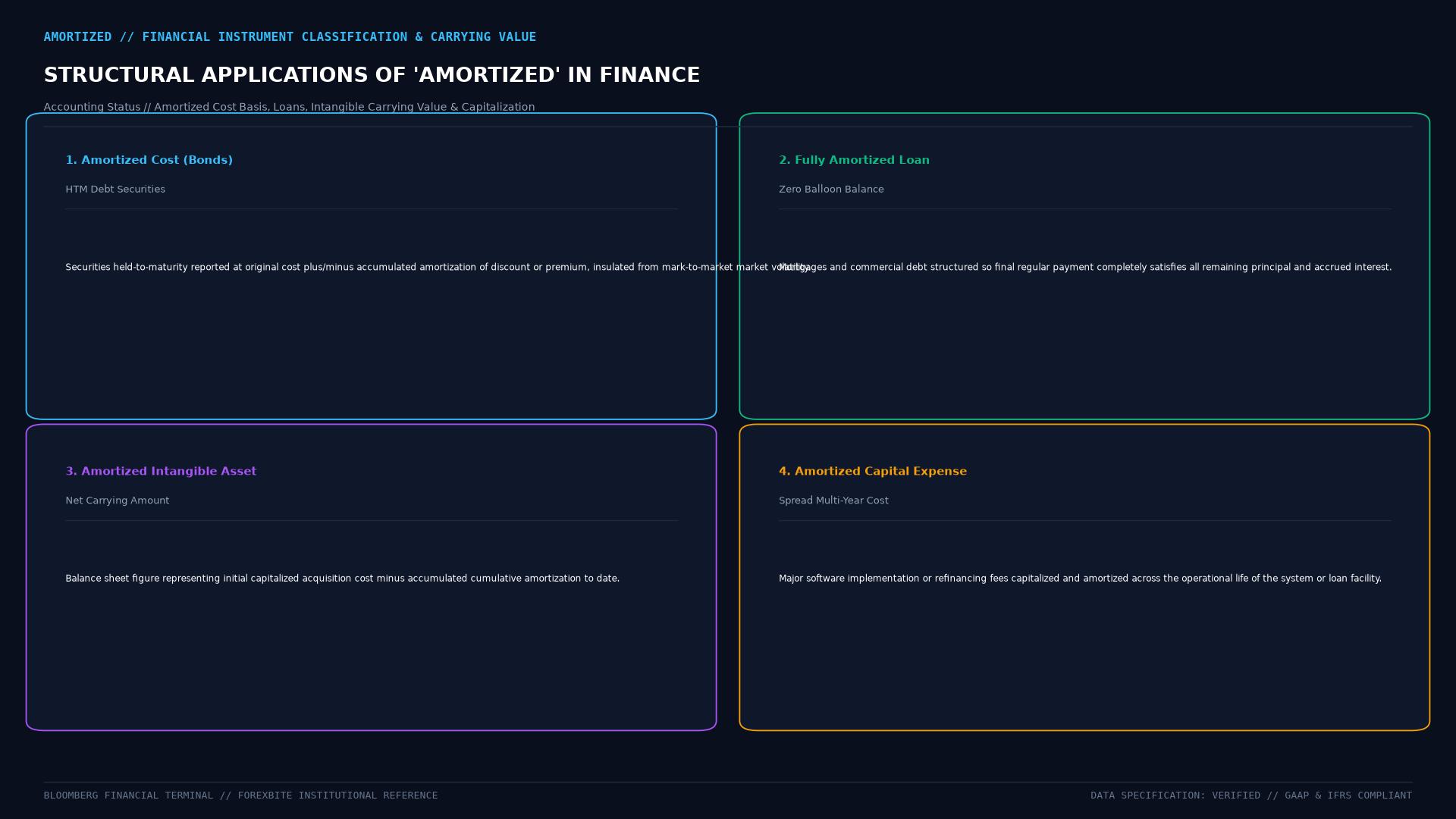 Figure: IFRS 9 / ASC 326 amortized cost measurement model for held-to-collect debt instruments, showing effective interest rate accretion/amortization of bond discounts and premiums over maturity.
The Spectrum of Amortized Loan Structures
In commercial lending and consumer credit, the degree to which a debt obligation is amortized over its contractual life determines repayment risk:
               LOAN AMORTIZATION STRUCTURES COMPARED
Balance ($)
   ^
   |  [=== Interest-Only (IO) Loan ===]  --> Zero Principal Amortized
$P +---------------------------------------------------+
   |                                                   |
   |  [=== Partially Amortized Loan ===]               |
   |   \                                               |
$B +----\----------------------------------------------+ --> Balloon Due
   |     \
   |      \  [=== Fully Amortized Loan ===]
   |       \
$0 +--------\------------------------------------------+ --> $0.00 Payoff
   0       Term                                      Maturity
1. Fully Amortized Loans
A loan facility where each periodic payment is calibrated so that the final installment completely satisfies the debt obligation without requiring a balloon payment or refinancing. Common examples include standard 15-year and 30-year fixed-rate residential mortgages and consumer auto loans.
2. Partially Amortized Loans
A debt agreement structured with an amortization schedule longer than the actual maturity of the note (for example, a 25-year amortization curve on a 7-year commercial loan). The borrower makes payments that partially pay down principal, but a substantial unamortized principal balance (known as a balloon balance, or $B$) remains due at maturity.
3. Non-Amortized (Interest-Only) Facilities
Loans where payments cover strictly the accrued periodic interest. The original borrowed principal ($P$) remains entirely unamortized throughout the loan term, requiring a full bullet repayment of the principal when the facility expires.
Amortized Intangibles and Unamortized Balances
On a corporate balance sheet, tracking what has been amortized versus what remains unamortized is essential for evaluating enterprise asset quality:
$$\text{Net Book Value} = \text{Capitalized Historical Cost} - \text{Accumulated Amortized Cost}$$
| Asset or Liability Type | Capitalized Trigger | Amortization Period | Accounting Treatment of Unamortized Balance |
|---|---|---|---|
| Acquired Software / Patents | Purchase of technology assets | Estimated useful economic life (3–10 yrs) | Written off immediately if technology becomes obsolete |
| Debt Issuance Costs | Underwriting and legal fees for bond issuance | Life of the issued bond (ASC 835-30) | Subtracted directly from debt liability; amortized to interest expense |
| Franchise Rights | Licensing fees paid to franchisor | Contractual duration of franchise agreement | Retained on balance sheet until franchise agreement terminates |
Accelerated Write-Off of Unamortized Debt Costs
When a corporation issues a 10-year bond, it may capitalize $5,000,000 in investment banking underwriting fees. Under ASC 835-30, these fees are amortized across the 10-year term as non-cash interest expense.
However, if interest rates fall four years later and the company exercises a call option to retire the debt early, the remaining six years of unamortized debt issuance costs cannot continue to be amortized. The remaining balance must be expensed immediately as a one-time non-operating charge on the income statement, reducing reported quarterly net income.
Cash Flow Statement Dynamics
The designation “amortized” triggers distinct treatment across the three sections of the GAAP Statement of Cash Flows:
- Cash Flows from Operating Activities (Indirect Method): Amortized intangible expenses are added back to Net Income. Because they reduced reported accounting profit without requiring actual cash expenditures during the current period, adding them back restores the true operating cash flow generated.
- Cash Flows from Financing Activities: When a company makes principal payments on an amortized bank loan, these cash outflows are recorded directly under financing activities as reductions in principal debt. Interest payments, by contrast, flow through operating activities.
Frequently Asked Questions
What is the difference between an amortized asset and an impaired asset?
An amortized asset has its carrying value written down on a predictable, predetermined linear or consumption-based schedule conforming to its expected useful life. An impaired asset suffers an unexpected, sudden permanent reduction in fair market value below its carrying book value, requiring an immediate one-time write-down under ASC 360 or IAS 36.
Why do corporate analysts differentiate between EBIT and EBITDA?
EBIT includes the impact of amortized intangibles and depreciated fixed assets, reflecting full accounting cost allocation. EBITDA adds back these charges to isolate pure operational cash earnings before the distortive effects of historical acquisition accounting, capital structure, and legacy intangible asset amortizations.
What does “unamortized bond discount” mean?
An unamortized bond discount is the remaining difference between the face value of a bond and its lower current carrying value on the issuer’s balance sheet. As the bond approaches maturity, the unamortized discount is systematically accreted to zero using the effective interest method, raising the bond’s book value to its face redemption value.
Ready to trade forex?
Open a free demo account with a regulated broker. Practice with virtual funds before risking real money.