Amount
In trading, banking, and derivatives contracts, amount specifies the exact numerical volume, face value, or notional principal underpinning a financial transaction, determining cash flow obligations and margin requirements.
What Is an Amount in Financial Markets?
In financial market microstructure, derivatives engineering, and commercial banking, the term amount designates the precise quantitative volume, face value, or capital balance governing a financial transaction. Rather than serving as a generic placeholder, the specification of an amount defines the contractual rights, credit exposures, margin calculations, and settlement liabilities between trading counterparties.
Depending on the asset class and execution venue, amount takes on specialized legal and operational definitions:
- Notional Amount: The theoretical face value used to calculate interest and cash flow obligations in derivative contracts, where the principal itself is rarely exchanged.
- Contract Lot Size (Trading Amount): The standardized unit volume traded on centralized exchanges or over-the-counter (OTC) dealing desks (such as standard, mini, and micro lots in foreign exchange).
- Settlement Amount: The net cash total required to finalize a trade following multilateral clearinghouse netting.
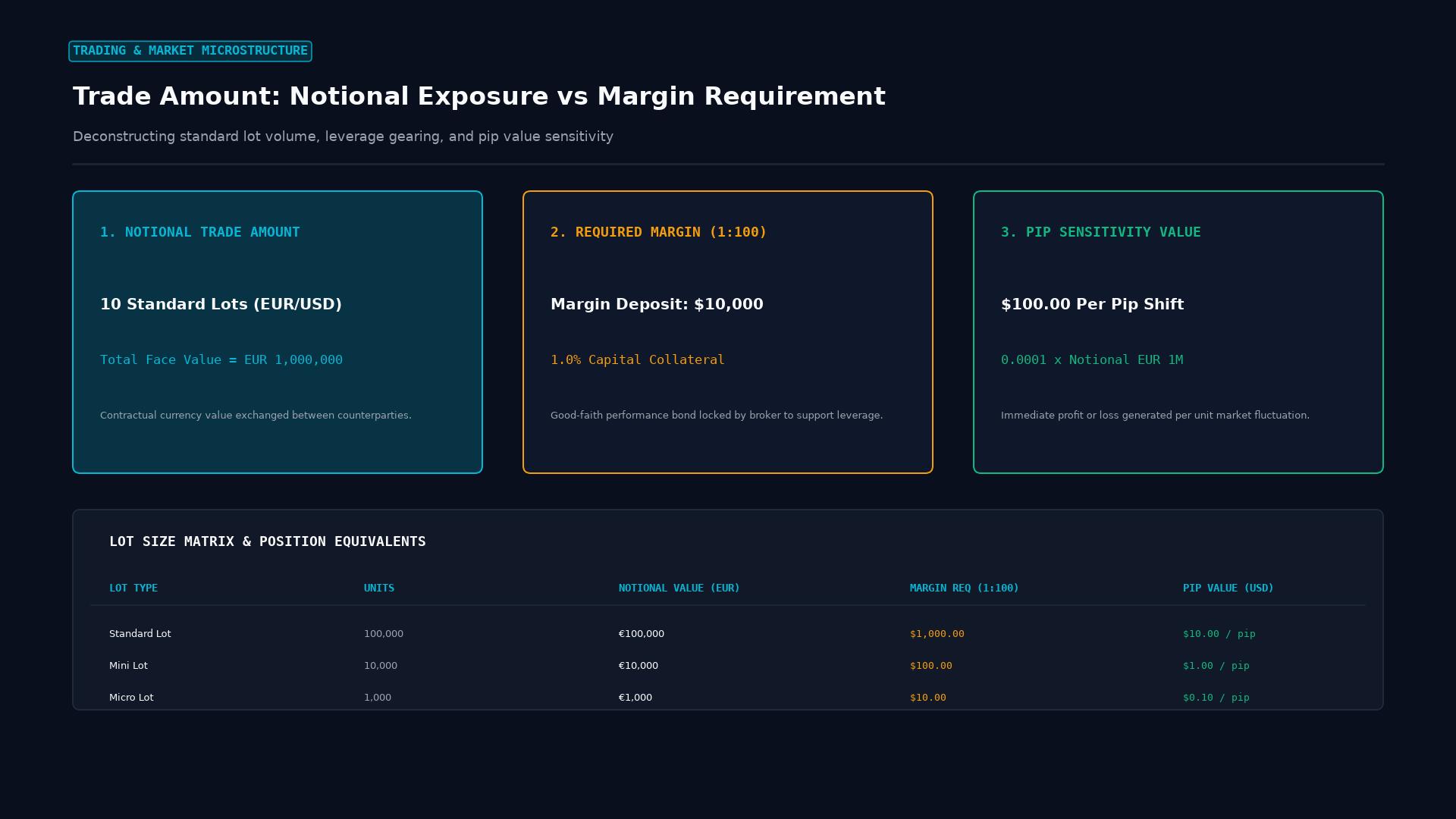 Figure: Deconstructing trade sizing: standard lot notional volume ($1,000,000), broker performance bond margin requirements (1:100 leverage), and pip value sensitivity.
Notional Amount in Derivatives Trading
In over-the-counter derivatives (including interest rate swaps, credit default swaps, and foreign exchange forwards), the notional amount serves as the mathematical base upon which contractual payments are derived:
$$\text{Cash Flow Obligation} = \text{Notional Amount} \times (\text{Reference Rate} \pm \text{Spread}) \times \left( \frac{\text{Day Count Convention}}{360 \text{ or } 365} \right)$$
Because counterparties exchange only net interest rate differentials rather than the underlying notional capital, the notional amount can vastly exceed the actual capital at risk. For example, the global OTC derivatives market reports over $600 trillion in gross notional amount, while the actual gross market value (the replacement cost of active contracts) typically represents less than $20 trillion.
Trading Amount Conventions in Foreign Exchange (Forex)
In retail and institutional foreign exchange markets, order size is standardized into lots, which dictate the specific currency amount transacted in the base currency:
| FX Lot Classification | Base Currency Amount | Units Transacted | Pip Value (EUR/USD Benchmark) | Minimum Capital Buffer |
|---|---|---|---|---|
| Standard Lot | 100,000 units | 1.00 Lot | $10.00 per pip | $2,000 – $5,000 |
| Mini Lot | 10,000 units | 0.10 Lot | $1.00 per pip | $200 – $500 |
| Micro Lot | 1,000 units | 0.01 Lot | $0.10 per pip | $20 – $50 |
| Nano Lot | 100 units | 0.001 Lot | $0.01 per pip | $5 – $10 |
Calculating Pip Value Based on Trade Amount
For currency pairs where the US dollar is the quote currency (e.g., EUR/USD or GBP/USD), the pip value is calculated directly:
$$\text{Pip Value} = \text{Trade Amount} \times 0.0001$$
For a standard lot transaction ($100,000\text{ units} \times 0.0001 = $10.00\text{ per pip}$). If the transaction size is entered as an irregular amount (e.g., $345,000 base units), every one-pip price movement equals exactly $$34.50$.
Position Sizing: Calculating the Optimal Trade Amount
Professional prop traders and quantitative algorithms never determine position amount arbitrarily. Position size is calculated using rigorous fixed-fractional risk models to ensure no single trade imperils portfolio solvency:
$$\text{Position Amount (Units)} = \frac{\text{Account Capital} \times \text{Risk Percentage}}{\text{Absolute Risk per Unit } (|P_{\text{entry}} - P_{\text{stop}}|)}$$
                   ALGORITHMIC POSITION SIZING CYCLE
+-----------------------------------------------------------------------+
| Account Equity: $250,000                                              |
| Maximum Risk per Trade: 1.0% ($2,500 Risk Capital)                    |
+-----------------------------------------------------------------------+
                                   │
                                   ▼
+-----------------------------------------------------------------------+
| EUR/USD Long Entry: 1.0850                                            |
| Stop Loss Level:    1.0800 (50 Pips Distance = $0.0050 per unit)      |
+-----------------------------------------------------------------------+
                                   │
                                   ▼
+-----------------------------------------------------------------------+
| Calculated Trade Amount: $2,500 / $0.0050 = 500,000 Base Currency    |
| Order Routing: Send Limit Order for exactly 5.0 Standard Lots         |
+-----------------------------------------------------------------------+
Gross vs. Net Settlement Amounts: Continuous Linked Settlement (CLS)
In global banking operations, multi-billion-dollar foreign exchange transactions carry significant settlement risk (historically known as Herstatt risk, which is the risk that one party delivers currency while the counterparty defaults before delivering the reciprocal leg).
To mitigate settlement exposure, the banking industry established the Continuous Linked Settlement (CLS) bank:
- Instead of settling trades on a gross bilateral basis (wiring billions back and forth), CLS operates a payment-versus-payment (PvP) settlement engine.
- CLS consolidates millions of daily transactions across 18 major global currencies, calculating the net settlement amount owed by each participating institution.
- Multilateral netting reduces the gross transaction amount by more than $96%$, meaning an institution with $10 billion in gross daily currency turnover might settle a net cash amount of just $350 million at the end of the day.
Frequently Asked Questions
What is the difference between face amount and market amount on a bond?
The face amount (or par value) is the nominal value printed on the debt instrument (typically $1,000 per bond), which the issuer promises to repay at maturity and upon which periodic coupon interest is computed. The market amount is the current price an investor must pay to acquire that bond on the secondary market, which fluctuates above or below face value based on prevailing benchmark interest rates and issuer credit spreads.
What is a minimum trade amount in institutional fixed income?
In institutional wholesale bond markets, corporate and sovereign debt is traded in standardized minimum institutional lot sizes. A typical institutional bond minimum order amount is $100,000 or $250,000 in par value, with secondary increments of $1,000. Retail investors unable to meet these large amount thresholds access fixed-income markets through diversified bond ETFs or mutual funds.
What does “notional principal amount” signify in a credit default swap (CDS)?
In a Credit Default Swap, the notional principal amount specifies the exact par value of the reference entity’s debt that is being insured. If the reference corporate issuer defaults, the protection seller must pay the protection buyer the recovery shortfall based directly on this notional amount.
Ready to trade forex?
Open a free demo account with a regulated broker. Practice with virtual funds before risking real money.