Analyst
An analyst is a financial professional who evaluates securities, corporate earnings, and macroeconomic data, producing research reports, valuation models, and investment ratings for buy-side funds or sell-side brokerages.
What Is a Financial Analyst?
A financial analyst is an investment professional responsible for examining financial data, corporate disclosures, macroeconomic indicators, and market trends to support capital allocation decisions. Analysts construct mathematical valuation models, conduct primary market due diligence, forecast corporate earnings, and issue investment recommendations (such as Buy, Hold, or Sell ratings) along with 12-month target prices.
In global capital markets, analysts are structurally divided into two distinct institutional spheres: Sell-Side Analysts, who produce published research for commercial distribution, and Buy-Side Analysts, who conduct proprietary, confidential research to guide direct portfolio investments for asset management institutions.
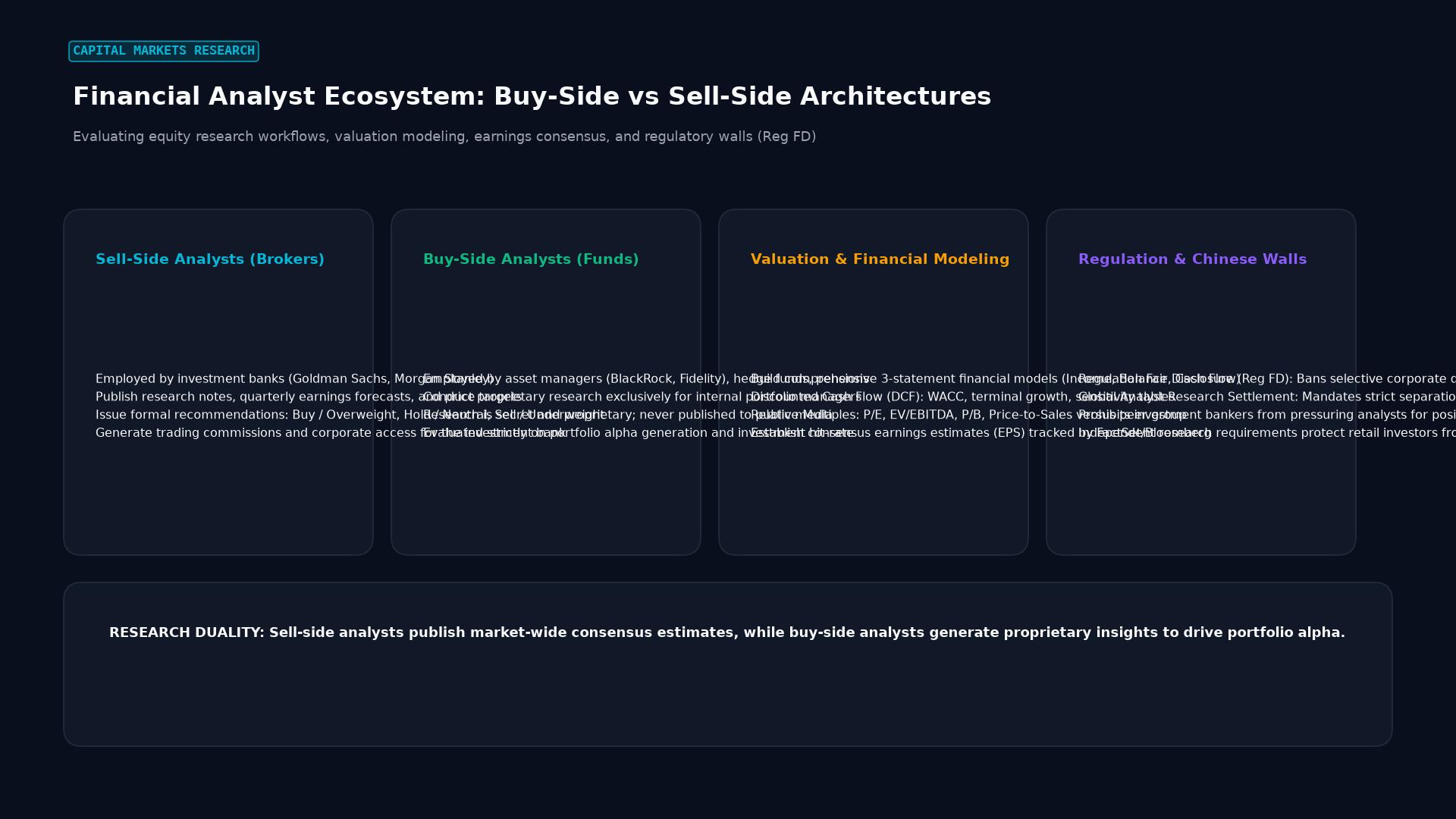 Figure: Evaluating equity research workflows, valuation modeling, earnings consensus, and regulatory walls (Reg FD)
Sell-Side vs. Buy-Side Analysts: Structural Comparison
Understanding the structural divergence between sell-side and buy-side analysts is essential for interpreting Wall Street ratings:
| Operational Dimension | Sell-Side Analyst | Buy-Side Analyst |
|---|---|---|
| Employer Type | Investment banks, commercial brokerages (Goldman Sachs, Morgan Stanley) | Asset managers, hedge funds, sovereign wealth funds (BlackRock, Fidelity) |
| Target Audience | External institutional clients, wealth managers, financial press | Internal portfolio managers, investment committees |
| Research Output | Publicly published equity research notes, Initiation reports | Internal investment memos, DCF models, proprietary conviction pitches |
| Compensation Driver | Research footprint, corporate access hosting, trading flow generated | Fund performance, portfolio returns, realized alpha generated |
| Licensing Requirements | FINRA Series 7, 63, 86, and 87 (Research Analyst) | CFA charter preferred; internal compliance registration |
| Information Policy | Strict public distribution under SEC Regulation Fair Disclosure (Reg FD) | Proprietary and highly confidential; zero public dissemination |
The Role of Sell-Side Consensus Estimates
Sell-side equity analysts publish quarterly financial forecast models detailing expected corporate revenue, gross margins, EBITDA, and Earnings Per Share (EPS).
Financial data providers (such as Bloomberg, FactSet, and Refinitiv) aggregate these individual estimates into the Wall Street Consensus:
                 THE QUARTERLY EARNINGS CONSENSUS CYCLE
+-----------------------------------------------------------------------+
| 30 Days Prior: Analysts update forward models; Consensus EPS is set   |
+-----------------------------------------------------------------------+
                                   │
                                   ▼
+-----------------------------------------------------------------------+
| Earnings Day: Corporation reports actual Q3 Financial Results         |
+-----------------------------------------------------------------------+
                                   │
          +────────────────────────┴────────────────────────+
          │                                                 │
          ▼                                                 ▼
+-----------------------------------+ +---------------------------------+
| EPS Beats Consensus by $0.15      | | EPS Misses Consensus by $0.08   |
| - Algorithmic buying triggered    | | - Liquidity liquidation hit     |
| - Forward guidance raised         | | - Analyst downgrades follow     |
+-----------------------------------+ +---------------------------------+
Key Consensus Dynamics
- Earnings Surprise: The percentage divergence between actual reported EPS and consensus estimates. Even if a corporation grows profits by $20%$, missing consensus expectations by two cents can trigger immediate share price declines.
- Whisper Numbers: Unofficial, unpublished earnings expectations whispered among institutional buy-side desks that often reflect higher hurdles than published sell-side consensus figures.
- Revision Momentum: Institutional quantitative models track the direction of analyst forecast revisions. Upward estimate revisions across multiple independent analysts serve as a statistically robust predictor of future equity outperformance.
Regulatory Safeguards and Conflict of Interest Controls
Historically, sell-side equity analysts faced severe conflicts of interest. Investment banks pressured research analysts to publish overly optimistic “Strong Buy” ratings on companies to win lucrative investment banking underwriting fees and IPO mandates.
To address these abuses, regulators enacted landmark reforms:
- The 2003 Global Settlement: A historic $1.4 billion enforcement settlement between the SEC, New York Attorney General Eliot Spitzer, and ten major investment banks. It mandated the complete institutional separation (known as the Chinese Wall) between investment banking divisions and equity research departments.
- FINRA Rule 2241 (Research Analysts): Prohibits investment banking personnel from supervising research analysts, reviewing draft research reports prior to publication, or tying analyst compensation to specific investment banking transactions.
- SEC Regulation Fair Disclosure (Reg FD): Enacted in 2000, Reg FD mandates that public corporations cannot selectively disclose material non-public information to favored Wall Street analysts before releasing it to the general public.
Credit, Macro, and Technical Analysts
While equity research analysts dominate financial media, other specialized analyst roles are critical to institutional markets:
- Credit Analysts: Evaluate the balance sheet solvency, debt covenants, and cash flow stability of corporate and sovereign bond issuers, assigning internal credit ratings to determine default probabilities.
- Macro Analysts (Macro Strategists): Forecast central bank interest rate trajectories, currency exchange rates, fiscal deficits, and geopolitical risk factors, directing top-down asset allocation for multi-asset funds.
- Quantitative Research Analysts (Quants): Mathematical modelers who write algorithmic trading code, identify statistical arbitrage opportunities, and construct systematic factor risk models using high-frequency market tick data.
Frequently Asked Questions
What certifications and licenses do financial analysts hold?
Professional financial analysts commonly hold the Chartered Financial Analyst (CFA) charter, widely recognized as the premier global designation in portfolio management and investment analysis. In the United States, sell-side research analysts must also pass FINRA Series 86 and Series 87 regulatory examinations to publish research reports.
Why do sell-side analysts rarely issue “Sell” ratings?
Sell ratings historically account for less than $10%$ of all published analyst ratings. Sell-side firms avoid aggressive sell ratings because corporate management teams may retaliate by restricting analyst access to executive briefings, earnings calls, and investor conferences, damaging the brokerage’s institutional corporate access business.
How do macroeconomic currency analysts forecast exchange rates?
Foreign exchange analysts evaluate monetary policy rate differentials between central banks, real bond yield spreads, inflation expectations, and balance-of-payments capital flows. They build econometric models to project cross-border capital reallocation and currency appreciation or depreciation over 3, 6, and 12-month horizons.
Ready to trade forex?
Open a free demo account with a regulated broker. Practice with virtual funds before risking real money.