Andorran Franc
The Andorran Franc (ADF) was a historical dual currency unit utilized in the Principality of Andorra alongside the Spanish peseta until both were permanently replaced by the euro.
What Was the Andorran Franc (ADF)?
The Andorran Franc (ISO 4217 legacy currency code: ADF) was one of the two de facto official currencies circulating in the Principality of Andorra prior to the introduction of the euro. Situated in the Pyrenees mountains between France and Spain, Andorra operated for centuries without an independent central bank or sovereign domestic fiat paper currency.
Instead, the principality functioned under a dual-currency monetary regime where the French Franc (FRF) and the Spanish Peseta (ESP) served as co-official legal tender throughout the microstate. The term Andorran Franc was used primarily in administrative contracts, international postal rates, and commercial bookkeeping to denote French franc cash transactions executed within the principality.
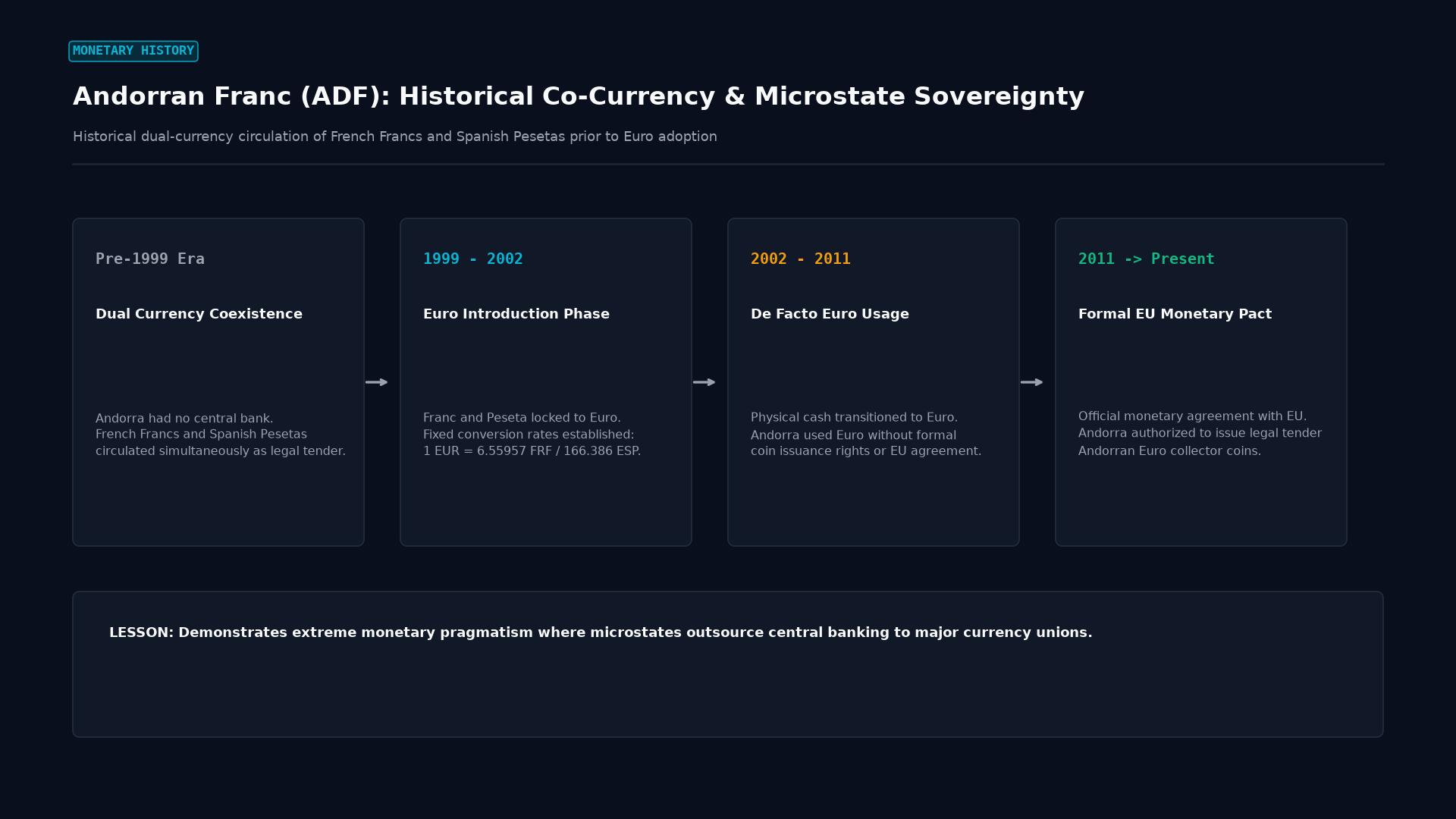 Figure: Historical dual-currency circulation: French Francs and Spanish Pesetas circulating simultaneously prior to official Eurozone monetary agreements.
Monetary Architecture: The Dual-Currency System
Unlike larger European sovereign nations that issued banknotes through domestic central banks, Andorra’s monetary architecture was dictated by its historic geopolitical co-principality status:
- The Co-Princes: Executive sovereignty was shared between the French Head of State (the President of France) and the Spanish Bishop of Urgell.
- De Facto Circulating Tender: Because of this dual constitutional bond, French francs and Spanish pesetas circulated freely across retail shops, ski resorts, and private commercial banking institutions.
- Diner Commemorative Issues: While Andorra minted occasional commemorative coins known as the diner (divided into 100 cèntims) for collectors and national ceremonies, the diner was never a circulating transaction currency and had no legal tender status for general commerce.
Commercial enterprises maintained dual-column accounting ledgers, pricing retail goods and services in both French francs and Spanish pesetas. Bank accounts in Andorra’s discreet private banking sector were held natively in FRF, ESP, or US dollars.
Transition to the Euro: Unilateral Adoption to Formal Treaty
When the euro launched on January 1, 1999, both of Andorra’s patron currencies (the French franc and the Spanish peseta) were irrevocably locked into the European single currency:
- 1 Euro = 6.55957 French Francs (FRF / ADF)
- 1 Euro = 166.386 Spanish Pesetas (ESP / ADP)
Between 1999 and 2002, Andorra used the euro for scriptural accounting and interbank wire transfers. On January 1, 2002, physical euro banknotes and coins were introduced, entirely replacing physical French francs and Spanish pesetas.
                 ANDORRA MONETARY SOVEREIGNTY TIMELINE
1993:  Andorra enacts modern constitution, establishing sovereign foreign policy.
1999:  Euro created; ADF locked at 6.55957 FRF per EUR for interbank transfers.
2002:  Physical euro banknotes and coins replace dual franc/peseta cash in circulation.
2003:  Andorra formally requests a monetary agreement with the European Union.
2011:  Historic EU-Andorra Monetary Agreement signed (in force April 2012).
2014:  Andorra strikes its first sovereign euro circulation coins with national motifs.
The 2011 EU Monetary Agreement
Initially, Andorra adopted the euro unilaterally, meaning it used the currency without a formal agreement with the European Central Bank (ECB) or the European Union. Under this arrangement, Andorra could not mint its own euro coins or access Eurosystem central bank liquidity facilities.
On June 30, 2011, Andorra signed a formal Monetary Agreement with the European Union:
- The euro became the official legal tender of Andorra.
- The principality agreed to transpose European financial regulations, anti-money laundering (AML) directives, and banking supervision standards into domestic law.
- In return, Andorra was granted the sovereign right to mint a predetermined annual quota of Andorran euro coins featuring national iconography (such as the Casa de la Vall and the Church of Santa Coloma), which entered circulation in 2014.
Banking Transformation: From Secrecy to Regulatory Integration
The demise of the Andorran franc and peseta coincided with a comprehensive transformation of the Andorran financial sector:
| Historical Era (ADF / ADP) | Modern Era (EUR / AFA) |
|---|---|
| Strict Bank Secrecy | Automatic Exchange of Information (AEOI / CRS) |
| Unregulated Parallel Currencies | Oversight by Andorran Financial Authority (AFA) |
| Cash-Based Ski & Duty-Free Tourism | Fully Integrated SEPA Digital Banking Infrastructure |
| Tax-Haven Haven Status (Pre-2010) | OECD Whitelist; Value Added Tax (IGI) and Corporate Tax |
Historical wealth management in Andorra relied on physical cash deposits in French francs, taking advantage of strict domestic bank secrecy. Following pressure from the OECD, the G20, and the European Union, Andorra abolished strict bank secrecy, introduced domestic income and corporate taxes, and joined the Single Euro Payments Area (SEPA).
Frequently Asked Questions
Did the Andorran Franc ever have distinct paper banknotes?
No. The Principality of Andorra never printed circulating paper banknotes for the Andorran franc. Commercial cash transactions used standard Bank of France banknotes, which circulated at a strictly maintained 1:1 parity with the administrative ADF unit.
Can old Andorran Francs or French Francs still be exchanged for Euros?
No. The Banque de France established a final deadline of February 17, 2012, for redeeming French franc banknotes into euros. After that date, French francs and legacy ADF cash ceased to have any redemption value at central banks and are now traded strictly as numismatic collectibles.
What is the currency of Andorra today?
The sole official currency of Andorra is the euro (EUR). Andorra issues its own distinct euro coins, which circulate interchangeably alongside euro coins issued by other eurozone member nations across the entire European Union.
Ready to trade forex?
Open a free demo account with a regulated broker. Practice with virtual funds before risking real money.