Andorran Peseta
The Andorran Peseta (ADP) was the primary historical circulating currency unit in Andorra, pegged at 1:1 parity with the Spanish peseta until the adoption of the euro.
What Was the Andorran Peseta (ADP)?
The Andorran Peseta (ISO 4217 legacy currency code: ADP) was the dominant de facto monetary unit utilized in the Principality of Andorra prior to the advent of the euro. Although the French Franc (ADF) was co-official due to Andorra’s historic dual constitutional sovereignty between France and the Bishop of Urgell in Spain, the Spanish peseta served as the primary everyday currency for domestic retail trade, banking deposits, and government budgeting.
Andorra did not operate an independent central bank to issue legal tender paper banknotes. Instead, standard Bank of Spain (Banco de España) banknotes circulated within Andorra at a fixed 1:1 exchange parity with the nominal Andorran peseta. When Spain entered the European Economic and Monetary Union, the Andorran peseta was permanently replaced by the euro at the official conversion rate of 1 EUR = 166.386 ESP / ADP.
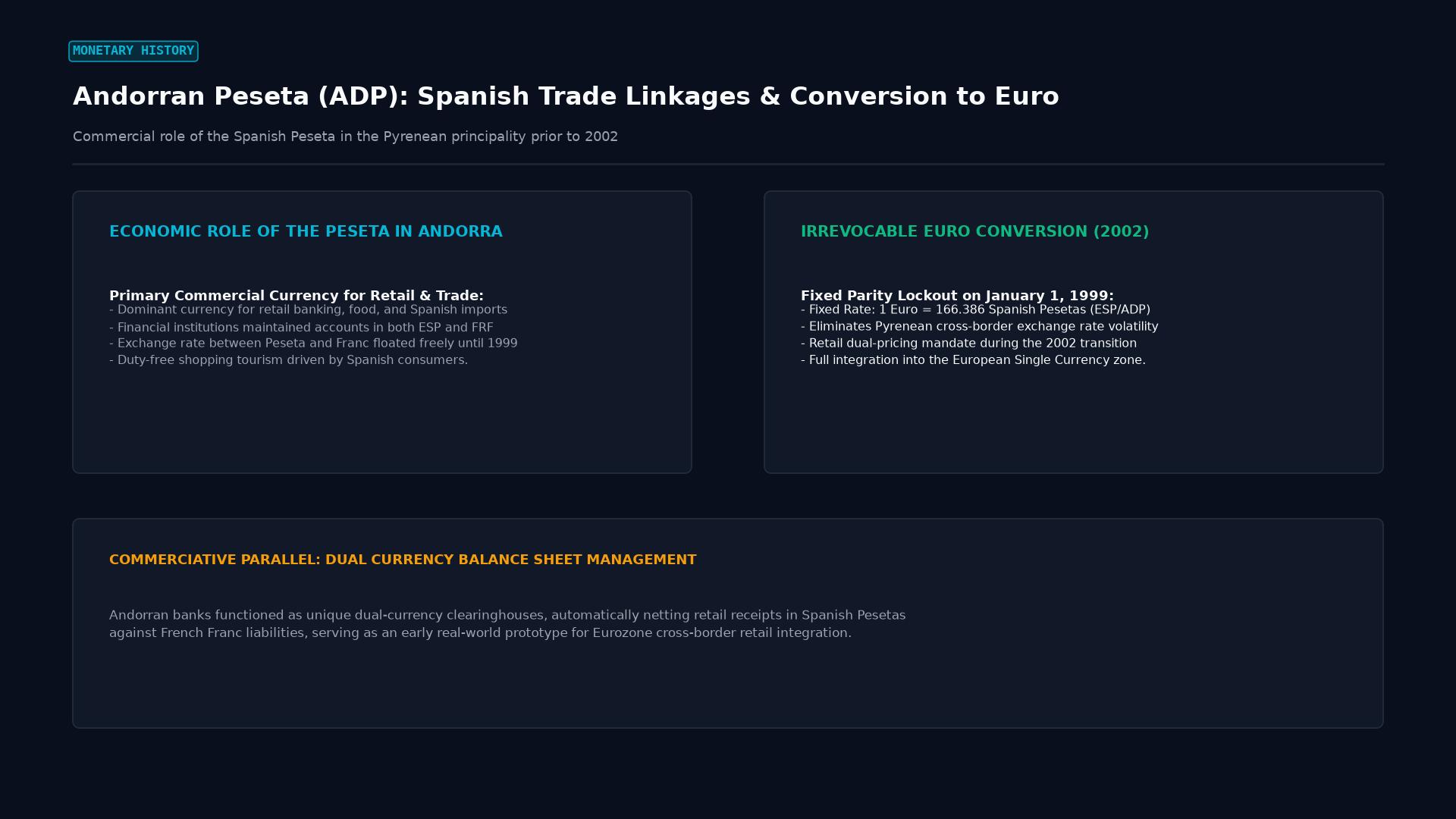 Figure: Microstate commercial currency integration: Spanish Peseta dominance in Pyrenean commerce and final irrevocable Euro conversion at 166.386 ESP.
Economic Role in the Andorran Microstate
Throughout the 20th century, the Andorran peseta played a far larger domestic commercial role than the Andorran franc:
- Trade Geography: Andorra shares an extensive border with Catalonia, Spain. The majority of food, fuel, construction materials, and retail consumer goods imported into the microstate originated in Spain, making the peseta the natural settlement currency for local merchants.
- Budgetary Base: The Consell General (Andorran parliament) denominated public budgets, customs duties, and official legal judgments primarily in pesetas, treating French francs as secondary currency reserves.
- Retail Quotations: Duty-free department stores in Andorra la Vella and Escaldes-Engordany displayed prices primarily in Spanish pesetas, with French francs calculated at fluctuating interbank spot cross-rates until the fixed euro peg stabilized exchange rates in 1999.
Banking Architecture and Offshore Growth
During the circulation of the ADP, Andorra developed a prominent international private wealth management industry. Five major domestic banking institutions (including Andbank, MoraBanc, and Crèdit Andorrà) expanded by managing non-resident deposits from Spain and across Europe.
Key characteristics of the Andorran banking sector during the peseta era included:
- Zero Capital Controls: Complete freedom of capital movement with Spain and international markets.
- Strict Numbered Accounts: Strong statutory secrecy laws attracted substantial savings from Spanish savers during eras of domestic political or fiscal instability in Spain.
- Fiduciary Investments: Banks accepted ADP deposits and deployed capital into European sovereign bonds, gold, and international equities.
                    ANDORRA BANKING EVOLUTION
     Peseta Era (1950–1999)                  Modern Euro Era (2012–Present)
+-------------------------------+       +-------------------------------+
| - Unregulated Private Wealth  |       | - AFA Banking Supervision     |
| - Numbered Bank Accounts      | ====> | - OECD Common Reporting (CRS) |
| - Zero Domestic Income Tax    |       | - SEPA Payment Integration    |
| - Physical Cash Deposits (ADP)|       | - Comprehensive Tax Treaties  |
+-------------------------------+       +-------------------------------+
Replacement by the Euro and Numismatic Heritage
On January 1, 1999, the exchange value of the Andorran peseta was fixed permanently against the euro alongside the Spanish peseta:
$$\text{Euro Value} = \frac{\text{Value in ADP}}{166.386}$$
Dual-pricing requirements were enforced in Andorra throughout 2001, requiring merchants to display prices in both pesetas and euros. Physical cash changeover occurred during the first two months of 2002:
| Currency Metric | Historical Andorran Peseta (ADP) | Modern Replacement (EUR) |
|---|---|---|
| ISO Code | ADP (Legacy numeric: 020) | EUR (Numeric: 978) |
| Central Bank Issuer | De facto Bank of Spain | European Central Bank (ECB) |
| Physical Banknotes | Standard Spanish Pesetas | Standard Euro Banknotes |
| Sovereign Coins | Occasional non-circulating Diners | Official Andorran Euro Coins (Since 2014) |
| Final Redenomination Date | January 1, 2002 (Cash phase-out) | March 1, 2002 (Full legal tender) |
Redemptions and Collectors
Unlike the French central bank, which stopped redeeming francs in 2012, the Bank of Spain maintained an open redemption window for legacy Spanish peseta banknotes and coins until June 30, 2021. Andorran residents holding legacy pesetas were able to redeem them directly at Bank of Spain branches in Barcelona or Madrid for euro credit up until that deadline.
Frequently Asked Questions
Why did Andorra not print its own sovereign peseta banknotes?
Andorra operated under a unique medieval feudal co-principality arrangement without an independent monetary authority. Establishing a domestic mint and central bank was deemed unnecessary and economically inefficient for a population of fewer than 70,000 residents, particularly when the Spanish peseta provided immediate liquidity and seamless trade integration with neighboring Spain.
Did Andorra ever issue legal tender coins denominated in pesetas?
No. Circulating coinage was entirely supplied by Spain. The Andorran government issued limited commemorative collector coins denominated in diners, but these were never used as circulating legal tender for general commerce.
How are Andorran financial institutions regulated today?
Today, all financial institutions operating in Andorra are regulated by the Andorran Financial Authority (Autoritat Financera Andorrana, AFA). The AFA oversees systemic solvency, anti-money laundering enforcement, and alignment with European Central Bank supervisory standards under the 2011 EU-Andorra Monetary Agreement.
Ready to trade forex?
Open a free demo account with a regulated broker. Practice with virtual funds before risking real money.