ANG
ANG is the ISO 4217 currency code for the Netherlands Antillean guilder (also called the florin), the official currency of Curaçao and Sint Maarten, pegged to the US dollar at 1.79.
What Is the Netherlands Antillean Guilder (ANG)?
ANG is the three-letter ISO 4217 currency code for the Netherlands Antillean guilder (locally referred to as the florin or abbreviated as NAƒ). It serves as the official legal tender for two autonomous Caribbean constituent countries within the Kingdom of the Netherlands: Curaçao and Sint Maarten.
The guilder is subdivided into 100 cents and is managed by the Central Bank of Curaçao and Sint Maarten (Centrale Bank van Curaçao en Sint Maarten, CBCS), the oldest surviving central bank in the Americas, established in 1828. Since 1971, the ANG has maintained one of the longest-running fixed currency pegs in modern financial history, pegged directly to the US Dollar (USD) at an official rate of 1 USD = 1.79 ANG.
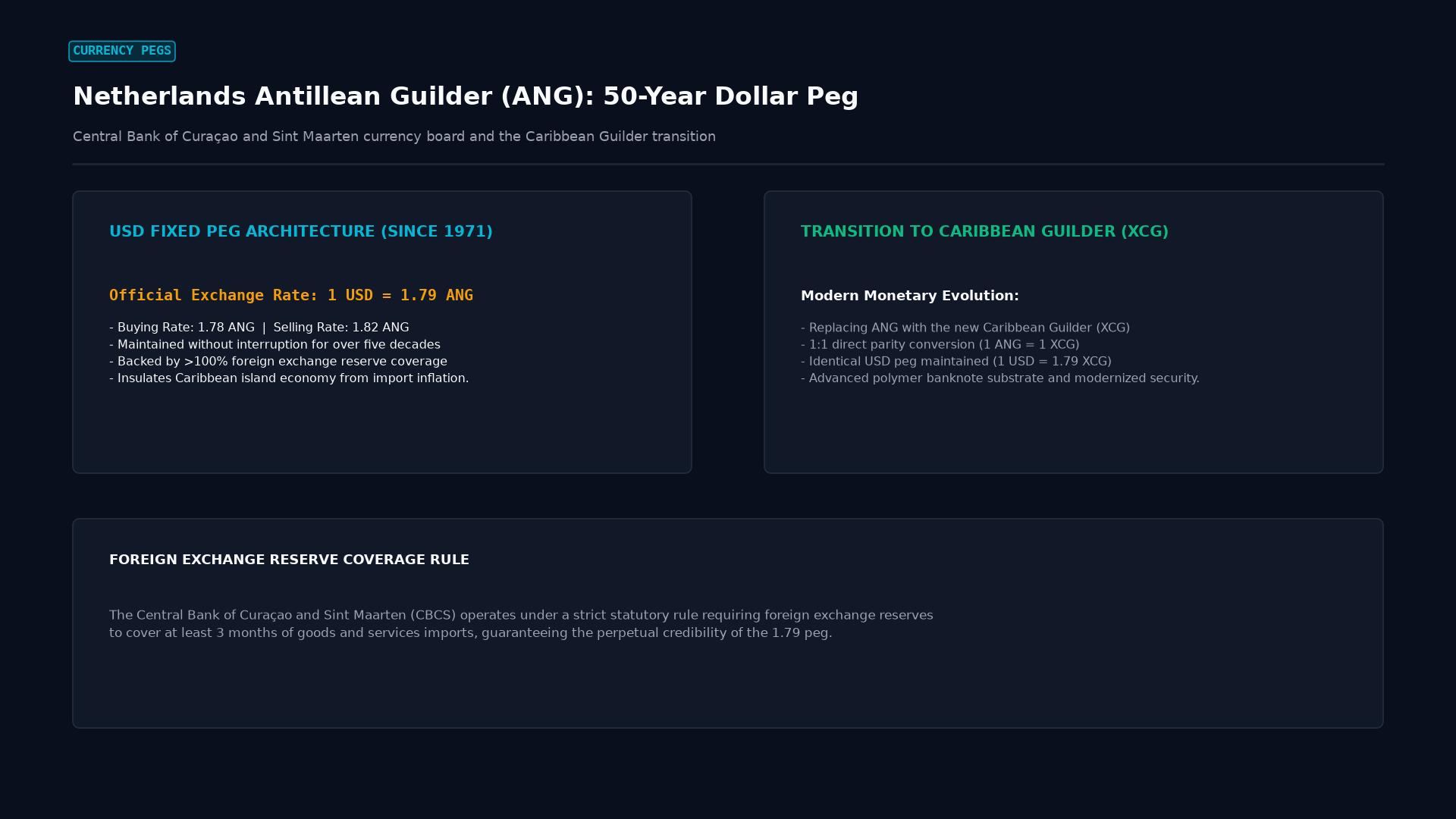 Figure: Currency board stability: 50-year fixed parity of 1.79 ANG per USD, foreign reserve coverage rules, and the Caribbean Guilder (XCG) transition.
Historical Context and Institutional Framework
The currency traces its origins to the 18th and 19th centuries during the Dutch colonial administration of the Caribbean. Following the German occupation of the Netherlands in May 1940, the colonial government severed the currency’s link to the Dutch guilder, establishing a dedicated peg to the US dollar to protect cross-border trade:
- 1940: Pegged to the US dollar at 1.88585 guilders per dollar.
- 1971: Following the collapse of the Bretton Woods gold standard and Smithsonian Agreement realignments, the peg was recalibrated to 1 USD = 1.79 ANG, where it remains anchored today.
- 2010 Dissolution of the Netherlands Antilles: When the Netherlands Antilles political entity was dissolved in October 2010, the islands followed divergent monetary paths:
- Bonaire, Sint Eustatius, and Saba (BES Islands): Became special municipalities of the Netherlands and fully dollarized, adopting the US dollar as legal tender on January 1, 2011.
- Curaçao and Sint Maarten: Formed an autonomous monetary union, retaining the ANG under the shared governance of the CBCS.
The FX Peg Mechanics: Buying vs. Selling Rates
To defend the fixed peg against speculative capital flows, the CBCS maintains a narrow exchange rate band for commercial bank transactions:
| Transaction Type | Commercial Bank Rate (USD/ANG) | Operational Flow |
|---|---|---|
| Official Central Parity | 1.7900 | Theoretical baseline reference rate |
| Commercial Bank Buying Rate | 1.7800 | Applied when customers sell USD to buy ANG |
| Commercial Bank Selling Rate | 1.8200 | Applied when customers buy USD using ANG |
| Foreign Exchange License Fee | 1.00% surcharge | Statutory tax levied on cross-border payments |
Due to the extreme stability of the peg and heavy tourist inflows from North America, the US dollar circulates as a parallel de facto currency throughout Curaçao and Sint Maarten. Retail merchants, hotels, and restaurants accept physical US dollar cash interchangeably with guilders, typically calculating transactions at an informal retail rate of 1.75 to 1.80 ANG per dollar.
Central Bank Reserve Requirements and Capital Controls
Maintaining an unbroken 50-year peg without sovereign debt default requires disciplined macroeconomic controls:
               CBCS RESERVE COVERAGE RATIO SAFETY BUFFER
Foreign Exchange Reserves ($)
    ^
    |  [================ Statutory 3-Month Import Reserve Floor ================]
    |
$1.5B +-------------------- ACTUAL CBCS FX RESERVES (4.5 - 6.0 Months) ----------+
    |
    |
$0.8B +-------------------- CRITICAL EMERGENCY INTERVENTION LEVEL ----------------+
    |
$0 +-----------------------------------------------------------------------------+- Import Cover Ratio: The CBCS is legally mandated to maintain official net foreign exchange reserves sufficient to cover at least three months of projected goods and services imports. Historically, reserves cover between 4.5 and 6 months of imports.
- Capital Account Restrictions: The central bank enforces foreign exchange licensing rules on significant capital outflows. Residents and domestic corporations wishing to invest substantial capital abroad must obtain an official FX license and pay a statutory 1.0% foreign exchange tax, curbing destabilizing capital flight.
The Caribbean Guilder (XCG) Transition
Following years of technical planning, the governments of Curaçao and Sint Maarten decided to replace the legacy Netherlands Antillean guilder with a modern successor currency: the Caribbean Guilder (ISO currency code: XCG).
Key parameters of the transition include:
- Preserved Peg: The Caribbean guilder retains the identical fixed exchange rate of 1 USD = 1.79 XCG.
- 1:1 Parity Exchange: Residents can exchange legacy ANG banknotes and coins for new XCG notes at a strict 1:1 ratio.
- Enhanced Security Features: Modern polymer and high-durability cotton substrates incorporating holographic foils, micro-lettering, and ultraviolet security elements to combat counterfeiting.
- Shared Monetary Union: Preserves the joint central banking institution of the CBCS.
Frequently Asked Questions
Can ANG be traded on retail Forex brokerage platforms?
No. Because the Netherlands Antillean guilder is pegged to the US dollar and protected by central bank capital controls, it is not listed as a tradable speculative pair on major retail CFD or interbank Forex platforms. Commercial conversions are handled through domestic banks in Curaçao and Sint Maarten.
What is the currency symbol for the Netherlands Antillean Guilder?
The traditional currency symbol is NAƒ (Netherlands Antilles Florin), while merchants also write Naf or ƒ. In international banking wire transfers (SWIFT MT103), it is identified strictly by the code ANG.
How does the Dutch government support the ANG currency peg?
While Curaçao and Sint Maarten are autonomous and manage their own central bank reserves, the Kingdom of the Netherlands provides systemic geopolitical stability. Under the Kingdom Charter, the Dutch state can provide financial liquidity backstops during extreme economic emergencies (such as hurricanes or pandemic shutdowns), reinforcing international confidence in the currency peg.
Ready to trade forex?
Open a free demo account with a regulated broker. Practice with virtual funds before risking real money.