Angel investor
An angel investor is a high-net-worth individual who provides seed or early-stage capital to startup enterprises, investing personal wealth in exchange for equity ownership or convertible debt.
What Is an Angel Investor?
An angel investor (also known as a business angel or private seed investor) is an accredited high-net-worth individual who provides financial backing to early-stage commercial ventures and entrepreneurial startups. Unlike institutional venture capital (VC) funds that manage pooled third-party capital from pension funds and endowments, angel investors deploy their own personal wealth.
Angel financing bridges the critical funding gap, often referred to as the “Valley of Death,” between initial friends-and-family bootstrapping and larger, institutional Series A rounds led by established venture firms. In addition to equity capital, experienced angel investors frequently contribute operational mentorship, executive recruitment advice, industry contacts, and corporate governance guidance.
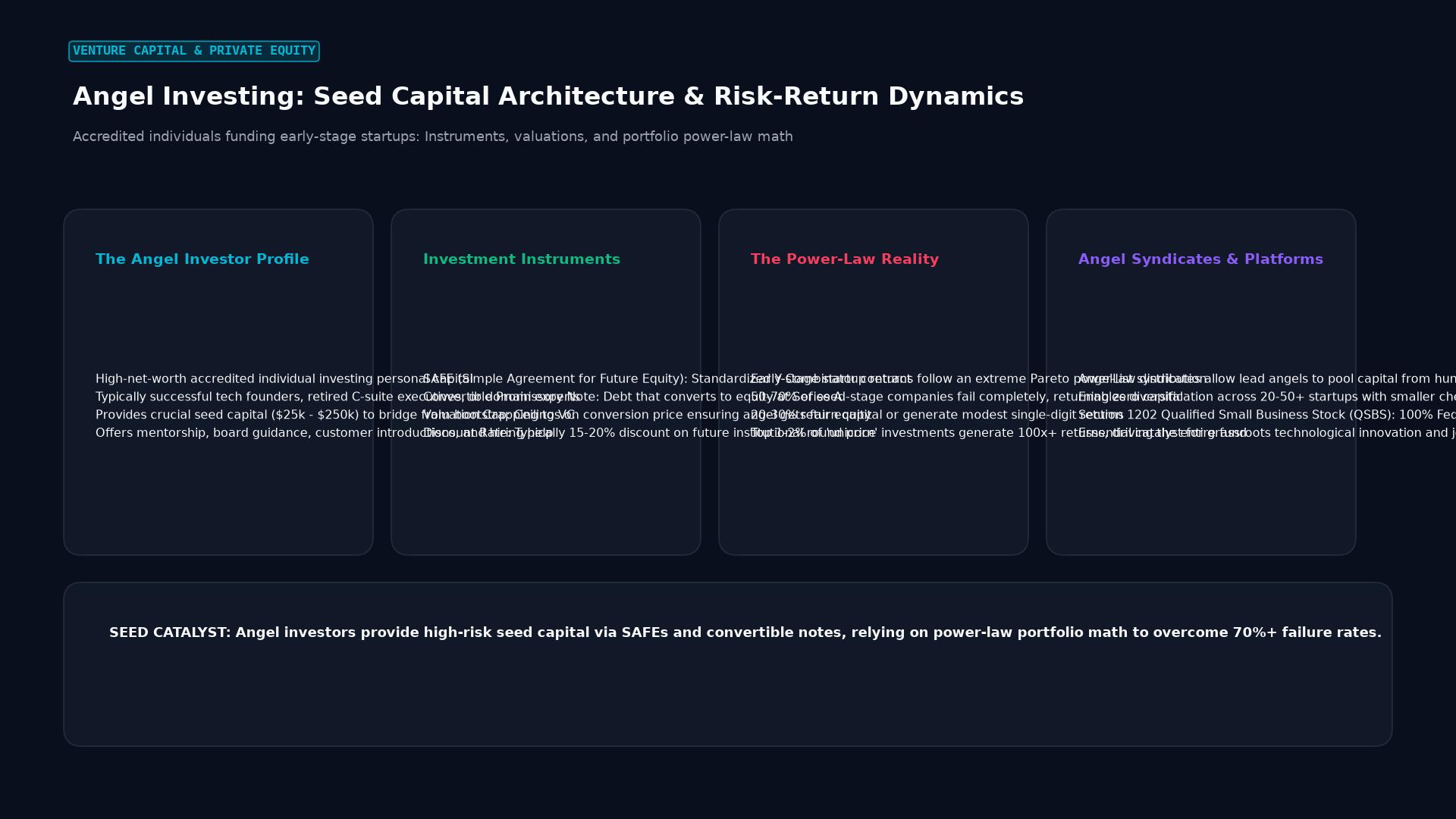 Figure: Accredited individuals funding early-stage startups: Instruments, valuations, and portfolio power-law math
Investment Instruments: SAFEs vs. Convertible Notes
Early-stage startups rarely possess the historical financial metrics required for traditional discounted cash flow valuation. To avoid contentious valuation disputes at the seed stage, angel investors typically structure their investments using convertible instruments:
1. Simple Agreement for Future Equity (SAFE)
Popularized by the accelerator Y Combinator, a SAFE is a legally binding contract that grants the investor the right to receive preferred equity shares in a future priced venture capital round.
- No Interest Accrual: Unlike debt, a SAFE carries no interest rate and no maturity date.
- Valuation Cap: Protects the angel by establishing the maximum effective valuation at which their investment will convert into shares during the Series A round: $$\text{Effective Conversion Price} = \frac{\text{Valuation Cap}}{\text{Fully Diluted Shares Outstanding}}$$
- Discount Rate: Provides a contractual discount (typically 15% to 20%) relative to the price paid by institutional Series A venture investors.
2. Convertible Promissory Notes
A debt instrument that automatically converts into equity upon the closing of a qualified financing round:
- Carries a stated annual interest rate (e.g., 5% to 8%), which accrues and is added to the principal balance at conversion.
- Includes a maturity date (typically 18 to 24 months), giving the investor legal leverage if the company fails to raise a subsequent round.
Comparative Matrix: Angel Investors vs. Venture Capitalists
| Feature | Angel Investors | Institutional Venture Capital (VC) |
|---|---|---|
| Capital Source | Personal private wealth | Pooled institutional funds (LPs, pensions) |
| Investment Stage | Pre-Seed and Seed | Series A, B, C, and Growth rounds |
| Typical Check Size | $10,000 to $100,000 (Individually) | $2,000,000 to $25,000,000+ |
| Due Diligence Period | Fast (1 to 3 weeks) | Rigorous (4 to 12 weeks) |
| Governance Role | Advisory; informal mentorship | Mandatory Board of Directors seat, protective vetoes |
| Fiduciary Duty | Accountable strictly to themselves | Fiduciary obligation to Limited Partners (LPs) |
Power Law Dynamics and Portfolio Construction
Angel investing is defined by extreme Power Law returns, where the vast majority of financial returns are generated by a tiny minority of outlier investments:
              ANGEL PORTFOLIO RETURN DISTRIBUTION (POWER LAW)
Portion of Portfolio (%)
    ^
65% +  [====================== TOTAL LOSS / BANKRUPTCY ======================]
    |
25% +  [========== CAPITAL RETURNED / MINIMAL GAIN (1x - 3x) ==========]
    |
10% +  [=== OUTLIERS / UNICORNS (20x - 100x+ GAINS) ===]
    +-------------------------------------------------------------------------+
    0                         Outlier Distribution
Empirical venture data indicates:
- Approximately 65% of seed-stage companies fail to return original invested capital.
- Roughly 25% return modest capital (breaking even or achieving 1x to 3x returns).
- Only 5% to 10% of investments achieve breakout success (generating 20x to 100x+ returns).
To survive this distribution, professional angel investors build diversified portfolios containing at least 20 to 50 startup holdings rather than concentrating capital into two or three favored companies.
Regulatory Framework: SEC Accreditation Rules
In the United States, federal securities laws regulate angel investing to protect retail savers from speculative illiquid losses. Under SEC Rule 501 of Regulation D, angel investors generally must qualify as Accredited Investors:
- Income Standard: Annual personal income exceeding $200,000 (or $300,000 combined with a spouse) in each of the two most recent years, with a reasonable expectation of reaching the same level in the current year.
- Net Worth Standard: Net worth exceeding $1,000,000 (individually or with a spouse), excluding the value of the primary residence.
- Professional Credentials: Holding active FINRA Series 7, Series 65, or Series 82 securities licenses in good standing.
Syndicates and Special Purpose Vehicles (SPVs)
Platforms like AngelList allow experienced “lead angels” to organize Special Purpose Vehicles (SPVs). An SPV aggregates capital from dozens of smaller accredited angels (each contributing $2,000 to $5,000) into a single legal entity on the startup’s cap table, providing small angels with access to premier deal flow.
Frequently Asked Questions
Can an angel investor lose more than their initial investment?
No. Startups are incorporated as limited liability entities (such as Delaware C-Corporations). An angel investor’s financial risk is strictly capped at the total capital contributed; they have no legal liability for the company’s debts or operational liabilities.
What is a “Super Angel”?
A Super Angel is a professional angel investor who operates with the speed and flexibility of an individual angel, but deploys substantial personal capital (writing $250,000 to $1,000,000+ checks per deal) or manages micro-venture funds full-time.
Why do startups prefer angel investors over bank loans?
Early-stage startups rarely generate the predictable cash flows or possess the physical tangible collateral required to qualify for commercial bank loans. Angel investors accept high risk of total loss in exchange for long-term equity upside without demanding monthly interest payments.
Ready to trade forex?
Open a free demo account with a regulated broker. Practice with virtual funds before risking real money.