Angel
An angel is an affluent private financier who injects personal equity capital into nascent business ventures, bearing high speculative risk in exchange for equity ownership and outsized venture returns.
What Is an Angel in Finance?
In venture capital and corporate finance, the term angel describes an affluent individual who commits private personal capital to fund early-stage, high-risk commercial enterprises. While commonly used as a shorthand for angel investor, the designation carries distinct historical and functional connotations across early-stage capital formation, distinguishing individual entrepreneurial benefactors from corporate or institutional investment entities.
Angels operate at the frontier of innovation finance, supplying risk capital when a business consists of little more than an unproven concept, a founding team, and an early prototype. Because traditional credit markets and commercial banks decline to underwrite uncollateralized startups, angels provide the vital seed liquidity that allows young enterprises to reach commercial viability.
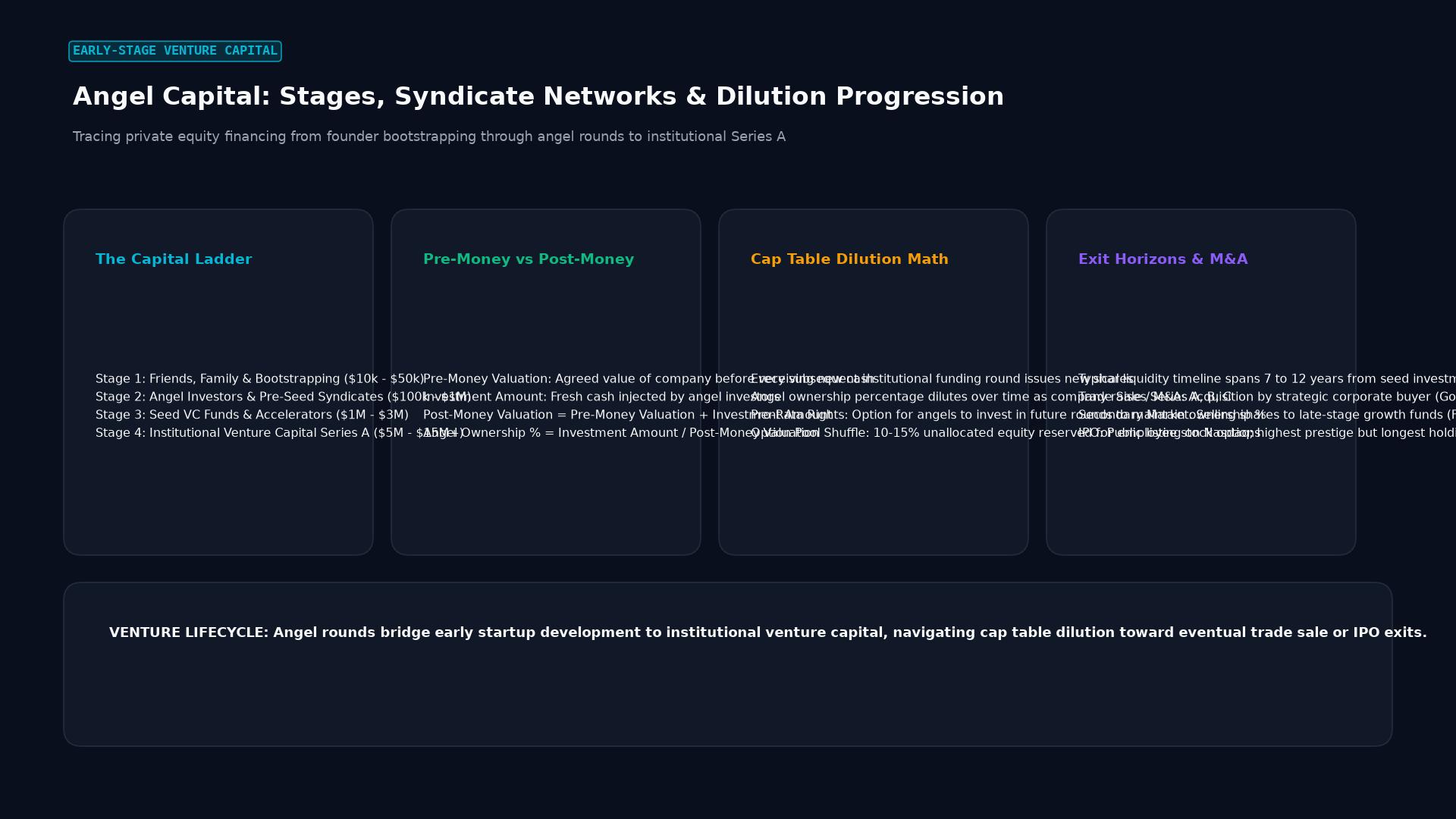 Figure: Tracing private equity financing from founder bootstrapping through angel rounds to institutional Series A
The Historical Origin: From Broadway to Silicon Valley
The moniker “angel” originated in the performing arts. In the late 19th and early 20th centuries, wealthy individuals who stepped in to rescue financially distressed Broadway theatrical productions were affectionately dubbed “angels.” If the theatrical production flopped, the backer lost their entire investment; if it became a smash hit, the return was immense.
In 1978, Professor William Wetzel of the University of New Hampshire applied the term to modern entrepreneurial finance in a landmark study analyzing informal risk capital in New England. Wetzel observed that wealthy individuals (often former founders and retired executives) were operating as informal business angels, providing seed equity to young high-growth companies that commercial banks refused to finance.
Operating Typologies of Business Angels
Not all angels operate with the same strategic objectives. The industry recognizes four distinct angel profiles:
| Angel Typology | Capital Capacity | Operational Involvement | Primary Motivation |
|---|---|---|---|
| Entrepreneurial Angel | High ($50k–$250k checks) | Heavy (Advisory, Board member) | Founder empathy; replicating past startup triumphs |
| Corporate Angel | Moderate ($25k–$50k checks) | Moderate (Industry introductions) | Commercial synergy; corporate executive diversification |
| Professional Angel | Moderate ($10k–$50k checks) | Specialized (Legal, accounting, IP) | Providing professional expertise alongside capital |
| Enthusiast / Passive | Low ($5k–$20k checks) | Negligible (Arm’s length) | Personal curiosity; passion for a specific product or cause |
Angel Groups and Syndicates
To overcome the informational disadvantages of investing individually, modern business angels frequently organize into Angel Networks or Angel Investment Groups:
                 ANGEL GROUP SCREENING & SYNDICATION FLOW
+-----------------------------------------------------------------------+
| 100+ Startup Pitches submitted annually to Angel Network Screening    |
+-----------------------------------------------------------------------+
                                   │
                                   ▼
+-----------------------------------------------------------------------+
| Selection Committee shortlists 4 to 6 finalists for Pitch Presentation|
+-----------------------------------------------------------------------+
                                   │
                                   ▼
+-----------------------------------------------------------------------+
| Collaborative Due Diligence: Legal, Technology, and Market Review     |
+-----------------------------------------------------------------------+
                                   │
                                   ▼
+-----------------------------------------------------------------------+
| Syndication: 20 Angels pool capital into a single SPV check ($500k)   |
+-----------------------------------------------------------------------+
Advantages of Angel Groups
- Shared Due Diligence: Members pool specialized technical expertise (e.g., a software engineer evaluates the code base, a patent attorney audits intellectual property claims, and a CFO inspects the unit economics).
- Cap Table Cleanliness: Rather than adding 20 individual names to the startup’s capitalization table, the group invests through a single entity, preserving a clean corporate structure for future Series A institutional rounds.
- Follow-On Reserve Power: Angel groups maintain collective capital reserves to participate in follow-on rounds, protecting their initial holdings from aggressive equity dilution.
Tax Incentives: Section 1202 Qualified Small Business Stock (QSBS)
To encourage affluent taxpayers to back speculative businesses, governments provide substantial tax incentives. In the United States, IRC Section 1202 provides the Qualified Small Business Stock (QSBS) tax exclusion:
- 100% Federal Capital Gains Exclusion: Eligible investors who purchase original-issue stock in a qualifying domestic C-corporation (gross assets under $50 million) and hold the shares for at least five years can exclude up to $10 million (or 10 times their investment basis) in capital gains from federal income tax.
- Section 1244 Ordinary Loss Treatment: If the startup fails, individual angel investors can write off up to $50,000 ($100,000 for married couples filing jointly) of their lost investment as an ordinary tax loss rather than a restricted capital loss, directly offsetting high-bracket ordinary income.
Frequently Asked Questions
What is the typical holding period for an angel investment?
Angel investments are completely illiquid, with typical holding periods lasting between 5 to 8 years before an exit event occurs via an initial public offering (IPO), strategic acquisition by a larger corporation, or secondary sale to a private equity firm.
What is the difference between an angel and a micro-VC?
An angel invests personal personal capital on a discretionary, deal-by-deal basis. A micro-VC is a formalized venture capital fund that raises institutional capital from third-party limited partners (LPs), charges management fees, and deploys capital according to a strict legal investment mandate.
What is pre-money vs. post-money valuation in angel deals?
The pre-money valuation is the agreed-upon value of the startup enterprise prior to receiving new capital. The post-money valuation equals the pre-money valuation plus the fresh cash injected by the angel ($\text{Post-Money} = \text{Pre-Money} + \text{Investment}$). The angel’s ownership percentage equals their investment divided by the post-money valuation.
Ready to trade forex?
Open a free demo account with a regulated broker. Practice with virtual funds before risking real money.