Angolan Kwanza
The Angolan Kwanza (AOA) is the legal tender currency of the Republic of Angola, issued and regulated by the National Bank of Angola and strongly linked to global crude oil export dynamics.
What Is the Angolan Kwanza (AOA)?
The Angolan Kwanza (ISO 4217 currency code: AOA) is the official fiat currency of the Republic of Angola, situated on the western coast of Southern Africa. Subdivided into 100 cêntimos and symbolized as Kz, the currency is issued, managed, and regulated by the National Bank of Angola (Banco Nacional de Angola, BNA).
As Africa’s second-largest crude oil producer behind Nigeria, Angola operates an economy where hydrocarbons generate more than 90% of export earnings and over 50% of government fiscal revenue. Consequently, the Angolan kwanza exhibits the classical structural properties of a petrocurrency: its exchange rate, domestic liquidity, and central bank foreign exchange reserves are tied directly to global crude oil price benchmarks like Brent.
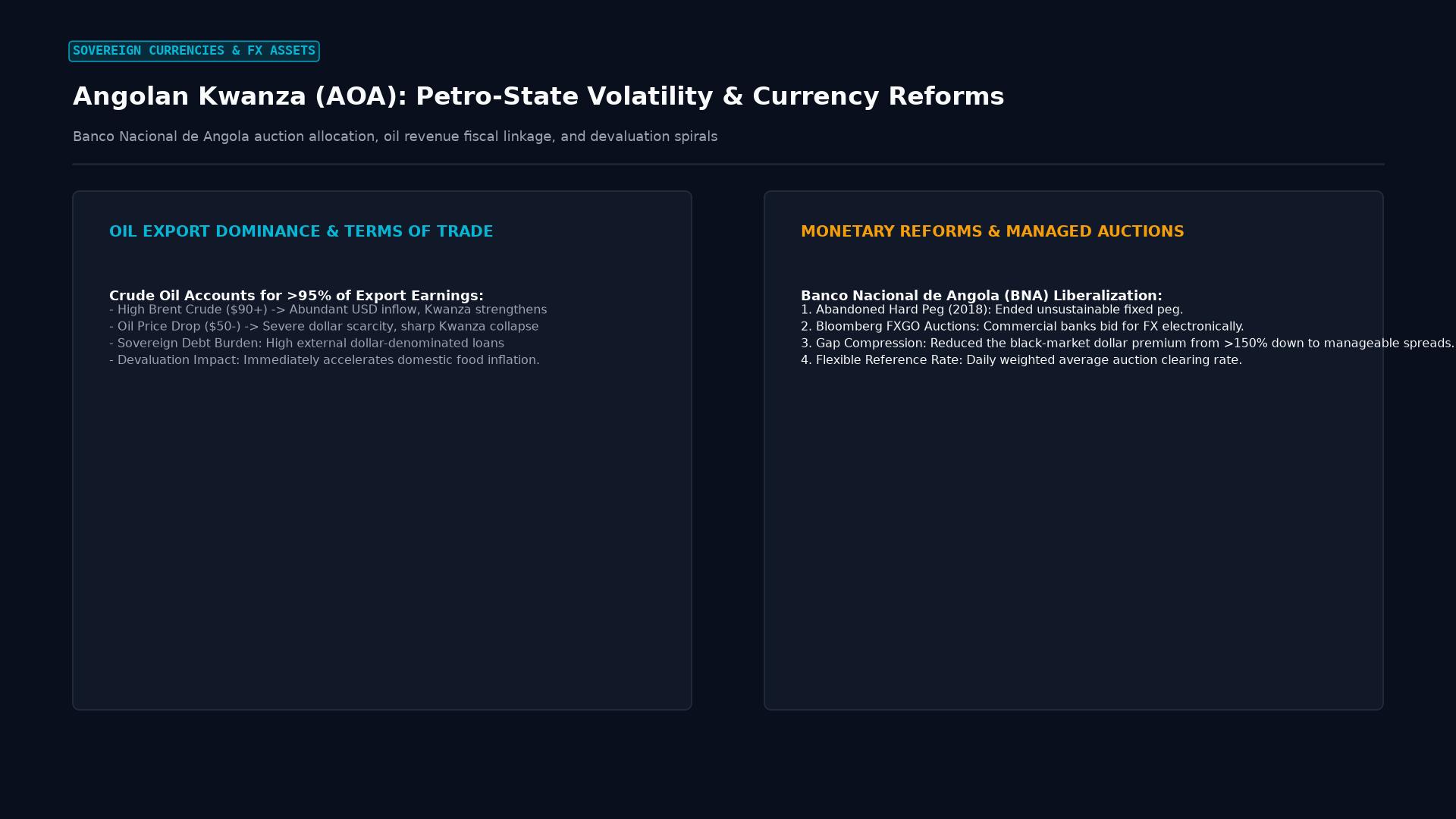 Figure: Petro-currency dynamics: Banco Nacional de Angola foreign exchange auctions, crude oil revenue linkage, and post-2018 currency liberalization.
Monetary History and Redenominations
Following independence from Portugal in 1975, Angola experienced protracted civil conflict and hyperinflation, forcing the government to replace its currency four times across three decades:
| Historical Era | Currency Name | ISO Code | Replacement Ratio | Primary Economic Context |
|---|---|---|---|---|
| 1977–1990 | First Kwanza | AOK | 1 AOK = 1 Angolan Escudo | Socialist central planning; strict price controls |
| 1990–1995 | Novo Kwanza | AON | 1 AON = 1 AOK | Confiscatory monetary reform; civil war escalation |
| 1995–1999 | Kwanza Reajustado | AOR | 1 AOR = 1,000 AON | Extreme hyperinflation; loss of public confidence |
| 1999–Present | Modern Kwanza | AOA | 1 AOA = 1,000,000 AOR | Post-war economic reconstruction; oil boom |
The cumulative redenomination factor was staggering: one modern kwanza (AOA) introduced in 1999 was mathematically equivalent to one billion first kwanzas from 1977.
Exchange Rate Regime: From Peg to Managed Float
Historically, the National Bank of Angola pegged the kwanza at an artificially strong official rate to keep the domestic cost of imported food and capital equipment low. However, this policy severely drained central bank foreign exchange reserves whenever global oil prices dropped.
                 BNA MONETARY REGIME LIBERALIZATION
+-----------------------------------------------------------------------+
| Pre-2018: Fixed / Narrowly Banded Peg to the US Dollar                |
| - Severe hard currency shortages; widespread dollar rationing         |
+-----------------------------------------------------------------------+
                                   │
                 2018 IMF Extended Fund Facility (EFF)
                                   ▼
+-----------------------------------------------------------------------+
| 2018–2020: Transition to a Managed Floating Regime                   |
| - Foreign currency auctions opened to commercial banks                |
| - Kwanza devalues by over 70% to match true market fundamentals       |
+-----------------------------------------------------------------------+
                                   │
                                   ▼
+-----------------------------------------------------------------------+
| Current Regime: Managed Float with Targeted Liquidity Interventions   |
| - BNA intervenes to smooth excessive oil-driven volatility            |
+-----------------------------------------------------------------------+
Under the reform program backed by the International Monetary Fund (IMF), the BNA dismantled the artificial peg in 2018, introducing competitive foreign exchange auctions and allowing commercial banks to negotiate bilateral FX trades.
While the managed float significantly narrowed the spread between the official exchange rate and the parallel street rate in Luanda, sharp fluctuations remain common during sudden commodity downturns.
The Parallel Market and Foreign Exchange Restrictions
In Angola, the informal street market for foreign currency, known colloquially as the kinguilas (female money changers who operate in open-air markets across Luanda), serves as a critical economic barometer:
- Parallel Spread: When oil revenues fall or the central bank restricts dollar distributions to protect its import coverage reserves, commercial banks ration foreign exchange. Importers and individuals turn to the informal market, causing the parallel exchange rate to trade at a substantial premium above the official BNA rate.
- Capital Repatriation Hurdles: Multinational corporations operating in Angola (including mining, construction, and oil service contractors) face bureaucratic delays when attempting to convert kwanza profits into US dollars or euros for cross-border dividend repatriation.
Inflation and Central Bank Policy Transmission
The BNA utilizes interest rate policy and mandatory reserve requirements to anchor price stability:
$$\text{BNA Policy Rate (Taxa BNA)} \longleftrightarrow \text{Commercial Bank Lending Spread} \longleftrightarrow \text{Money Supply (M2)}$$
Because Angola imports the majority of its processed consumer goods and agricultural foodstuffs, the pass-through effect from exchange rate depreciation to domestic consumer price inflation (CPI) is rapid and pronounced. When the kwanza weakens by 20%, imported food prices rise almost immediately, forcing the BNA to hike its policy interest rate into the 16% to 20% range to curb domestic inflation.
Frequently Asked Questions
Can retail Forex traders trade USD/AOA on MetaTrader 4 or 5?
Generally, no. The Angolan kwanza is an exotic, non-convertible frontier market currency subject to capital controls. International retail brokers do not offer USD/AOA trading pairs. Wholesale foreign exchange exposure is traded via non-deliverable forwards (NDFs) settled in US dollars between institutional investment banks.
What are the main denominations of the Angolan Kwanza?
The BNA issues banknotes in denominations of 200, 500, 1,000, 2,000, 5,000, and 10,000 kwanzas. Modern polymer notes, introduced in 2020, feature advanced security watermarks, color-shifting ink, and portraits of Angola’s founding president, António Agostinho Neto.
Is the US Dollar accepted for cash purchases inside Angola?
Under Angolan domestic monetary laws, all retail transactions inside the country must be settled legally in Angolan kwanzas. While US dollars are highly prized in informal exchanges, using foreign currency directly in domestic retail shops or restaurants is restricted by financial regulations.
Ready to trade forex?
Open a free demo account with a regulated broker. Practice with virtual funds before risking real money.