Announcement date
The announcement date is the official calendar date on which a corporation's board of directors publicly discloses an upcoming corporate action, including dividend distributions, stock splits, or merger proposals.
What Is the Announcement Date in Finance?
The announcement date (frequently termed the declaration date) is the official business date on which a publicly traded company’s board of directors releases formal notice of a material corporate action to the public and market regulatory bodies. Corporate actions governed by announcement dates include quarterly dividend payments, special cash distributions, stock splits, share buyback authorizations, rights offerings, and major strategic transactions such as mergers, acquisitions, or spin-offs.
In equity markets, the announcement date carries legal and financial significance. Once the board announces a dividend, the payment shifts from an executive discretion into a binding legal balance sheet liability for the enterprise. In mergers and acquisitions (M&A), the announcement date establishes the starting point for quantitative merger arbitrage strategies.
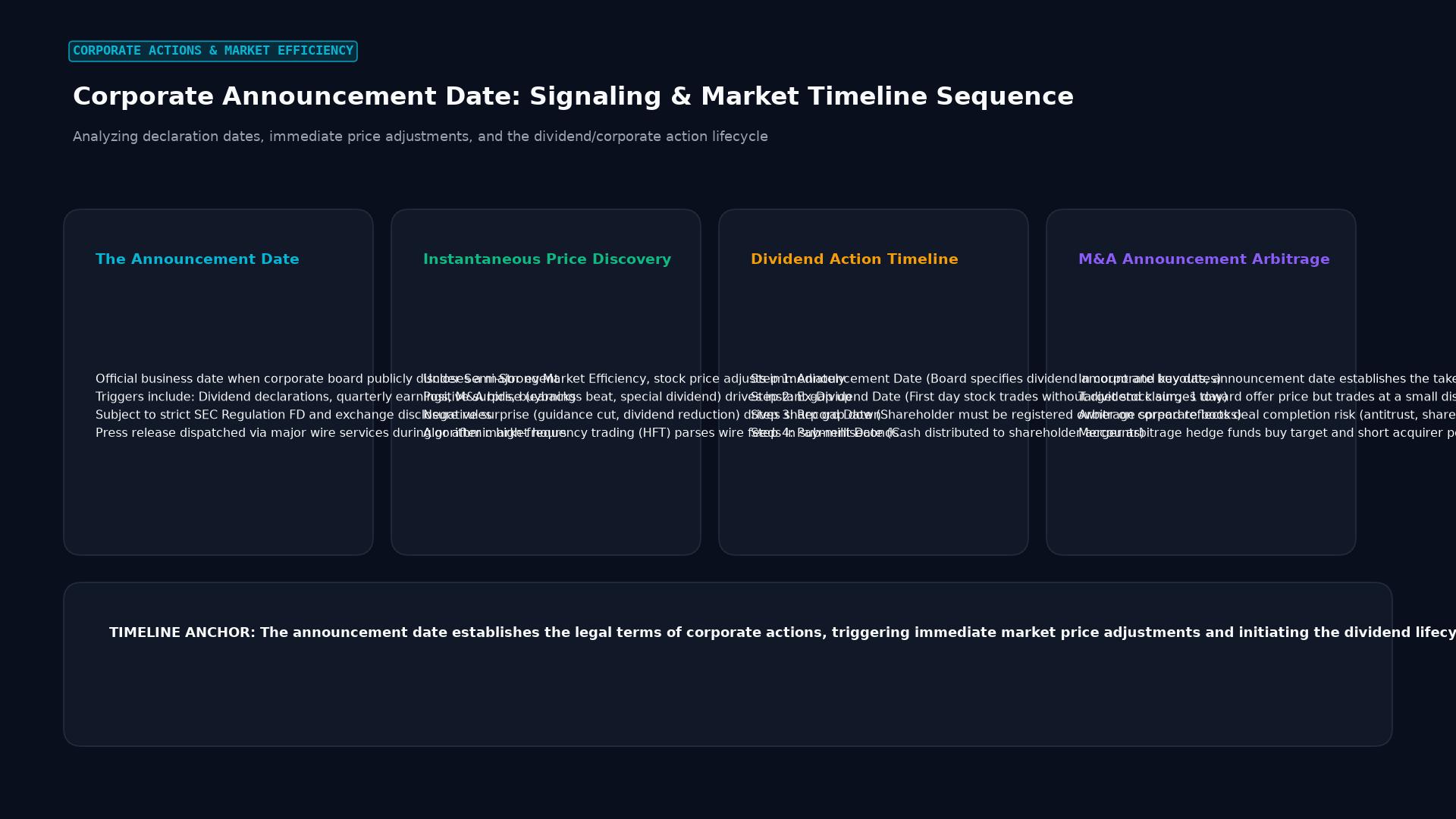 Figure: Analyzing declaration dates, immediate price adjustments, and the dividend/corporate action lifecycle
The Four Cardinal Dividend Dates
For income investors and equity derivatives desks, understanding the announcement date requires tracking the four sequential dates in the corporate distribution cycle:
- Announcement Date (Declaration Date): The board of directors issues a press release and files SEC Form 8-K stating the exact dividend dollar amount per share, the record date, and the scheduled payment date.
- Ex-Dividend Date: Established by exchange rules (such as NYSE or NASDAQ) pursuant to the T+1 settlement cycle, this is the first date on which the stock trades without the dividend entitlement. An investor buying on or after the ex-dividend date will not receive the declared dividend.
- Record Date: The date on which an investor must be officially registered on the company’s shareholder books to receive the distribution. Under T+1 settlement rules, the ex-dividend date and the record date occur on the same calendar day.
- Payment Date: The final date on which the corporate transfer agent or depositary bank distributes the cash or dividend reinvestment shares to registered accounts.
Accounting Impact on the Announcement Date
On the declaration date, the company’s accounting department records an immediate journal entry:
- Debit: Retained Earnings (reducing shareholders’ equity).
- Credit: Dividends Payable (establishing a current liability).
M&A Announcement Date and Merger Arbitrage
In corporate mergers and acquisitions, the announcement date represents the moment a formal tender offer or definitive merger agreement is disclosed to the market.
                    MERGER ARBITRAGE SPREAD BEHAVIOR
Stock Price ($)
    ^
$50 +=========================================== Acquisition Offer: $50.00
    |                                                /
$47 +---------------------- ARBITRAGE SPREAD -------/--------------------+
    |                      (Deal Risk Discount)    /
    |                      ▲                      /
    |                      │                     /
$35 +-- Pre-Deal Price ----+                    /
    |                      │                   /
$0  +----------------------|------------------/--------------------------+
      Pre-Announcement     Announcement Date            Target Closes Deal
The Arbitrage Mechanics
Consider Company A announcing an agreement to acquire Target B for $50.00 cash per share when Target B was trading at $35.00:
- Immediate Price Pop: Following the announcement date, Target B’s stock price surges toward the offer price, but typically stalls around $47.00 to $48.50.
- The Gross Arbitrage Spread: The $1.50 to $3.00 discount between the market trading price and the $50.00 offer price represents the merger arbitrage spread.
- Priced Risks: The spread reflects the time value of money until closing, alongside the risk that antitrust regulators (such as the FTC or European Commission) block the merger, financing falls apart, or target shareholders vote against the deal.
Specialized event-driven hedge funds buy Target B on or immediately following the announcement date, capturing the spread as pure alpha when the transaction successfully closes.
Announcement Date vs. Effective Date in Stock Splits
When a corporation executes a stock split (such as a 4-for-1 forward split), two critical dates govern market quoting:
| Milestone Date | Primary Function | Market Price Reaction |
|---|---|---|
| Announcement Date | Public notice of split ratio and regulatory filings | Stock price typically rallies due to retail accessibility sentiment |
| Effective (Trading) Date | Stock begins trading at the split-adjusted price | Quoted share price is divided by the split factor; share count multiplies |
For example, when an enterprise trading at $400 announces a 4-for-1 split, the stock continues trading at $400 until the designated effective date, at which point the quoted price adjusts automatically to $100 while existing shareholders receive three additional shares for every share held.
Regulatory Disclosure Mandates: SEC Form 8-K
Under federal securities regulations, material corporate announcements cannot be withheld or leaked selectively to favored market participants:
- SEC Form 8-K: Under SEC rules, public companies must file a Form 8-K within four business days of any material corporate event, including board leadership changes, bankruptcy filings, acquisitions, or significant corporate restructurings.
- Regulation Fair Disclosure (Reg FD): Companies must disseminate announcements broadly through approved press release wires, public webcasts, and SEC EDGAR filings simultaneously, preventing insider trading before the formal announcement date.
Frequently Asked Questions
Can a company cancel a dividend after the announcement date?
In almost all jurisdictions, no. Once a cash dividend has been formally announced and approved by the board of directors, it becomes an irrevocable legal debt owed by the corporation to its shareholders. In extreme situations (such as sudden bankruptcy insolvency before payment), court injunctions can freeze distributions, but cancellation under normal operating conditions is legally prohibited.
Why do options prices spike on corporate announcement dates?
In advance of scheduled earnings announcements or strategic investor days, implied volatility (IV) surges as market makers price in heightened uncertainty regarding the company’s forward guidance. Following the announcement, this volatility collapses rapidly, an event known to options traders as IV Crush.
How does the market react if an acquisition offer is hostile?
If an unsolicited hostile takeover bid is disclosed on the announcement date, the target company’s stock often trades above the initial offer price. This occurs because institutional arbitrageurs anticipate that the acquiring suitor will be forced to sweeten its offer, or that a white-knight rival bidder will emerge with a superior competing bid.
Ready to trade forex?
Open a free demo account with a regulated broker. Practice with virtual funds before risking real money.