Annual exclusion
The annual exclusion is the statutory dollar limit an individual can transfer as a gift to any single recipient within a tax year without incurring federal gift tax or reducing their lifetime estate tax exemption.
What Is the Annual Exclusion in Tax Law?
In federal wealth transfer and estate planning law, the annual exclusion is the statutory dollar ceiling an individual taxpayer can transfer to any single recipient during a calendar year without incurring federal gift tax or filing an IRS gift tax return. Codified under Internal Revenue Code (IRC) Section 2503(b), the annual exclusion applies on a per-donor, per-donee basis, allowing donors to distribute wealth across multiple recipients every year with zero gift or estate tax liability.
Gifts that fall within the annual exclusion threshold do not deplete the donor’s unified Lifetime Estate and Gift Tax Exemption. Consequently, maximizing annual exclusion gifts is one of the most effective structural strategies utilized by family offices and private wealth managers to systematically reduce the size of a taxable estate over time.
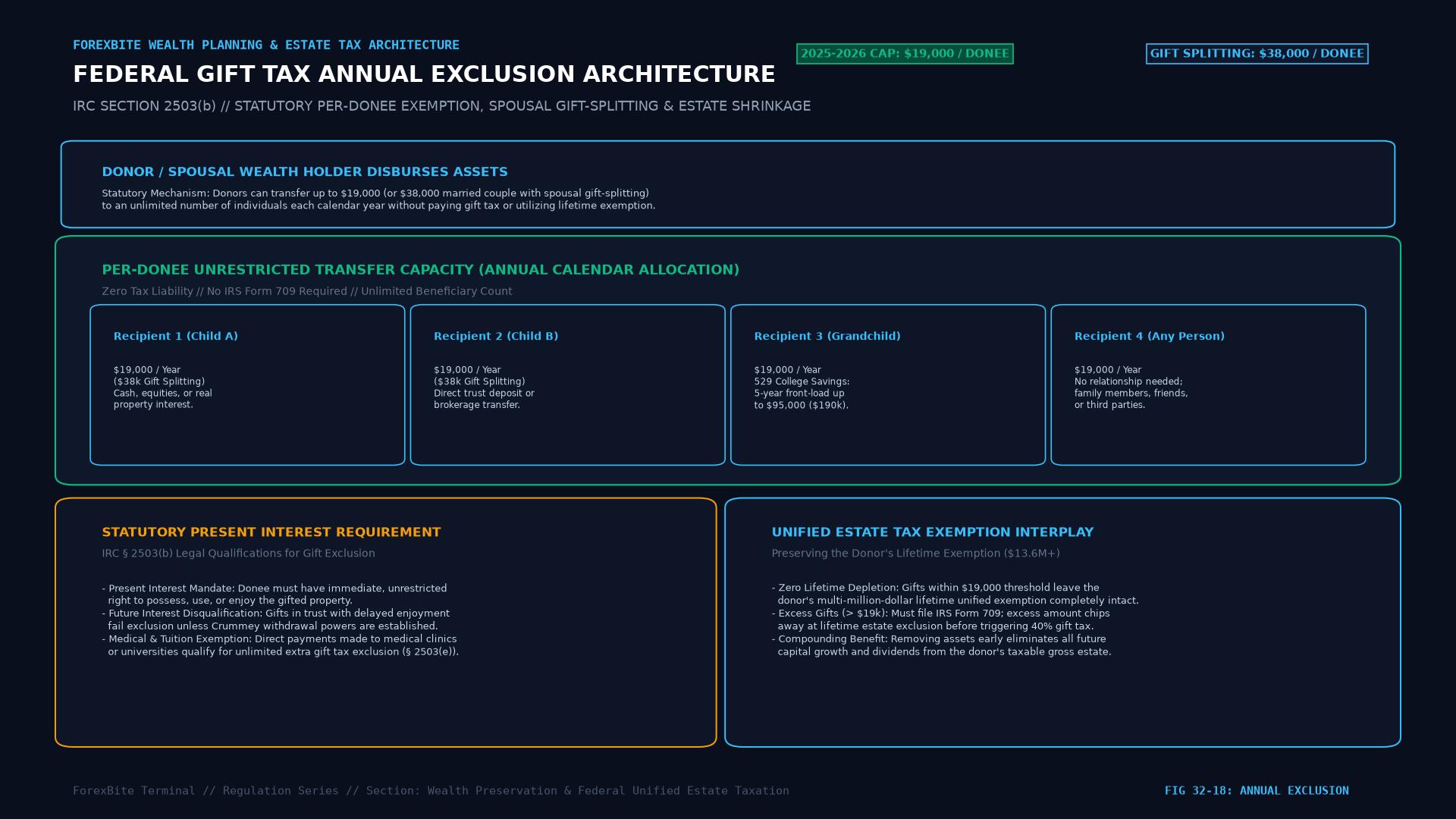 Figure: The federal gift tax annual exclusion framework under IRC § 2503(b), showing per-donee transfer limits, spousal gift-splitting, and lifetime estate exemption preservation.
Statutory Limits and Inflation Adjustments
Under federal tax provisions enacted in the Taxpayer Relief Act of 1997, the annual exclusion amount is indexed annually for consumer price inflation, rounding down to the nearest $1,000 increment:
| Tax Year | Annual Exclusion per Recipient (Individual) | Combined Annual Exclusion (Gift Splitting Spouses) |
|---|---|---|
| 2002–2005 | $11,000 | $22,000 |
| 2006–2008 | $12,000 | $24,000 |
| 2009–2012 | $13,000 | $26,000 |
| 2013–2017 | $14,000 | $28,000 |
| 2018–2021 | $15,000 | $30,000 |
| 2022 | $16,000 | $32,000 |
| 2023 | $17,000 | $34,000 |
| 2024 | $18,000 | $36,000 |
| 2025–2026 | $19,000 | $38,000 |
There is no statutory restriction on the total number of distinct individuals to whom a donor can make annual exclusion gifts. A parent with three children and six grandchildren can gift $19,000 to all nine family members annually, transferring $171,000 per year entirely free of tax.
Gift Splitting for Married Couples (IRC § 2513)
Under IRC Section 2513, married couples who are both US citizens or residents can elect to treat all gifts made by either spouse during the year as if each spouse contributed exactly half:
- Mechanics: If a donor spouse writes a check for $38,000 to their adult child from a separate individual account, the couple can elect gift splitting. The transfer is treated as two distinct gifts of $19,000: one from the donor and one from the non-donor spouse.
- Reporting Requirement: Unlike direct individual gifts that require zero tax reporting, electing gift splitting mandates filing IRS Form 709 (United States Gift and Generation-Skipping Transfer Tax Return), where both spouses formally sign their consent to split gifts for that calendar year.
Present Interest vs. Future Interest: The Crummey Trust
Under IRC § 2503(b), the annual exclusion applies exclusively to gifts of a present interest in property. A present interest means the recipient must have an immediate, unrestricted legal right to use, possess, or enjoy the gifted property or the income generated by it.
Gifts of a future interest (where possession or enjoyment is postponed until a future date, such as placing assets into an irrevocable trust for a minor) do not qualify for the annual exclusion unless specific legal mechanisms are implemented:
                     THE CRUMMEY POWER ARCHITECTURE
+-----------------------------------------------------------------------+
| Donor contributes $19,000 cash to Irrevocable Life Insurance Trust     |
+-----------------------------------------------------------------------+
                                   │
                                   ▼
+-----------------------------------------------------------------------+
| Trustee issues formal "Crummey Notice" to Trust Beneficiary           |
| - Beneficiary is granted a 30-day window to withdraw the $19,000 cash |
+-----------------------------------------------------------------------+
                                   │
                                   ▼
+-----------------------------------------------------------------------+
| Beneficiary allows the 30-day window to lapse without withdrawing     |
| - The temporary right of withdrawal converts the gift into a          |
|   PRESENT INTEREST, qualifying it for the Annual Exclusion!          |
+-----------------------------------------------------------------------+
Derived from the landmark 1968 tax court decision Crummey v. Commissioner, this legal structure allows donors to fund irrevocable trusts and life insurance premiums utilizing annual exclusions without triggering taxable gifts.
Special Exemptions: Education, Medical, and 529 Plans
The tax code provides several powerful carve-outs that operate outside and above the standard annual exclusion:
1. Direct Qualified Tuition and Medical Expenses (IRC § 2503(e))
Payments made directly to an educational institution for a student’s tuition, or paid directly to a medical healthcare provider for an individual’s medical care, are completely exempt from federal gift tax. These direct payments are unlimited in dollar amount and do not reduce the annual exclusion. A grandparent can pay $60,000 directly to a university for a grandchild’s annual tuition and still gift the grandchild the full $19,000 annual exclusion in cash.
2. Five-Year Front-Loading of 529 College Savings Plans
Under IRC Section 529(c)(2)(B), donors can elect to make a single lump-sum contribution to a 529 college savings plan and treat it as if it were made ratably over a five-year period:
- An individual can contribute $95,000 ($19,000 × 5) in a single day.
- A married couple splitting gifts can contribute $190,000 ($38,000 × 5) in a single year for each beneficiary.
- If the donor survives the full five-year period, the entire $95,000 or $190,000 is removed from their gross taxable estate with zero gift tax consequences.
Frequently Asked Questions
What happens if a gift exceeds the annual exclusion threshold?
If an individual gifts more than the annual exclusion amount to a single recipient (e.g., gifting $30,000 when the limit is $19,000), the donor must file IRS Form 709. The excess $11,000 is reported as a taxable gift. However, no actual tax is paid out of pocket unless the donor has already exhausted their multi-million-dollar lifetime estate and gift tax exemption.
Does the recipient of an annual exclusion gift pay income tax?
No. Under IRC Section 102, gross income does not include the value of property acquired by gift, bequest, or inheritance. The recipient pays zero federal income tax on the cash or property received, and gifts are not reported on Form 1040.
Can annual exclusion gifts be made in stocks or real estate?
Yes. Annual exclusion gifts can be made in cash, publicly traded equity shares, fractional interests in real estate, or private partnership units. For non-cash property, the value applied against the annual exclusion is the fair market value (FMV) of the asset on the exact date the transfer is legally completed.
Ready to trade forex?
Open a free demo account with a regulated broker. Practice with virtual funds before risking real money.