Annual meeting
An annual meeting, commonly termed the Annual General Meeting (AGM), is a statutory yearly assembly where corporate directors and common shareholders convene to vote on board elections, executive pay, and shareholder resolutions.
What Is an Annual Meeting?
An annual meeting (officially termed the Annual General Meeting, or AGM) is a mandatory yearly gathering of a corporation’s common equity shareholders, executive management, and board of directors. Mandated by state corporate law (such as the Delaware General Corporation Law) and stock exchange listing standards (such as NYSE and NASDAQ), the annual meeting serves as the primary formal forum for corporate governance and shareholder democracy.
During the meeting, shareholders exercise their voting rights on key governance matters, including electing the board of directors, ratifying the independent external accounting auditor, approving executive compensation structures (Say-on-Pay), and voting on shareholder proposals. For institutional allocators and retail investors, annual meetings provide direct transparency into corporate operational strategy and management accountability.
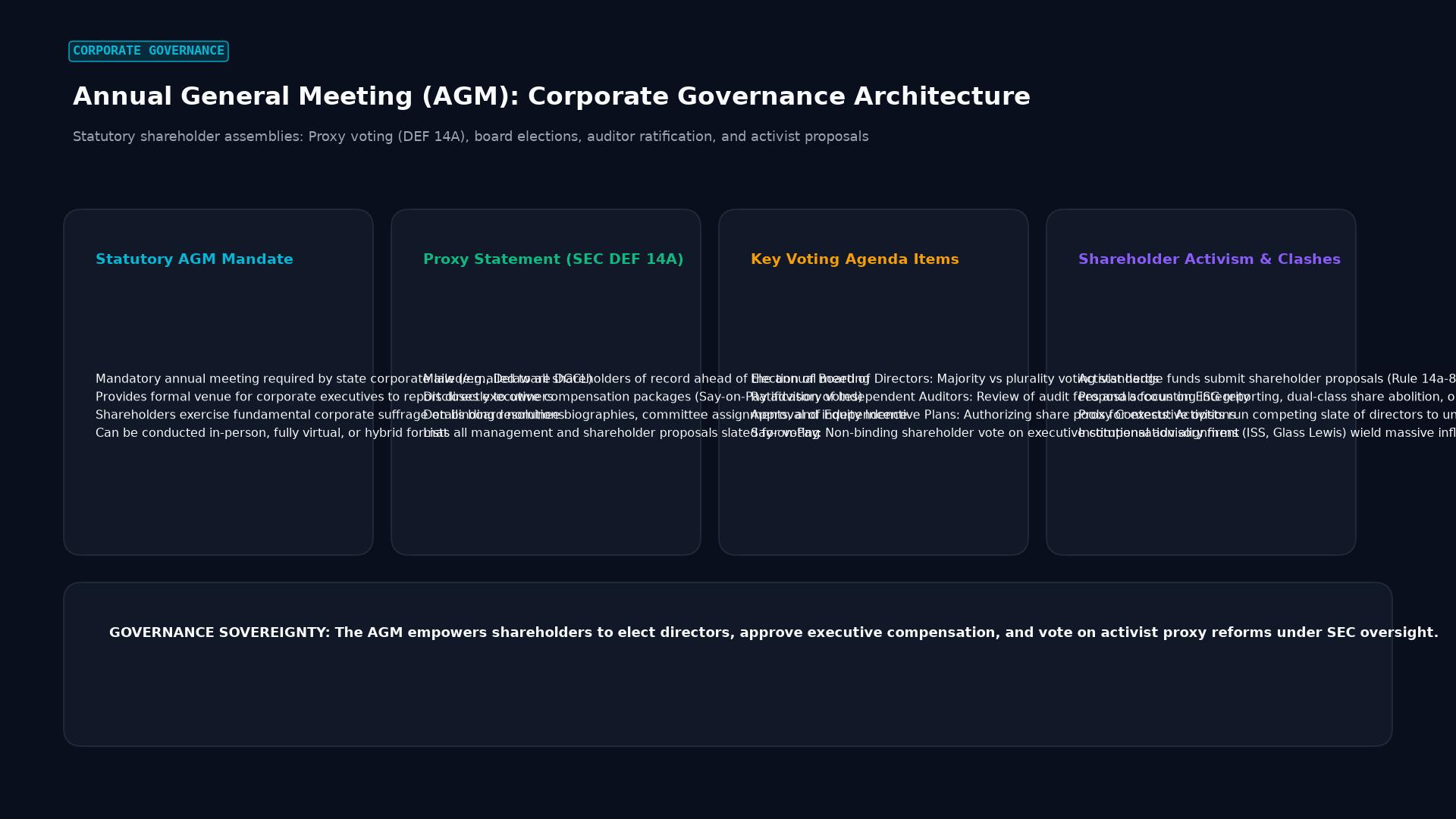 Figure: Statutory shareholder assemblies: Proxy voting (DEF 14A), board elections, auditor ratification, and activist proposals
Statutory Agenda Items at an Annual Meeting
While the ceremonial atmosphere of annual meetings ranges from routine corporate webcasts to massive cultural gatherings (such as Berkshire Hathaway’s annual “Woodstock for Capitalists” in Omaha), all annual meetings must execute core statutory business:
1. Election of the Board of Directors
Shareholders cast ballots to elect the board of directors, who oversee executive management on behalf of shareholders. Voting structures vary:
- Plurality Voting: A director candidate needs only to receive the highest number of votes, regardless of whether a majority of shareholders voted against them.
- Majority Voting: A director must receive a majority of votes cast (“For” exceeding “Against”) to win or retain a board seat.
- Staggered (Classified) Boards: Only one-third of the board stands for election each year, providing a defensive anti-takeover barrier against hostile corporate raiders.
2. Ratification of Independent Auditors
Shareholders formally vote to approve the board’s audit committee selection of the independent public accounting firm (e.g., PwC, Deloitte, Ernst & Young, or KPMG) responsible for auditing the corporation’s GAAP financial statements.
3. Advisory Vote on Executive Compensation (“Say-on-Pay”)
Under Section 951 of the Dodd-Frank Act, public companies must provide shareholders with an advisory, non-binding vote at least once every three years to approve the compensation packages awarded to named executive officers (NEOs). While technically advisory, a negative vote (failing to achieve 50% approval) creates intense reputational pressure, forcing the board’s compensation committee to renegotiate equity grants and clawback provisions.
The Proxy Voting Infrastructure
Because millions of individual and institutional shareholders cannot physically travel to corporate headquarters, the vast majority of voting occurs via proxy:
                  INSTITUTIONAL PROXY VOTING ECOSYSTEM
+-----------------------------------------------------------------------+
|  Institutional Asset Managers (BlackRock, Vanguard, State Street)     |
+-----------------------------------------------------------------------+
                                   │
                                   ▼
+-----------------------------------------------------------------------+
|  Proxy Advisory Firms (Institutional Shareholder Services - ISS,      |
|  Glass Lewis) - Issue Independent Governance Research & Recommendations|
+-----------------------------------------------------------------------+
                                   │
                                   ▼
+-----------------------------------------------------------------------+
|  Broadridge Financial Solutions (ProxyEdge Central Clearinghouse)     |
|  - Consolidates custodian bank votes and delivers to Corporate Scrutineer|
+-----------------------------------------------------------------------+
Under federal securities regulations, registered investment advisers (RIAs) and mutual fund managers have a fiduciary duty under the Investment Advisers Act of 1940 to vote all proxies in the best economic interest of their underlying fund investors.
Shareholder Activism and Rule 14a-8 Proposals
The annual meeting is the central battlefield for shareholder activism. Under SEC Rule 14a-8, any shareholder who has continuously held at least $2,000 in market value (or a qualifying percentage) of a company’s stock for a specified statutory period can submit a resolution to be included directly on the company’s proxy card.
Common shareholder proposal categories include:
- Environmental, Social, and Governance (ESG): Demands for audited climate transition plans, greenhouse gas disclosures, or human rights risk reports.
- Governance Reform: Proposals to declassify the board of directors, separate the roles of CEO and Chairman of the Board, or eliminate dual-class super-voting share structures.
- Proxy Contests: Activist hedge funds (such as Elliott Management or Trian Partners) nominate their own slate of alternative director candidates to replace incumbent board members, waging high-stakes campaigns to force divestitures, share repurchases, or management overhauls.
Virtual vs. In-Person Annual Meetings
Following changes to Delaware corporate law and accelerated by the 2020 pandemic, corporations have transitioned toward virtual-only annual meetings conducted via encrypted webcasts:
| Format Type | Operational Advantages | Governance Criticisms |
|---|---|---|
| Physical (In-Person) | Enables face-to-face dialogue, spontaneous floor debate, and direct accountability | Costly to stage; geographically limits participation for global retail investors |
| Virtual-Only | Maximizes shareholder access; reduces corporate logistical overhead | Management can screen or censor critical questions; sanitizes shareholder dissent |
| Hybrid Meeting | Combines physical attendance with real-time digital voting and audio streams | High technical complexity; requires redundant connectivity platforms |
Frequently Asked Questions
What happens if an annual meeting fails to reach a quorum?
A corporate annual meeting cannot legally transact business or conduct binding votes without a quorum, which typically requires the presence (in person or by proxy) of holders representing at least a majority of outstanding voting shares. If a quorum is not present, the meeting must be adjourned to a later date while the company spends additional resources soliciting proxy votes.
What is the record date for an annual meeting?
The record date is the cutoff date established by the board of directors (usually 30 to 60 days prior to the meeting) to determine which shareholders are entitled to receive notice of and vote at the annual meeting. If an investor purchases shares after the record date, they cannot vote at that year’s annual meeting.
Are institutional investors required to disclose their annual meeting votes?
Yes. Under SEC regulations, registered management investment companies (mutual funds and ETFs) must file SEC Form N-PX annually, disclosing their complete proxy voting records across every corporate ballot item at every portfolio company held during the preceding 12-month period.
Ready to trade forex?
Open a free demo account with a regulated broker. Practice with virtual funds before risking real money.