Annual mortgagor statement
An annual mortgagor statement is a mandatory year-end disclosure provided by a mortgage servicer to a borrower summarizing total principal repaid, interest paid, escrow account transactions, and remaining loan balance.
What Is an Annual Mortgagor Statement?
An annual mortgagor statement is an official year-end accounting document furnished by a mortgage loan servicer to a real estate borrower (the mortgagor). Required under federal consumer protection laws, this annual statement provides a complete financial reconciliation of all mortgage transactions processed during the preceding calendar year.
The document details the total dollar amounts allocated toward principal reduction, mortgage interest charges, property tax distributions, homeowner’s insurance escrows, private mortgage insurance (PMI) premiums, and late servicing fees. It also states the exact unpaid principal balance remaining at the close of the fiscal year.
In personal income taxation, the data contained within the annual mortgagor statement forms the basis for claiming the mortgage interest deduction on federal and state tax returns via IRS Form 1098.
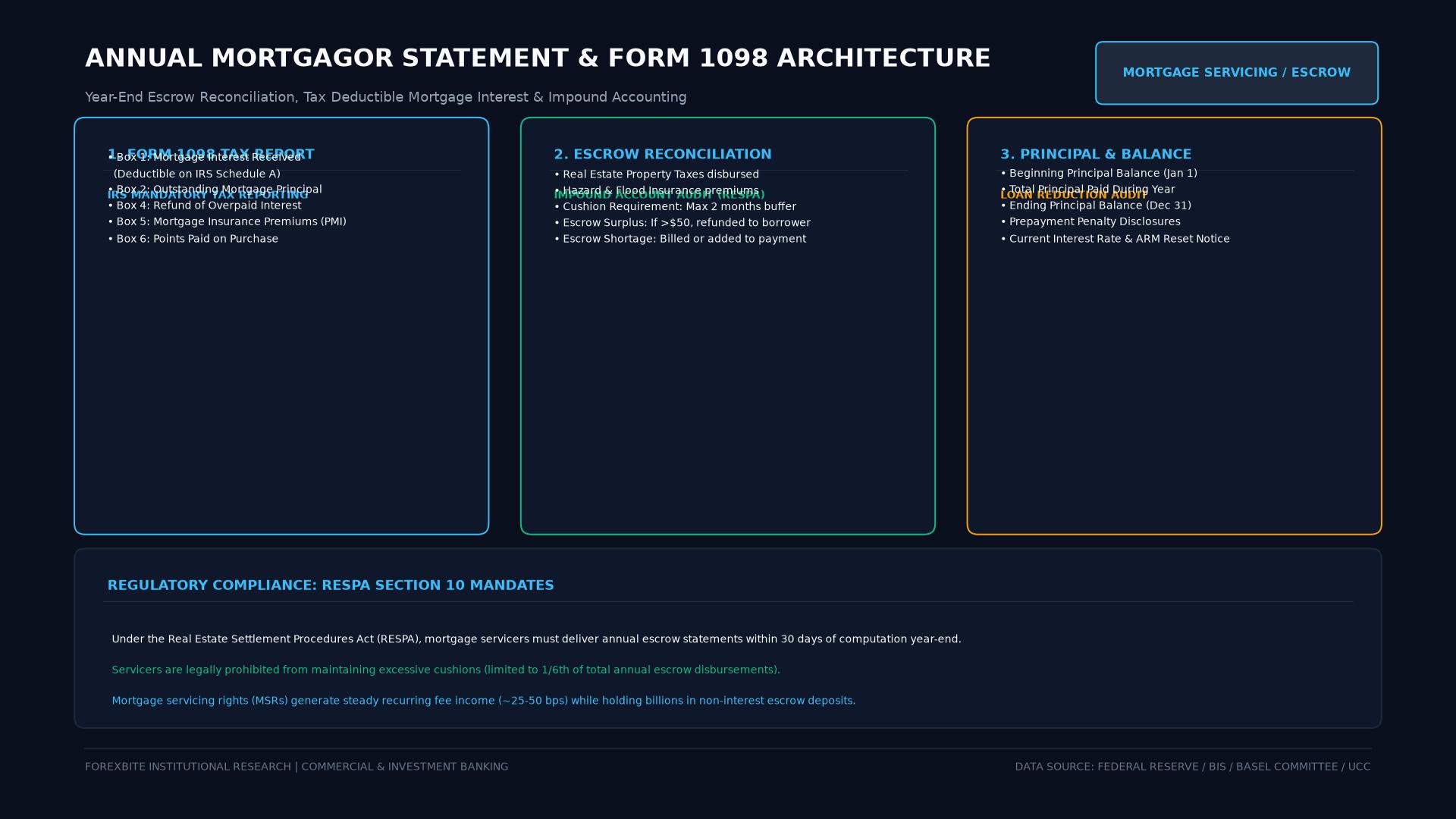 Figure: Year-end mortgage statement accounting: principal balance reduction, deductible mortgage interest paid, and property tax/homeowner insurance escrow disbursements.
Regulatory Mandates: RESPA Section 10 Escrow Analysis
Under Section 10 of the Real Estate Settlement Procedures Act (RESPA), codified in federal regulations under 12 CFR § 1024.17, mortgage servicers are legally required to deliver an Annual Escrow Account Statement within 30 days of the completion of the escrow account computation year.
RESPA strictly regulates how mortgage lenders handle borrowers’ escrow funds, preventing lenders from holding excessive cash cushions:
| RESPA Escrow Metric | Statutory Regulatory Requirement |
|---|---|
| Maximum Escrow Cushion | Capped at one-sixth (1/6) of the estimated total annual disbursements (equivalent to two months of escrow payments) |
| Escrow Surplus Refund | If an annual reconciliation reveals an escrow surplus of $50 or more, the servicer must refund the cash directly to the borrower within 30 days |
| Escrow Shortage Recovery | If an escrow account experiences a shortage (due to rising county property tax assessments or insurance rate hikes), the servicer can spread the repayment over a minimum of 12 equal monthly installments |
                 RESPA ESCROW CUSHION CALCULATION
Total Projected Annual Property Taxes + Hazard Insurance = $6,000.00
Maximum Permissible Cushion = 1/6th of $6,000.00 = $1,000.00 (Two Months Reserve)
Any escrow balance projected to remain above $1,000.00 must be refunded to mortgagor!
Tax Deductions: Connection to IRS Form 1098
The annual mortgagor statement is either integrated directly with, or serves as the detailed companion document to, IRS Form 1098 (Mortgage Interest Statement). Under federal tax law, mortgage lenders who receive $600 or more of mortgage interest from an individual during the calendar year must file Form 1098 with the IRS and provide a copy to the borrower by January 31.
Key line items reconciled for tax reporting include:
- Box 1 (Mortgage Interest Received): Deductible by taxpayers who itemize deductions on IRS Form 1040, Schedule A, subject to statutory indebtedness caps ($750,000 of qualifying acquisition debt under the Tax Cuts and Jobs Act of 2017).
- Box 2 (Outstanding Mortgage Principal): Reports the remaining unpaid loan balance as of January 1.
- Box 4 (Refund of Overpaid Interest): Reports any interest overpayments returned to the mortgagor.
- Box 5 (Mortgage Insurance Premiums): Historical reporting for deductible private mortgage insurance (PMI).
Core Components of the Annual Ledger
An itemized annual mortgagor statement includes distinct analytical sections:
- Transaction History Ledger: A complete month-by-month accounting of every payment received, detailing posting dates, check/ACH trace numbers, and exact dollar distributions across principal, interest, and escrow.
- Escrow Account Reconciliation: An itemized breakdown of all outgoing disbursements made on the borrower’s behalf, including municipal school taxes, county property assessments, flood insurance premiums, and hazard insurance policies.
- Projected Escrow Forecast: A 12-month forward projection modeling anticipated property tax increases, determining whether the borrower’s monthly escrow payment will increase or decrease for the upcoming year.
- Loan Identification Details: Includes the property address, loan account number, current interest rate, investor loan identifier (such as Fannie Mae or Freddie Mac pool numbers), and whether the rate is fixed or subject to adjustable-rate reset.
Practical Importance for Homeowners and Borrowers
Reviewing the annual mortgagor statement is a crucial financial habit for borrowers:
- Identifying Servicing Errors: Servicers frequently miscalculate escrow projections or fail to disburse property taxes before local municipal penalty deadlines. The statement provides the paper trail needed to dispute servicing fees.
- Verifying Amortization Progress: Allows homeowners to confirm that extra principal prepayments submitted during the year were properly credited toward principal reduction rather than misapplied to future interest or unallocated suspense accounts.
- PMI Cancellation Eligibility: Under the Homeowners Protection Act of 1998 (HPA), borrowers have the statutory right to request the cancellation of Private Mortgage Insurance (PMI) once the principal balance drops to 80% of the original property value, and servicers must automatically terminate PMI when the loan balance reaches 78%. The annual statement reveals when this threshold has been reached.
Frequently Asked Questions
What should a mortgagor do if the annual statement reveals an escrow shortage?
When an escrow shortage occurs (often caused by an increase in local property taxes), the borrower typically has two options: pay the entire shortage as a single lump sum, or allow the servicer to spread the deficit across the subsequent 12 monthly mortgage payments, which will temporarily increase the monthly payment.
Is the annual mortgagor statement the same as a monthly mortgage bill?
No. A monthly mortgage statement is a billing invoice for the upcoming billing cycle showing the immediate amount due. The annual mortgagor statement is a comprehensive, retrospective 12-month audit covering the entire prior year’s transactions, cumulative interest, and escrow reconciliations.
Why do some annual statements show funds placed in a “suspense account”?
If a borrower submits a partial payment that does not satisfy the full monthly contractual payment (such as sending $1,000 toward a $1,500 due amount), the servicer cannot apply the funds to principal or interest under standard accounting rules. The funds are held temporarily in an unallocated suspense account until the remaining balance is received.
Ready to trade forex?
Open a free demo account with a regulated broker. Practice with virtual funds before risking real money.