Annual Percentage Rate
The Annual Percentage Rate (APR) is the standardized metric expressing the annual cost of credit to a borrower, including nominal interest rates, origination fees, discount points, and mandatory finance charges.
What Is the Annual Percentage Rate (APR)?
The Annual Percentage Rate (APR) is the standardized measure of the annual cost of borrowing money, expressed as a single annualized percentage. Governed in the United States by the Truth in Lending Act (TILA) and implemented under the Consumer Financial Protection Bureau’s Regulation Z, APR provides consumers and businesses with a uniform metric to compare credit products across competing financial institutions.
Unlike a nominal interest rate (which reflects strictly the baseline percentage charged on borrowed principal), the APR incorporates the broader spectrum of upfront lender fees, loan origination points, broker commissions, and mandatory administrative financing charges. Because it reflects the total effective cost of credit per dollar borrowed, the APR on a loan is almost always higher than the nominal interest rate.
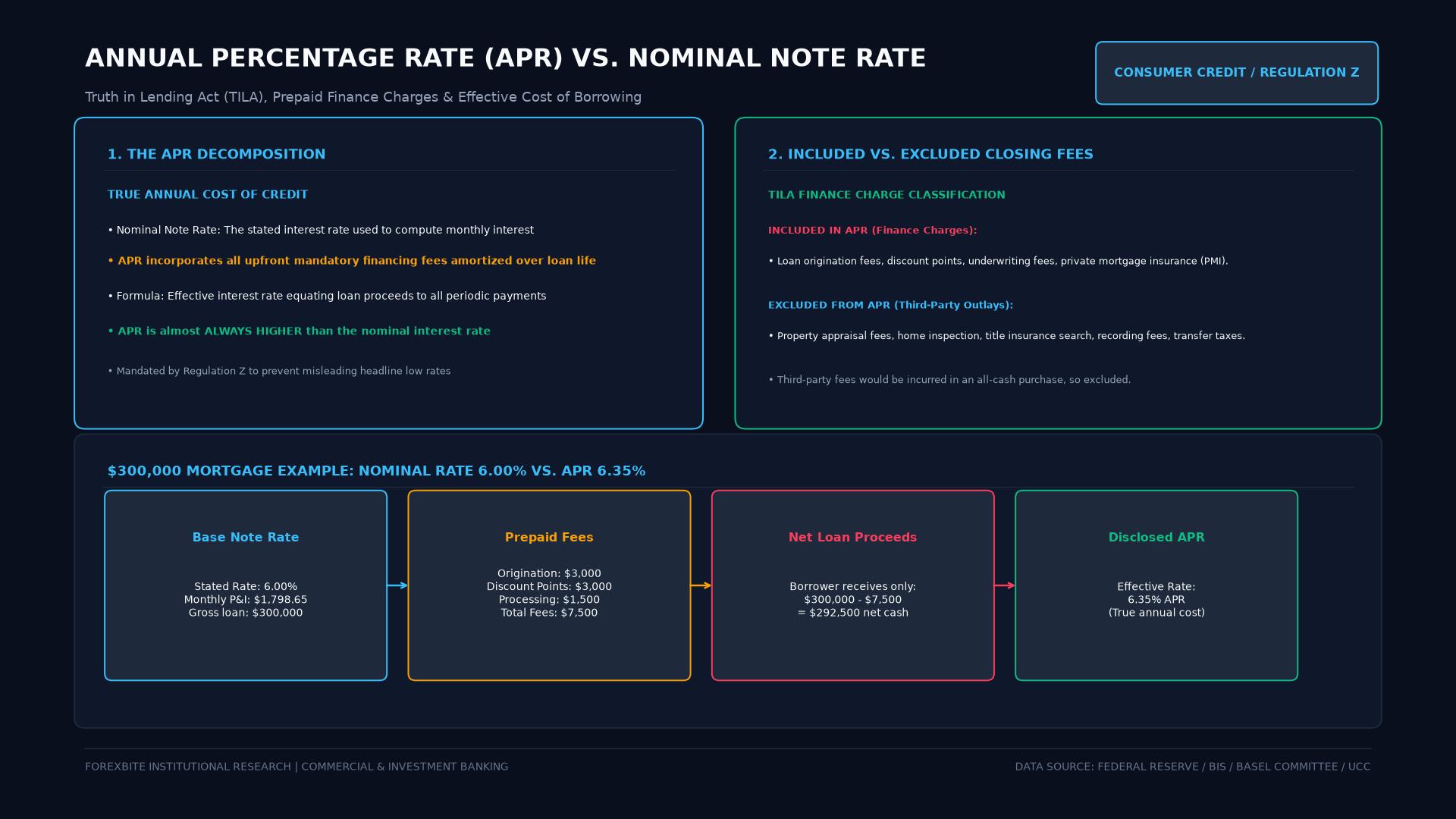 Figure: Truth in Lending Act (TILA) cost of borrowing disclosure: nominal contract interest rate blended with points, processing fees, and mortgage insurance.
What Is Included in APR? (TILA Regulation Z Framework)
Federal statutory guidelines draw clear distinctions between mandatory credit finance charges that must be included in the APR calculation and independent third-party closing costs that are excluded:
| Included in APR (Mandatory Finance Charges) | Excluded from APR (Third-Party / Operational Fees) |
|---|---|
| Nominal Interest Charges (Base interest over term) | Real Estate Appraisal Fees (Independent appraiser) |
| Loan Origination / Underwriting Fees | Title Search, Title Insurance, and Escrow Fees |
| Mortgage Broker Commissions | Home Property Inspection Fees |
| Discount Points (Prepaid interest to lower rate) | County Recording Fees and State Transfer Taxes |
| Private Mortgage Insurance (PMI) premiums | Attorney Document Preparation Fees (when customary) |
| Mandatory Credit Life / Disability Insurance | Notary and Courier Verification Charges |
Because closing costs like title insurance and home inspections do not represent compensation to the credit underwriter, federal law excludes them from the APR formula.
Mathematical Calculation of APR
In consumer installment credit and fixed-rate term lending, APR is calculated by amortizing total prepaid finance charges across the contractual life of the borrowing facility:
$$\text{APR} = \left( \frac{\text{Total Finance Charges} + \text{Total Interest Paid}}{\text{Net Principal Proceeds Received} \times \text{Loan Term in Days}} \right) \times 365 \times 100$$
Step-by-Step Mortgage APR Example
Consider a borrower applying for a $200,000, 30-year fixed-rate mortgage with a 6.0% nominal interest rate ($1,199.10 monthly payment):
- Gross Loan Amount: $200,000.
- Upfront Finance Charges: The lender charges $4,000 in origination fees and discount points.
- Net Cash Disbursed to Borrower: $$200,000 - $4,000 = \mathbf{$196,000}$.
- Solving for Internal Rate of Return (IRR): The monthly payment remains $1,199.10 across 360 months. The mathematical discount rate that equates 360 monthly payments of $1,199.10 to the net proceeds of $196,000 is 0.518% per month.
- Annualizing: $0.518% \times 12 = \mathbf{6.22%\text{ APR}}$.
While the nominal note rate is 6.0%, the true annualized borrowing cost is 6.22% APR.
Fixed vs. Variable APR in Revolving Credit
In credit card agreements and home equity lines of credit (HELOCs), APR operates under revolving frameworks:
                  REVOLVING VARIABLE APR CALCULATION
+-----------------------------------------------------------------------+
|  Benchmark Reference Rate: US Prime Rate (e.g., 8.50%)                 |
+-----------------------------------------------------------------------+
                                   │
                                  [+]
+-----------------------------------------------------------------------+
|  Lender Risk Margin / Spread: Fixed Contractual Add-On (e.g., 14.99%)  |
+-----------------------------------------------------------------------+
                                   │
                                   ▼
+-----------------------------------------------------------------------+
|  Total Variable Purchase APR = 23.49%                                 |
|  (Calculates Daily Periodic Rate: 23.49% / 365 = 0.06435% per day)    |
+-----------------------------------------------------------------------+
Daily Periodic Rate (DPR)
Credit card issuers do not calculate interest once a year. They divide the annual APR by 365 days to establish the Daily Periodic Rate (DPR), applying this daily rate to the account’s Average Daily Balance.
APR vs. APY: The Fundamental Difference
The distinction between APR and Annual Percentage Yield (APY) is one of the most critical concepts in banking:
| Feature | Annual Percentage Rate (APR) | Annual Percentage Yield (APY) |
|---|---|---|
| Perspective | Borrower’s Cost (Loans, Mortgages, Credit Cards) | Saver’s Return (Savings Accounts, CDs, Bonds) |
| Fee Inclusion | Includes upfront origination fees and points | Ignores operational fees; focuses on interest return |
| Compounding Effect | Ignores intra-year compounding | Fully incorporates compounding frequency |
| Regulatory Law | Truth in Lending Act (Regulation Z) | Truth in Savings Act (Regulation DD) |
Because APR ignores the compounding of interest within the year, the true cost of credit card debt where interest compounds daily is higher than the stated nominal APR.
Frequently Asked Questions
Why does APR become misleading if a mortgage is paid off early?
APR calculations spread upfront fees across the full contractual term of the loan (such as 30 years). If a homeowner pays $6,000 in upfront points on a 30-year mortgage with a 6.2% APR but refinances or sells the property after only three years, the upfront fees are absorbed across just 36 months, causing the true effective annualized borrowing cost to surge well above 8%.
What is the difference between a Purchase APR and a Cash Advance APR?
On credit cards, the Purchase APR applies to everyday retail transactions and typically features a 21-to-25-day interest-free grace period if the statement balance is paid in full. A Cash Advance APR is significantly higher (often 28% to 32%), carries zero grace period (interest accrues immediately on day one), and incurs an upfront cash advance fee (typically 3% to 5%).
What is an introductory 0% APR?
An introductory (or promotional) 0% APR is a marketing feature offering zero interest on purchases or balance transfers for a specified promotional window (such as 12 to 21 months). If the borrower fails to pay off the balance before the promotional window expires, the remaining balance immediately begins accruing interest at the standard variable purchase APR.
Ready to trade forex?
Open a free demo account with a regulated broker. Practice with virtual funds before risking real money.