Annual Percentage Yield
The Annual Percentage Yield (APY) is the standardized metric reflecting the total annualized rate of return on a deposit or investment, fully accounting for the compounding of interest over time.
What Is the Annual Percentage Yield (APY)?
The Annual Percentage Yield (APY) is the standardized financial metric that measures the actual annualized rate of return earned on an interest-bearing deposit or investment, fully reflecting the power of compound interest. Governed in the United States by the Truth in Savings Act (TISA) and administered under the Federal Reserve and Consumer Financial Protection Bureau’s Regulation DD, APY ensures that depository institutions disclose investment returns using a uniform mathematical formula.
While a nominal or stated interest rate ignores how frequently earned interest is credited and reinvested, APY accounts directly for the frequency of compounding, whether interest is credited annually, semiannually, monthly, daily, or continuously. Because compounding allows interest to earn interest upon itself, the APY on a savings account or certificate of deposit (CD) is consistently higher than its nominal interest rate whenever compounding occurs more than once per year.
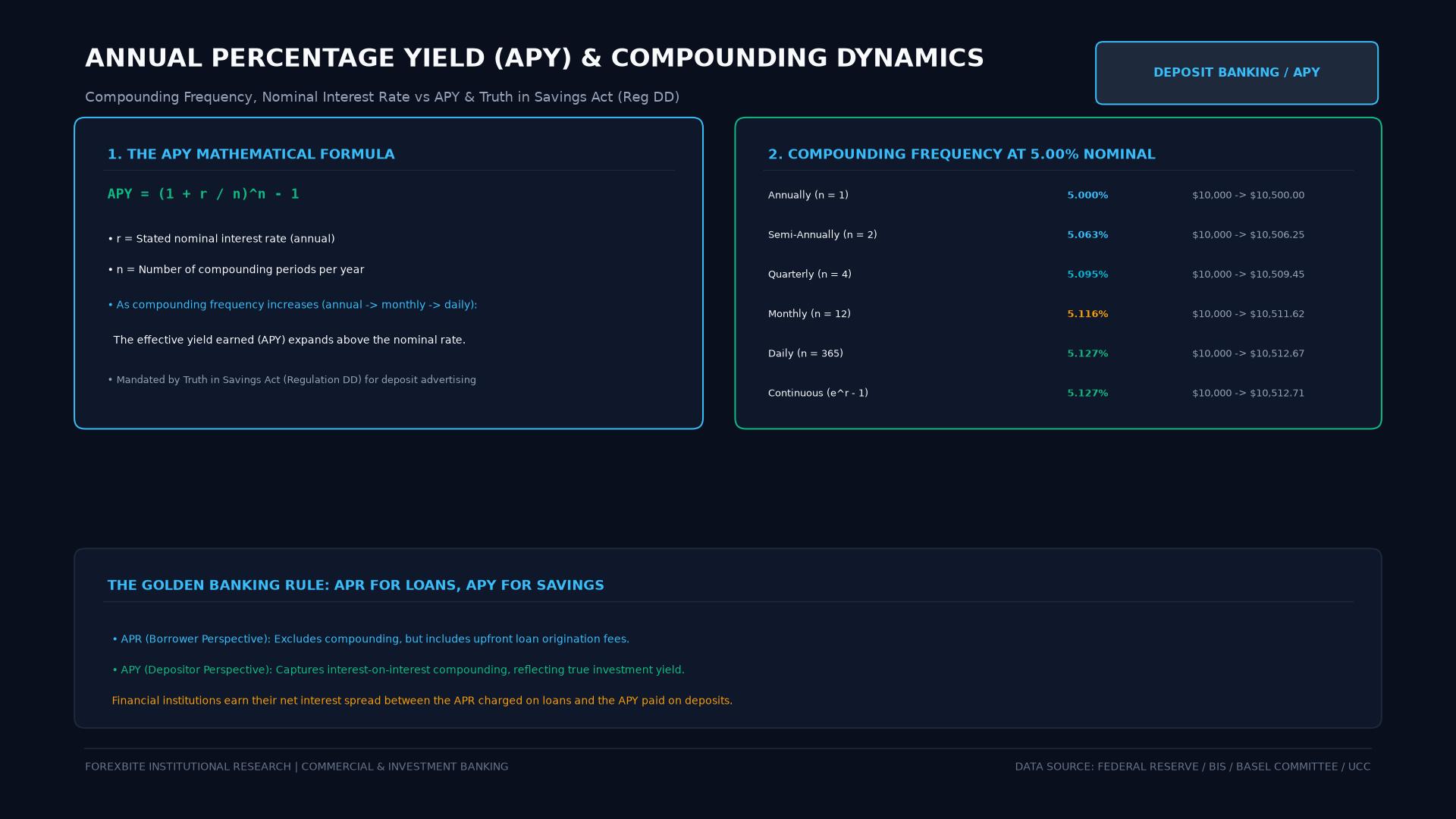 Figure: Exponential compounding frequency impact: progression of effective yield from annual to continuous compounding across depository products.
The Mathematical Formula for APY
Under Regulation DD, financial institutions calculate APY using the following core formula:
$$\text{APY} = \left( 1 + \frac{r}{n} \right)^n - 1$$
Where:
- $r$ = Stated nominal annual interest rate (as a decimal).
- $n$ = Number of compounding periods per calendar year ($n=12$ for monthly, $n=365$ for daily).
Step-by-Step Calculation Example
Suppose a high-yield savings account advertises a nominal interest rate of 4.85% with daily compounding ($n = 365$):
-
Calculate the daily periodic rate: $$\frac{r}{n} = \frac{0.0485}{365} = 0.0001328767$$
-
Add 1 to the periodic rate: $$1 + 0.0001328767 = 1.0001328767$$
-
Raise to the 365th power: $$(1.0001328767)^{365} \approx 1.049694$$
-
Subtract 1 and convert to percentage: $$\text{APY} = 1.049694 - 1 = 0.049694 \times 100 = \mathbf{4.97%\text{ APY}}$$
An investor depositing $50,000 earns $2,485 in annual interest, reflecting an effective yield of 4.97% rather than the nominal 4.85% baseline.
Compounding Frequency Comparison Matrix
The following table demonstrates how compounding frequency amplifies yields across common deposit instruments for a baseline nominal rate of 5.25%:
| Compounding Period | $n$ Periods | Factor Formula: $(1 + 0.0525/n)^n$ | Effective APY | Annual Interest on $100,000 |
|---|---|---|---|---|
| Annual | 1 | $(1 + 0.0525)^1$ | 5.250% | $5,250.00 |
| Semiannual | 2 | $(1 + 0.02625)^2$ | 5.319% | $5,319.14 |
| Quarterly | 4 | $(1 + 0.013125)^4$ | 5.354% | $5,354.27 |
| Monthly | 12 | $(1 + 0.004375)^{12}$ | 5.378% | $5,378.19 |
| Daily | 365 | $(1 + 0.000143836)^{365}$ | 5.390% | $5,389.86 |
| Continuous | $\infty$ | $e^{0.0525}$ | 5.390% | $5,390.26 |
                 COMPOUNDING CURVE DIMINISHING RETURNS
APY (%)
   ^
5.390% +----------------------------------------------- Daily / Continuous Limit
       |                                             /
5.378% +-------------------------------- Monthly ---/
       |                                      /
5.354% +----------------------- Quarterly ---/
       |                               /
5.319% +---------------- Semiannual --/
       |                        /
5.250% +--- Annual ------------/
       +------------------------------------------------------------------------>
       n=1 (Annual)          n=4 (Quarterly)        n=12 (Monthly)   n=365 (Daily)
As the curve illustrates, the jump from annual to monthly compounding provides a significant yield boost (12.8 basis points). However, the progression from daily to continuous compounding produces rapidly diminishing incremental returns (less than 40 cents per year on $100,000).
Regulatory Rules: Regulation DD and Deposit Advertising
To protect consumers from misleading financial promotions, federal regulations enforce strict standards on how APY is presented in commercial banking:
- Equal Prominence Rule: If a bank advertises a nominal interest rate in any print, television, or digital medium, it must display the APY with equal or greater visual prominence.
- Tiered APY Disclosures: For accounts that pay tiered interest rates based on account balance (e.g., 5.0% on the first $10,000, and 1.5% on balances above $10,000), banks must disclose the blended APY range reflecting how larger balances receive lower effective yields.
- Minimum Balance and Term Mandates: Advertisements must explicitly state any minimum deposit required to open the account, minimum balances needed to earn the stated APY, and early withdrawal penalties for fixed-term certificates of deposit (CDs).
Variable APY vs. Fixed APY
In retail banking, APY structures fall into two categories:
- Fixed APY: The yield is contractually guaranteed for the entire term of the deposit. Standard Certificates of Deposit (CDs) feature fixed APYs, protecting savers against central bank interest rate cuts during economic downturns.
- Variable APY: Found on High-Yield Savings Accounts (HYSAs) and Money Market Accounts (MMAs). Banks retain discretionary authority to adjust the APY at any time in response to shifts in the Federal Reserve’s benchmark Federal Funds Rate.
Frequently Asked Questions
Why does a bank advertise APR on loans but APY on savings?
Banks act as self-interested financial intermediaries. On lending products (credit cards, mortgages), banks market the APR because it displays a lower percentage by excluding compounding. On deposit products (savings accounts, CDs), banks market the APY because compounding produces a higher, more attractive percentage to prospective depositors.
Does APY include account maintenance fees?
No. Standard APY formulas measure pure gross interest return and do not deduct monthly service fees, wire charges, or paper statement fees. If an account with a 5.0% APY charges a $15 monthly maintenance fee on a small balance, the net realized yield will be significantly lower, or even negative.
What is the difference between simple interest and APY?
Simple interest calculates returns strictly on the original principal balance, ignoring accumulated interest: $\text{Interest} = P \times r \times t$. APY reflects compound interest, where each cycle’s credited interest is added to the principal, so subsequent interest calculations earn returns on previously earned interest.
Ready to trade forex?
Open a free demo account with a regulated broker. Practice with virtual funds before risking real money.