Annual reports
Annual reports are comprehensive, audited corporate disclosures published at the close of each fiscal year detailing operational performance, financial statements, and executive strategic guidance for shareholders and regulators.
What Are Corporate Annual Reports?
An annual report is a formal, comprehensive publication issued by a public corporation at the conclusion of each fiscal year. Governed by federal securities legislation (most notably the Securities Exchange Act of 1934 and rules enforced by the Securities and Exchange Commission), the annual report provides shareholders, creditors, and institutional market participants with an audited assessment of the enterprise’s financial health, operational achievements, and forward-looking risks.
In capital markets, investors distinguish between two forms of the annual report:
- The Glossy Shareholder Report: A beautifully designed marketing and public relations document containing executive letters, product photographs, and strategic commentary sent directly to shareholders.
- SEC Form 10-K: The standardized, unadorned regulatory filing containing legally binding audited financial statements, GAAP footnotes, and mandatory risk disclosures filed on the SEC EDGAR system.
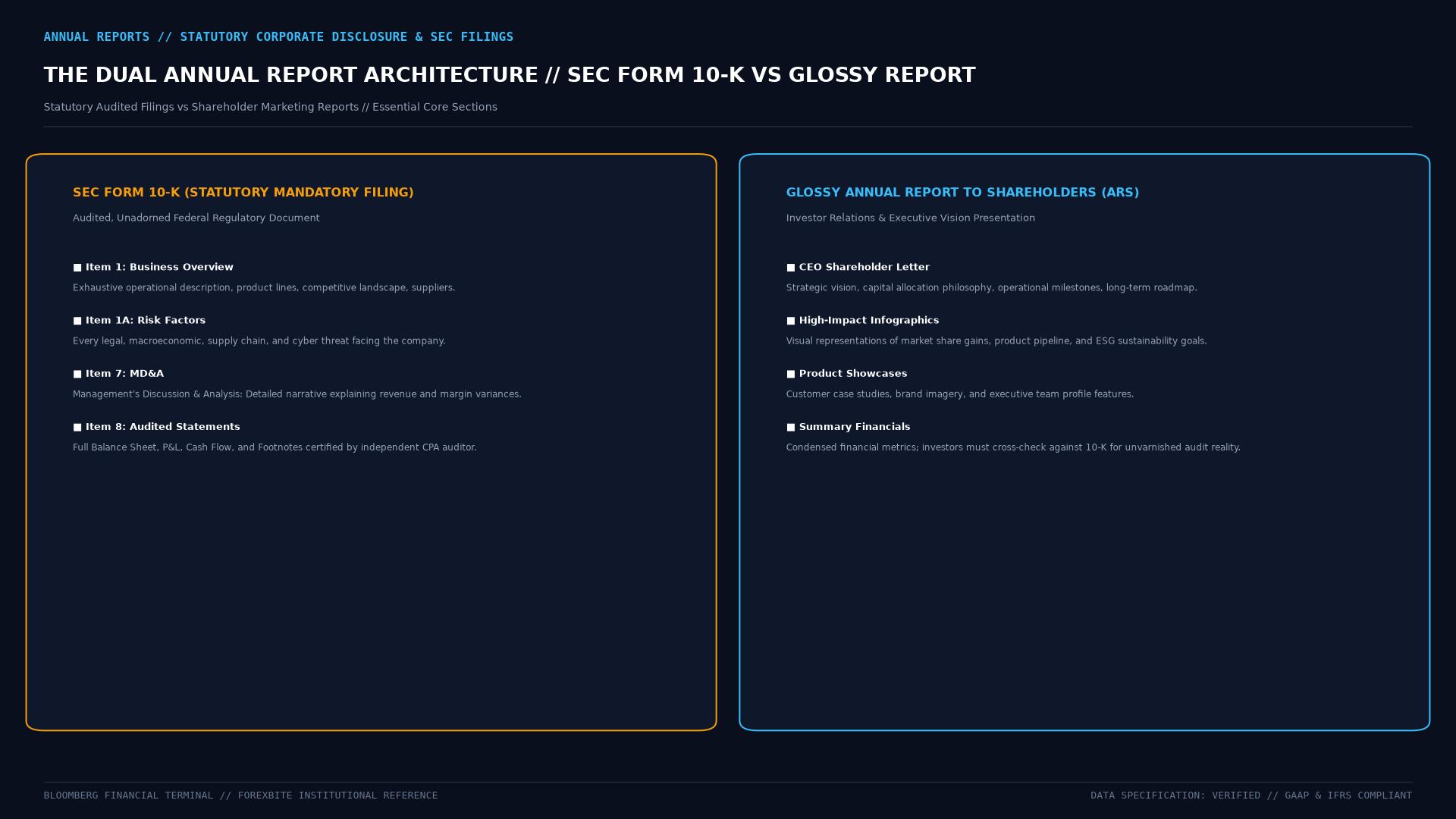 Figure: Form 10-K / Annual Report anatomical structure detailing Item 1 (Business), Item 7 (MD&A), Item 8 (Audited Financial Statements & Notes), and the External Auditor’s Report with Key Audit Matters (KAMs).
The Four Primary Financial Statements
At the heart of every annual report are the four foundational financial statements, certified by an independent Public Company Accounting Oversight Board (PCAOB) registered auditor:
| Financial Statement | Primary Accounting Objective | Core Valuation Question Answered |
|---|---|---|
| Balance Sheet (Statement of Financial Position) | Snapshot of assets, liabilities, and shareholders’ equity at fiscal year-end | What resources does the firm own, and how are they financed? |
| Income Statement (Statement of Operations) | Summary of revenues, operating expenses, and net profit over 12 months | Is the business generating a true operational accounting profit? |
| Statement of Cash Flows | Reconciles accrual net income to actual cash across Operations, Investing, and Financing | How much actual cash entered and exited the corporate treasury? |
| Statement of Shareholders’ Equity | Details changes in common stock, retained earnings, AOCI, and treasury shares | How has book value and retained earnings evolved over the year? |
Key Regulatory Sections of SEC Form 10-K
For fundamental equity analysts, credit rating agencies, and quantitative modelers, the Form 10-K contains several critical statutory sections:
                    CORE SECTIONS OF SEC FORM 10-K
+-----------------------------------------------------------------------+
|  Item 1: Business (Products, competitive moats, regulatory frameworks)|
+-----------------------------------------------------------------------+
                                   │
                                   ▼
+-----------------------------------------------------------------------+
|  Item 1A: Risk Factors (Litigation, cyber risks, macro exposures)    |
+-----------------------------------------------------------------------+
                                   │
                                   ▼
+-----------------------------------------------------------------------+
|  Item 7: Management's Discussion and Analysis (MD&A)                  |
|  - Executive explanation of revenue trends, margins, liquidity, and   |
|    capital expenditures across operating segments                     |
+-----------------------------------------------------------------------+
                                   │
                                   ▼
+-----------------------------------------------------------------------+
|  Item 8: Audited Financial Statements and Supplementary Notes         |
|  - Full GAAP/IFRS balance sheets, income statements, and footnotes   |
+-----------------------------------------------------------------------+
                                   │
                                   ▼
+-----------------------------------------------------------------------+
|  Item 9A: Controls and Procedures (Sarbanes-Oxley Section 404 audit)  |
+-----------------------------------------------------------------------+
The Power of Footnotes (Notes to Financial Statements)
Sophisticated institutional investors spend the majority of their analytical time reading the Notes to Financial Statements in Item 8. Footnotes reveal hidden balance sheet liabilities and accounting assumptions, including:
- Revenue recognition timing criteria under ASC 606.
- Defined benefit pension obligations and expected return-on-asset assumptions.
- Operating lease liabilities under ASC 842.
- Valuation allowances recorded against Deferred Tax Assets (DTAs).
- Contingent legal liabilities, pending patent disputes, and government investigations.
The Independent Auditor’s Report
Every annual report must include a signed audit opinion from an independent certified public accounting firm. The opinion falls into one of four categories:
- Unqualified Opinion (“Clean Opinion”): The auditor concludes that the financial statements present fairly, in all material respects, the financial position of the company in conformity with US GAAP or IFRS.
- Qualified Opinion: Financial statements are generally accurate, except for a specific isolated departure from accounting standards or an inability to audit a specific transaction.
- Adverse Opinion: The auditor discovers pervasive material misstatements or fraud, warning that the financial statements cannot be relied upon.
- Disclaimer of Opinion: The auditor is unable to obtain sufficient audit evidence to formulate an opinion, or independence was compromised.
The “Going Concern” Warning
If the auditor doubts the enterprise’s ability to survive without bankruptcy over the subsequent 12 months, it adds an explanatory paragraph containing a Going Concern Warning, which typically triggers immediate credit downgrades and plunges in equity valuation.
Reading Between the Lines: Forensic Red Flags
Forensic analysts inspect annual reports for warning signs that indicate deteriorating underlying business quality:
- Divergence Between Net Income and Operating Cash Flow: If reported net income rises while operating cash flow declines, the company may be aggressively capitalizing costs or booking uncollected revenues.
- Surging Days Sales Outstanding (DSO): Accounts receivable growing significantly faster than revenue indicates that customers are struggling to pay or the firm is offering loose credit terms to pull forward future sales (“channel stuffing”).
- Frequent Auditor Resignations: Sudden changes in independent audit firms, particularly over disputes regarding internal controls or revenue recognition, frequently precede major accounting restatements.
- Sudden Changes in Accounting Estimates: Modifying the depreciation lifespan of equipment or lowering expected credit loss reserves to cosmetically inflate quarterly EPS.
Frequently Asked Questions
When are public companies required to file their annual Form 10-K?
Under SEC filing deadlines, companies are categorized by market float:
- Large Accelerated Filers (public float of $700 million or more) must file within 60 days after fiscal year-end.
- Accelerated Filers (float between $75 million and $700 million) must file within 75 days.
- Non-Accelerated Filers (float under $75 million) have 90 days.
Can an annual report be restated after publication?
Yes. If an enterprise or its auditor discovers material accounting errors, fraud, or misapplication of GAAP rules, the company must file an amended Form 10-K/A with the SEC. Material restatements erode investor confidence and often trigger shareholder class-action lawsuits.
How does an annual report differ from a quarterly report (Form 10-Q)?
A Form 10-Q is filed three times per year for the first three fiscal quarters. Unlike the comprehensive Form 10-K annual report, quarterly Form 10-Q statements are unaudited, provide condensed footnote disclosures, and lack full internal control attestations.
Ready to trade forex?
Open a free demo account with a regulated broker. Practice with virtual funds before risking real money.