Annualizing
Annualizing is the practice of converting financial statements, operational metrics, or economic indicators measured over sub-annual intervals into full-year equivalents for comparative and forecasting purposes.
What Is the Practice of Annualizing?
Annualizing is the active financial practice of extrapolating sub-annual data (such as weekly sales, monthly cash burns, or quarterly operating earnings) into a standardized twelve-month full-year figure. In financial statement analysis, corporate budgeting, and macroeconomic forecasting, annualizing serves as an operational bridge, enabling analysts to compare companies reporting across mismatched fiscal periods or evaluate newly launched enterprises that lack a multi-year operating history.
While the verb annualize defines the mathematical transformation, annualizing describes the broader institutional process and analytical discipline. When financial controllers project full-year corporate tax liabilities from second-quarter results, or when venture capitalists calculate an early-stage startup’s annual revenue run-rate from its latest month of customer billing, they are engaged in the practice of annualizing.
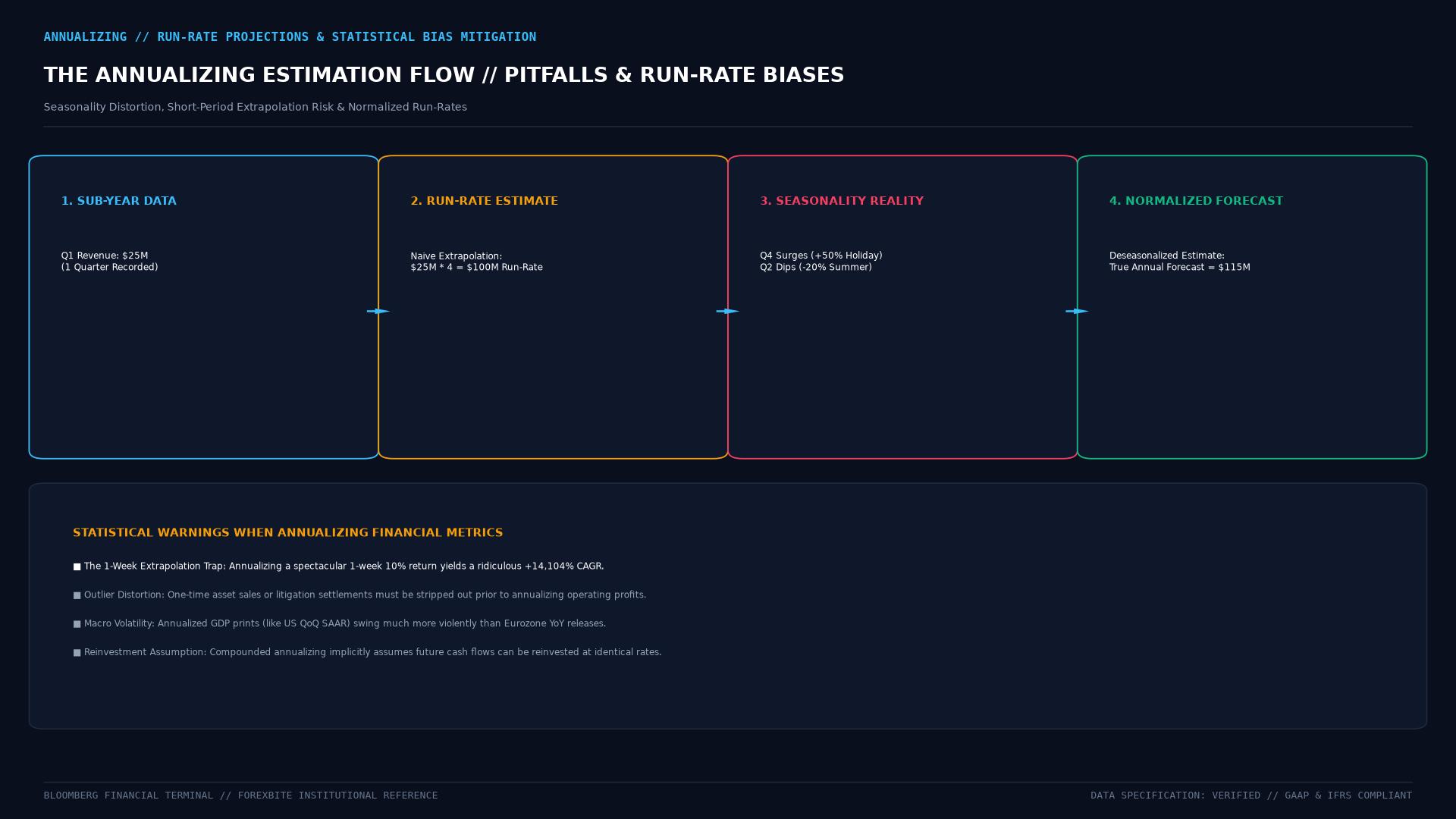 Figure: Systematic annualization workflow for quarterly GDP, monthly inflation (CPI), and corporate earnings, contrasting Compounded Annual Rate (SAAR) with Run-Rate methods and seasonal smoothing filters.
Core Applications in Corporate Finance
Annualizing is routinely applied across multiple corporate accounting disciplines:
1. The Run-Rate Revenue Calculation
In fast-growing technology, media, and subscription software sectors, trailing twelve-month (TTM) historical figures fail to reflect current operating scale. Corporate finance desks calculate Annual Run-Rate Revenue:
$$\text{Annual Run-Rate} = \text{Latest Period Revenue} \times \text{Periods per Year}$$
If a software firm records $1,500,000 in monthly recurring software licenses in June, its annualized run-rate stands at $18,000,000 ($1,500,000 \times 12$). Investment bankers utilize this annualized run-rate as the baseline denominator when negotiating enterprise valuation multiples during M&A rounds.
2. Interim Corporate Tax Estimation (ASC 740)
Under US GAAP (ASC 740), corporations cannot calculate quarterly tax expenses based solely on that quarter’s standalone income. Instead, corporate controllers must estimate the Estimated Annual Effective Tax Rate (EAETR) by annualizing projected full-year taxable income, applying that annualized rate to year-to-date operating earnings.
3. Interim Financial Ratios
When calculating credit covenants (such as the Interest Coverage Ratio or Net Debt-to-EBITDA) at mid-year review dates, lenders annualize interim six-month EBITDA (multiplying by 2) to evaluate whether the borrower complies with ongoing loan agreements.
Comparative Methodologies: Linear vs. Seasonally Adjusted
The following matrix contrasts common annualizing methodologies deployed by financial analysts:
| Annualizing Method | Mathematical Formula | Key Advantage | Primary Limitation |
|---|---|---|---|
| Linear Simple Run-Rate | $\text{Metric} \times \left( \frac{12}{\text{Months}} \right)$ | Rapid, transparent, and easy to compute | Completely ignores seasonal sales peaks and cyclical slowdowns |
| Seasonally Adjusted (SAAR) | $\text{Metric} / \text{Historical Seasonal Factor}$ | Corrects for predictable holiday or weather distortions | Requires robust historical multi-year seasonal data |
| Rolling Last-Twelve-Months (LTM) | $\text{Prior Full Year} - \text{Prior Period} + \text{New Period}$ | Uses 100% actual historical data; eliminates estimation error | Backward-looking; lags sudden inflection points |
                 SEASONAL ANNUALIZING VS. LINEAR RUN-RATE
Retailer generates $4,000,000 Revenue in Q4 (Holiday Season).
- Linear Run-Rate Method:       $4,000,000 × 4 = $16,000,000  (MASSIVELY OVERSTATED!)
- Seasonally Adjusted Method:   Q4 historically represents 40% of annual sales.
                                $4,000,000 / 0.40 = $10,000,000 (REALISTIC PROJECTION!)
Annualizing in Macroeconomic Indicators
Central banks and economic ministries apply annualizing techniques to eliminate short-term calendar noise:
- Inflation Annualizing (Month-over-Month to Annualized Rate): Economists convert volatile monthly Consumer Price Index (CPI) readings into annualized momentum figures: $$\text{Annualized Monthly Inflation} = \left[ (1 + \text{MoM CPI})^{12} - 1 \right] \times 100$$ If headline CPI rises by 0.3% in July, the annualized monthly inflation rate is 3.66%, indicating whether short-term price momentum is aligning with the central bank’s 2.0% target.
- Housing Starts: The US Department of Housing and Urban Development reports residential home construction on an annualized basis, transforming monthly building permits into the total volume of houses that would be built if that monthly pace persisted for a full twelve months.
Critical Risks: What Can Go Wrong When Annualizing
Relying on annualized figures without investigating the underlying qualitative drivers creates dangerous analytical vulnerabilities:
- Extrapolating Non-Recurring Windfalls: If an enterprise records an extraordinary $5,000,000 legal settlement or asset divestiture in Q2, annualizing that quarter’s net income by multiplying by four artificially bloats projected annual profitability by $20,000,000, distorting valuation models.
- Ignoring Capacity Limits: An industrial manufacturing plant operating at 95% capacity during a single surge month cannot physically maintain that pace for a full year without equipment downtime, maintenance overhauls, and supply chain constraints.
- Burn-Rate Projections in Distressed Entities: Annualizing cash burn from a benign single quarter often conceals impending insolvency if large semiannual bond coupon payments or tax liabilities are scheduled for subsequent quarters.
Frequently Asked Questions
Why do venture capitalists prefer annualized run-rate over trailing twelve-month revenue?
In high-growth early-stage startups, trailing twelve-month (TTM) figures are heavily depressed by low revenue recorded 9 to 12 months ago when the enterprise was much smaller. Annualizing the most recent month of subscription billings provides a more accurate reflection of current commercial scale and forward-looking momentum.
How does annualizing differ from seasonal adjustment?
Annualizing scales a short-term figure into a full-year 12-month total. Seasonal adjustment removes predictable recurring calendar effects (such as post-holiday retail lulls or winter agricultural slowdowns) from monthly or quarterly data before the annualizing formula is applied.
What is the formula for annualizing a 6-month bond yield?
For a 6-month bond paying a periodic yield of $y$, the nominal annualized yield is calculated as $y \times 2$. To account for semiannual compounding of interest, the effective annualized yield is computed as $(1 + y)^2 - 1$.
Ready to trade forex?
Open a free demo account with a regulated broker. Practice with virtual funds before risking real money.