Annuitant
An annuitant is the designated individual whose life expectancy determines the timing, duration, and dollar amount of periodic benefit payments disbursed under an annuity insurance contract.
What Is an Annuitant?
An annuitant is the individual whose life expectancy serves as the formal actuarial measuring benchmark for an annuity contract issued by a life insurance company, and who is entitled to receive the contractual stream of periodic income distributions. In insurance and pension mathematics, the life expectancy, biological age, and gender of the annuitant dictate the exact dollar amount of each monthly or annual payment disbursed once the contract enters its distribution phase.
While the annuitant is commonly the person who purchased the annuity, insurance contracts draw strict legal distinctions between three distinct parties: the Contract Owner, the Annuitant, and the Beneficiary.
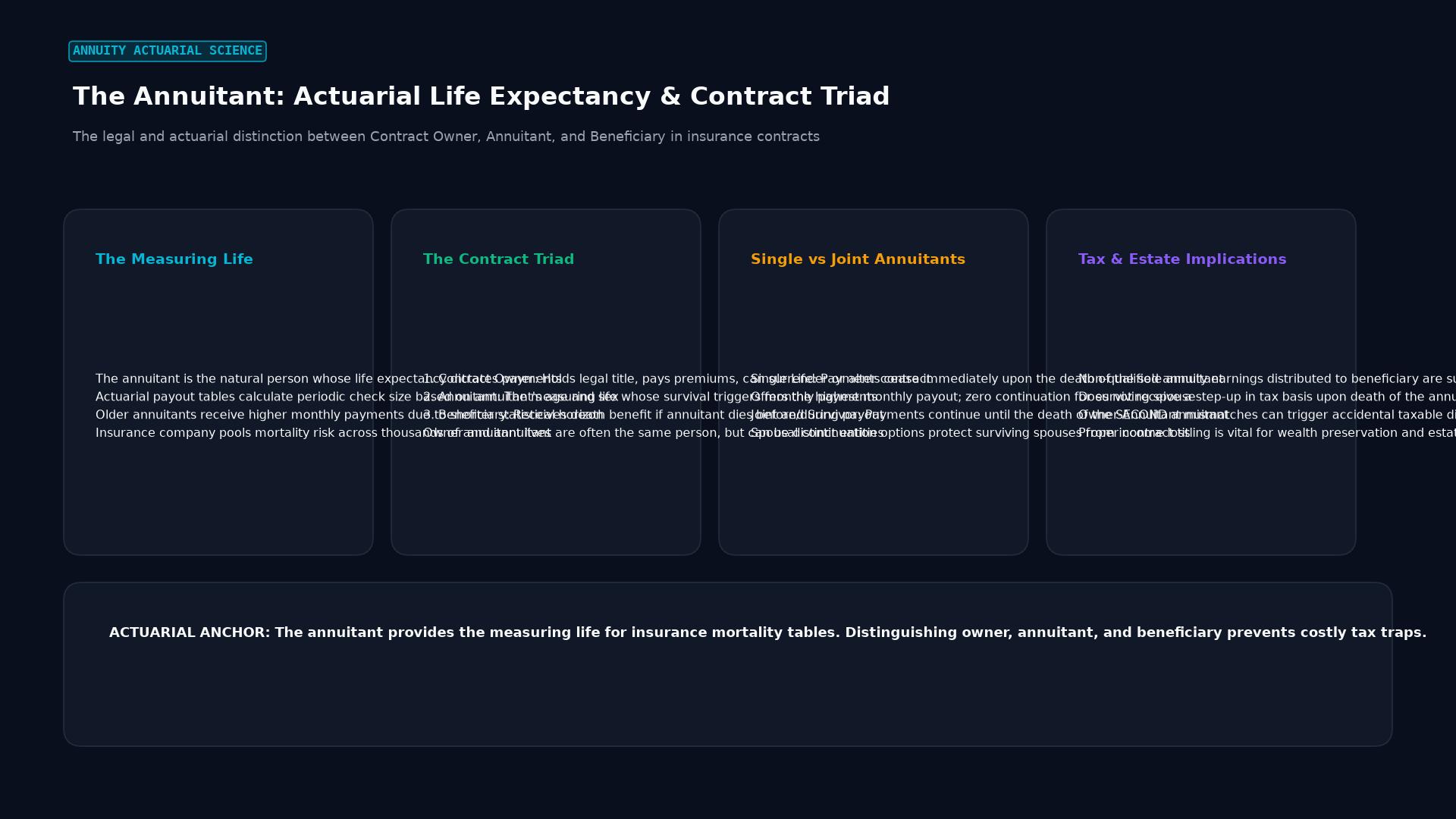 Figure: The legal and actuarial distinction between Contract Owner, Annuitant, and Beneficiary in insurance contracts
The Three Parties to an Annuity Contract
Understanding the legal rights and tax consequences of an annuity requires separating the three designated roles:
| Contract Role | Legal Rights & Powers | Tax Liability | Can Be Changed? |
|---|---|---|---|
| Contract Owner | Full control; power to withdraw funds, change beneficiaries, or annuitize | Responsible for income taxes on withdrawals during accumulation | Yes, ownership can be transferred |
| Annuitant | Purely the actuarial measuring life; receives scheduled income streams | Reports income taxes on annuitized lifetime payments received | No, cannot be changed once established |
| Beneficiary | Holds zero rights during owner’s life; receives residual death benefits | Responsible for income taxes on inherited taxable gains | Yes, can be updated by the owner anytime |
In most retail retirement contracts, the Owner and the Annuitant are the identical individual (e.g., a retiree buys an annuity with personal savings to fund retirement living expenses). However, structural splits are common in estate planning and corporate executive deferred compensation.
Actuarial Mathematics and Mortality Tables
The insurance company’s pricing actuaries determine the periodic payment amount ($PMT$) disbursed to an annuitant using mortality tables (such as the Annuity 2000 Mortality Table or Society of Actuaries Individual Annuity Reserving Table):
$$PMT = \frac{\text{Accumulated Contract Value}}{\ddot{a}_x}$$
Where $\ddot{a}_x$ represents the actuarial present value of an annuity-due of 1 per period payable for the remaining life of an individual aged $x$:
$$\ddot{a}x = \sum{t=0}^{\infty} v^t \cdot {}_t p_x$$
Where:
- $v^t = (1 + i)^{-t}$ is the financial discount factor at assumed interest rate $i$.
- ${}_t p_x$ is the probability that an annuitant aged $x$ will survive for at least $t$ additional years.
                 ANNUITANT AGE AND MONTHLY PAYOUT SIZE
Monthly Income on $500,000 Single Premium Immediate Annuity (SPIA)
Annuitant Age at Commencement       Actuarial Life Expectancy       Estimated Monthly Payout
─────────────────────────────       ─────────────────────────       ────────────────────────
Age 60                              ~24.5 Years                     $2,750 / month
Age 65                              ~20.0 Years                     $3,150 / month
Age 70                              ~15.8 Years                     $3,720 / month
Age 75                              ~12.0 Years                     $4,510 / month
Because an older annuitant has a shorter actuarial life expectancy, the insurance carrier distributes the principal and interest across fewer projected years, resulting in a substantially higher monthly income stream.
Contract Structures: Single Life vs. Joint Annuitants
When an annuity is finalized, the contract owner selects the payout structure governing the annuitant’s life:
1. Single Life Annuity (Straight Life)
Payments continue for the natural lifespan of the designated annuitant, extinguishing immediately upon the annuitant’s death. This structure produces the highest possible monthly cash payout because the insurer assumes zero obligation to pay heirs after death.
Risk: If the annuitant dies six months after commencing payouts, the insurance company retains the remaining balance, leaving zero residual proceeds for heirs unless a “period certain” guarantee was purchased.
2. Joint and Survivor Annuity
The contract establishes two annuitants (typically spouses: Primary Annuitant and Secondary Annuitant).
- Monthly distributions continue as long as either annuitant survives.
- The contract can specify that payments remain at 100% following the first death, or reduce to 75%, 66%, or 50% to lower initial underwriting costs.
- Under ERISA Section 205, married participants in qualified corporate pension plans are legally required to receive their benefit as a Qualified Joint and Survivor Annuity (QJSA) unless the spouse formally signs a notarized waiver.
Taxation of Payments Received by the Annuitant
When an annuitant receives distributions from a non-qualified annuity (purchased with after-tax personal funds), payments are not taxed entirely as income. The IRS applies the Exclusion Ratio under IRC Section 72:
$$\text{Exclusion Ratio} = \frac{\text{Total Investment in Contract (Cost Basis)}}{\text{Total Expected Return Over Life Expectancy}}$$
Each monthly payment is split into two components:
- Tax-Free Return of Principal: The portion representing the original cost basis ($\text{Payment} \times \text{Exclusion Ratio}$).
- Taxable Ordinary Income: The remaining portion representing accumulated interest, dividends, and market gains, taxed at the annuitant’s marginal ordinary income tax rate.
Once the annuitant lives past their actuarial life expectancy and has fully recouped their original cost basis, all subsequent payments become 100% taxable as ordinary income.
Frequently Asked Questions
Can an annuitant change the payout schedule once annuitization begins?
No. Once an annuity is formally annuitized into an irrevocable stream of lifetime income payments, the terms are legally locked. The annuitant cannot increase the monthly payment, withdraw a lump sum, or reverse the contract.
What happens if the contract owner and the annuitant are different people and the owner dies?
Under federal tax law (IRC Section 72(s)), if the contract owner dies before the annuity is fully annuitized, the contract value must be distributed to the designated beneficiary within five years or paid out over the beneficiary’s life expectancy, even if the named annuitant is still alive.
What is a “contingent annuitant”?
A contingent (or secondary) annuitant is an individual designated in a joint-and-survivor annuity contract who begins receiving payments only after the primary annuitant passes away, ensuring uninterrupted income for a surviving spouse.
Ready to trade forex?
Open a free demo account with a regulated broker. Practice with virtual funds before risking real money.