Annuitize
To annuitize is the irreversible process of converting an accumulated annuity cash balance into a permanent, guaranteed stream of periodic income distributions over a specified period or the annuitant's lifetime.
What Does It Mean to Annuitize?
To annuitize is the formal legal and contractual act of converting the accumulated cash value of a deferred annuity into an irrevocable series of scheduled, periodic income distributions. Executed between the contract owner and a life insurance company, annuitization marks the structural transition from the accumulation phase (where savings compound on a tax-deferred basis) to the distribution (payout) phase (where the insurer guarantees regular income for life or a fixed multi-year period).
Once an investor elects to annuitize, the underlying lump-sum principal is surrendered to the insurance company’s general or separate account in exchange for the insurer’s contractual guarantee of lifetime income. Because annuitization is permanent and irreversible, selecting the appropriate payout option requires thorough analysis of longevity expectations, inflation risk, and spousal survivor needs.
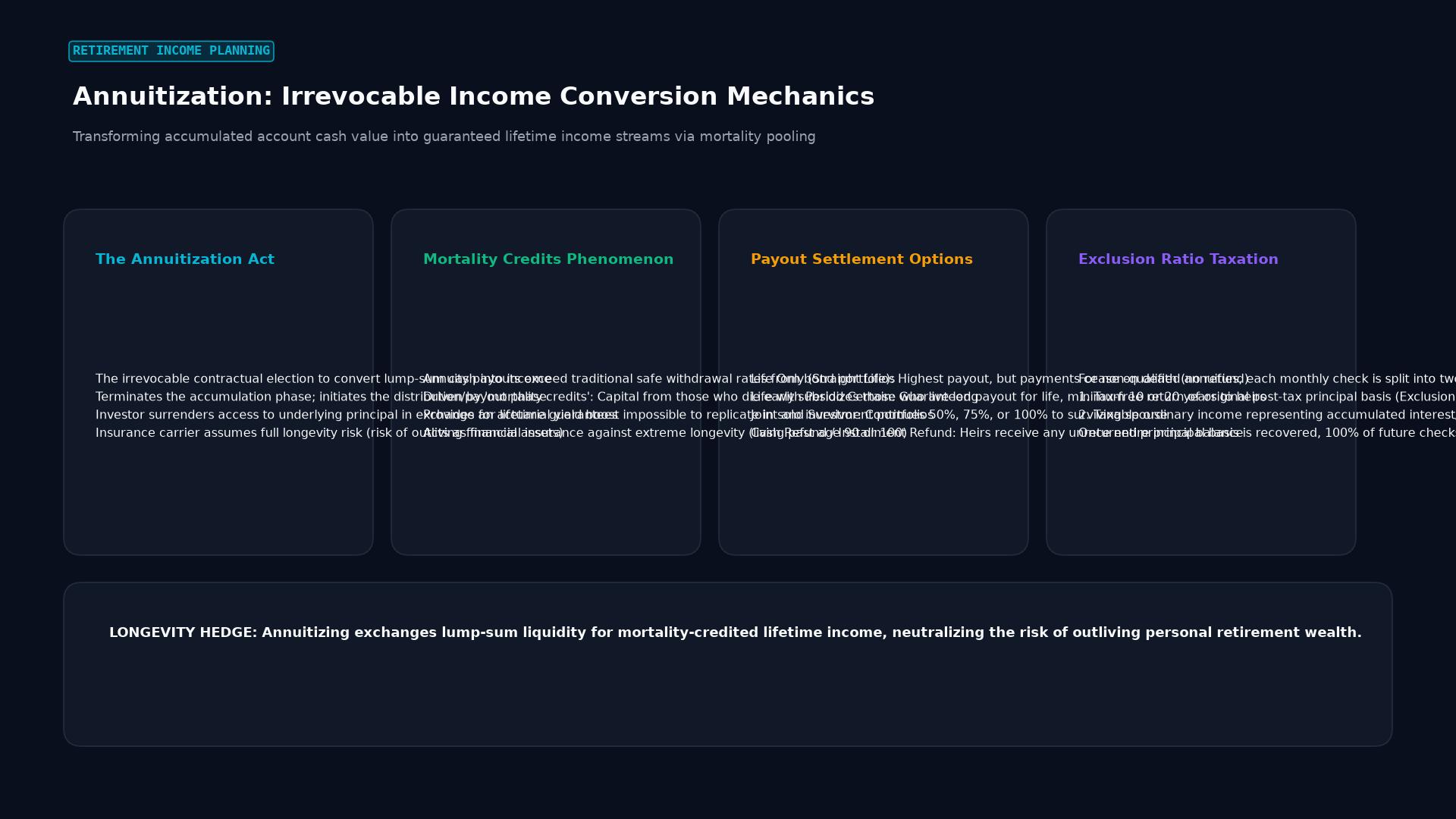 Figure: Transforming accumulated account cash value into guaranteed lifetime income streams via mortality pooling
Primary Annuitization Payout Structures
When electing to annuitize, contract owners must choose from several standardized settlement options:
| Settlement Option | Duration of Payout | Capital Protection for Heirs | Relative Monthly Payout Size |
|---|---|---|---|
| Straight Life (Life Only) | Natural life of the annuitant | Zero; payments cease immediately upon death | Highest (Maximum monthly cash flow) |
| Life with Period Certain | Annuitant’s life, with a guaranteed minimum period (e.g., 10 or 20 years) | Heirs receive remaining payments if annuitant dies before period ends | Moderate to High |
| Joint and Survivor | Lifespan of two individuals (annuitant and spouse) | Payouts continue to surviving spouse (at 50%, 75%, or 100%) | Moderate (Lower due to dual lives) |
| Cash Refund / Installment Refund | Annuitant’s life | Beneficiaries receive the difference between principal and total payments paid | Moderate |
| Period Certain Only (Fixed Term) | Fixed number of years only (e.g., 15 years); no life contingency | Heirs receive remaining payments if annuitant dies during term | Dictated strictly by term and interest rate |
                 PAYOUT STRUCTURE COMPARISON ON $500,000
Settlement Structure          Guaranteed Monthly Income       Residual Heirs Protection
────────────────────          ─────────────────────────       ─────────────────────────
Straight Life Only:           $3,200 / month                  None (Insurer keeps balance)
Life with 10-Yr Certain:      $3,050 / month                  10-year floor for heirs
Life with 20-Yr Certain:      $2,780 / month                  20-year floor for heirs
Joint & Survivor (100%):      $2,550 / month                  Surviving spouse protected
Economic Trade-Offs: Why Annuitize?
The decision to annuitize represents an explicit transfer of financial risk from the individual to an institutional balance sheet:
1. Eliminating Longevity Risk (The “Mortality Credits” Advantage)
If an individual manages their own retirement portfolio using the standard 4% safe withdrawal rule, they face the risk of running out of money if they live to age 95 or endure a severe early bear market (sequence-of-returns risk).
When investors annuitize into a life insurance pool, those who die earlier than average leave capital behind in the pool, subsidizing payments to those who live longer. These actuarial gains, known as mortality credits, allow insurers to offer higher guaranteed withdrawal rates than an individual could safely achieve investing alone.
2. The Loss of Capital Liquidity
The primary drawback of annuitizing is the absolute surrender of principal. Once annuitization begins:
- The contract owner no longer owns an accessible cash account.
- The investor cannot access a lump sum to pay for medical emergencies or capital expenditures.
- Future payments cannot be accelerated or adjusted upward if market inflation surges.
Modern Alternatives: Guaranteed Lifetime Income Riders (GLWBs)
Due to consumer reluctance to permanently surrender principal via traditional annuitization, insurance carriers developed the Guaranteed Lifetime Withdrawal Benefit (GLWB) rider on variable and fixed indexed annuities:
              TRADITIONAL ANNUITIZATION VS. GLWB RIDER
Dimension                   Traditional Annuitization         GLWB Income Rider
─────────                   ─────────────────────────         ─────────────────
Principal Control:          Surrendered permanently           Retained by owner
Withdrawal Flexibility:     Locked; zero lump-sum access      Owner can withdraw principal
Heirs Legacy:               Often extinguished upon death     Remaining balance passes to heirs
Contract Fee:               Zero ongoing rider fee            0.75% to 1.50% annual rider fee
Guaranteed Lifetime Income: Contractual obligation            Contractual obligation
With a GLWB, the investor receives a guaranteed stream of income for life while maintaining their underlying investment account balance. If the account balance drops to zero through longevity, the insurer continues paying the guaranteed income from its own reserves.
Tax Implications: Non-Qualified Annuity Exclusion Ratios
When annuitizing a non-qualified annuity (funded with personal after-tax dollars), Internal Revenue Code Section 72 requires using the Exclusion Ratio to divide each payment into taxable and non-taxable portions:
$$\text{Exclusion Ratio} = \frac{\text{Initial Investment in Contract}}{\text{Expected Return Over Actuarial Life Expectancy}}$$
If a retiree invests $200,000, and their actuarial life expectancy projects total lifetime payments of $400,000:
- The Exclusion Ratio is $50%$ ($$200,000 / $400,000$).
- Exactly half of each monthly check is treated as a tax-free return of personal capital.
- The remaining half is taxed as ordinary income at the investor’s current tax bracket.
By contrast, annuitizing a Qualified Annuity (held inside a traditional IRA or 401(k)) results in 100% of every distribution being taxed as ordinary income, because the initial contributions were made with pre-tax dollars.
Frequently Asked Questions
Can a contract owner reverse the decision to annuitize?
No. Standard state insurance regulations and contract statutes make annuitization completely irrevocable once the statutory “free look” period (typically 10 to 30 days after signing) expires.
What is the difference between an immediate annuity and annuitizing a deferred annuity?
A Single Premium Immediate Annuity (SPIA) is purchased with a single lump-sum check and annuitizes immediately, with payouts beginning within 30 days. Annuitizing a deferred annuity occurs after the contract has spent years or decades growing tax-deferred in the accumulation phase.
How does the prevailing interest rate environment impact annuitization?
Annuitization rates are heavily tied to prevailing benchmark bond yields. If an investor annuitizes during an era of elevated interest rates, the insurer locks in higher bond coupon yields, producing permanently higher monthly lifetime payments than if the contract were annuitized during a near-zero interest rate regime.
Ready to trade forex?
Open a free demo account with a regulated broker. Practice with virtual funds before risking real money.