Annuity factor method
The annuity factor method is an IRS-sanctioned distribution formula under Section 72(t) that utilizes actuarial mortality tables and statutory interest rates to determine fixed, penalty-free early retirement withdrawals.
What Is the Annuity Factor Method?
The annuity factor method is one of three statutory calculation frameworks authorized by the Internal Revenue Service (IRS) under Internal Revenue Code (IRC) Section 72(t). It allows individuals under the age of $59\frac{1}{2}$ to take a series of Substantially Equal Periodic Payments (SEPP) from their traditional IRA, 401(k), or other qualified retirement plans without triggering the standard 10% IRS early withdrawal penalty.
Under the annuity factor method, the annual distribution amount is determined by dividing the retirement account’s total cash balance by an actuarial annuity factor derived from approved IRS mortality tables and an authorized statutory interest rate. Once established, the annual distribution amount remains fixed for the duration of the SEPP schedule, providing predictable income for early retirees.
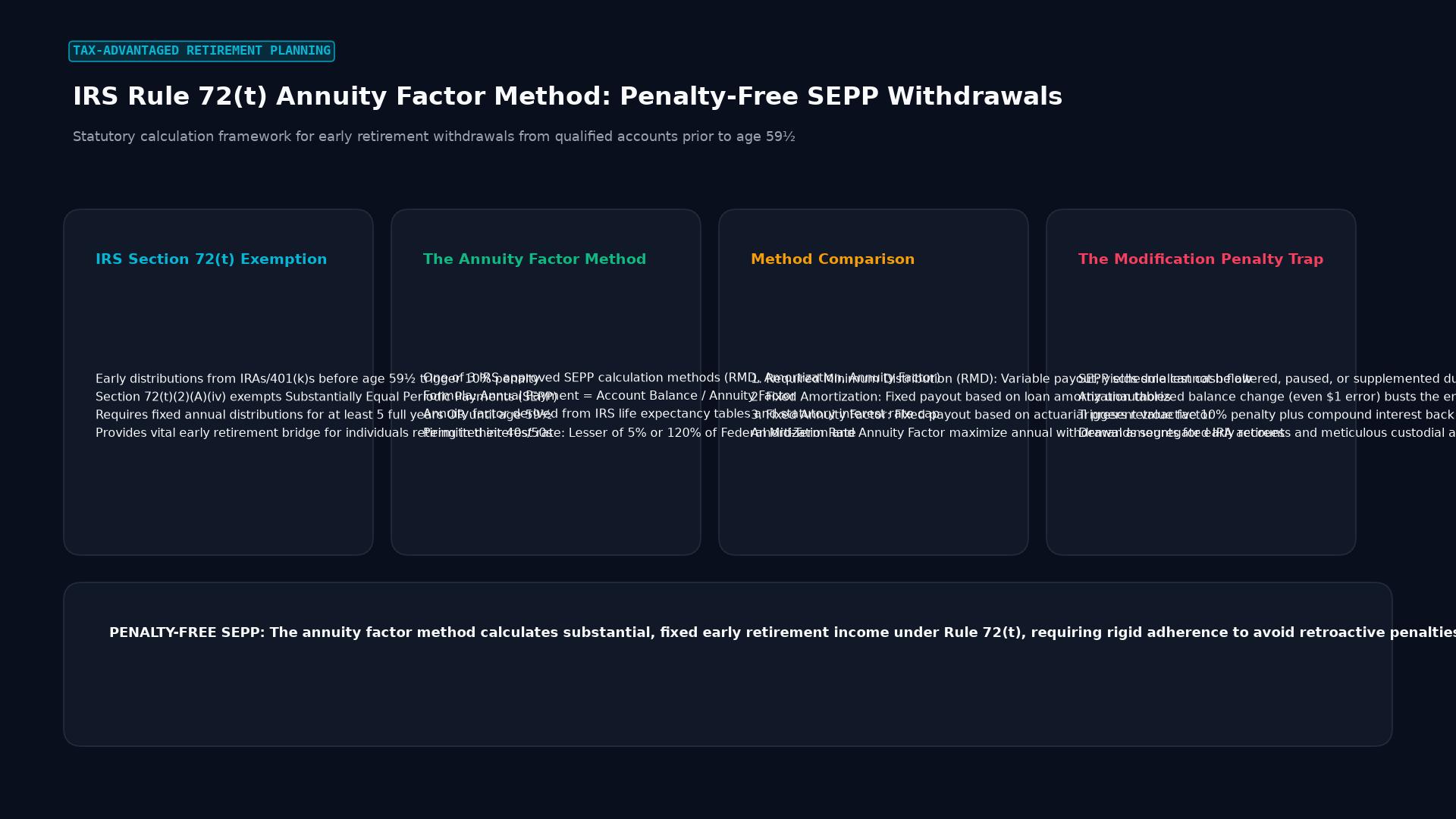 Figure: Statutory calculation framework for early retirement withdrawals from qualified accounts prior to age 59½
The Three IRS Section 72(t) Calculation Methods
Taxpayers initiating a SEPP schedule under IRS Notice 2022-6 must select from three distinct methodologies:
| SEPP Method | Calculation Mechanics | Annual Payment Behavior | Relative Payout Size |
|---|---|---|---|
| Required Minimum Distribution (RMD) | Account balance divided annually by IRS life expectancy factor | Variable; fluctuates each year based on balance and aging | Lowest (Preserves maximum account balance) |
| Fixed Amortization Method | Amortizes balance over life expectancy using a fixed statutory rate | Fixed; remains identical every year | Highest (Maximizes cash flow) |
| Annuity Factor Method | Account balance divided by an actuarial single-life annuity factor | Fixed; remains identical every year | Very Close to Amortization (Typically within 0.1%) |
While both the amortization method and the annuity factor method generate fixed annual distributions, the annuity factor method derives its payout directly through continuous actuarial life table present-value discounting rather than an ordinary bank loan amortization schedule.
Mathematical Derivation of the Annuity Factor
The annuity factor represents the actuarial present value of an annuity-due that pays $1 per year for the life of the account owner, beginning at age $x$:
$$\text{Annual SEPP Payment} = \frac{\text{Account Balance}}{\text{Annuity Factor } (a_x)}$$
The actuarial factor is computed using the standard summation formula:
$$a_x = \sum_{t=0}^{\infty} \left( \frac{1}{1 + r} \right)^t \cdot {}_t p_x$$
Where:
- $r$ = Chosen statutory interest rate.
- ${}_t p_x$ = The probability that an individual aged $x$ will survive for at least $t$ years, extracted directly from approved IRS mortality tables:
- The Uniform Lifetime Table (most common; produces the highest factor and modest payouts).
- The Single Life Expectancy Table (produces smaller factors and higher annual payouts).
- The Joint and Last Survivor Table (used when naming a designated spousal beneficiary).
                 ANNUITY FACTOR CALCULATION EXAMPLE
Account Balance:                 $1,000,000
Taxpayer Age:                    52
Selected Interest Rate:          4.50% (Complies with Notice 2022-6)
Mortality Table:                 IRS Single Life Expectancy
Calculated Annuity Factor (a_x): 15.824
Annual SEPP Payment:             $1,000,000 / 15.824 = $63,195.15 / year
Under this schedule, the 52-year-old taxpayer withdraws exactly $63,195.15 annually without incurring the 10% penalty ($6,319.52 saved per year in IRS penalties).
IRS Notice 2022-6: Modern Interest Rate Rules
Prior to 2022, IRS rules capped the interest rate used in SEPP calculations at 120% of the federal mid-term rate, which caused withdrawal allowances to collapse during the zero-interest-rate environment following 2008.
Under IRS Notice 2022-6, the Treasury modernized the interest rate guidelines:
- The permissible interest rate is defined as any rate that is not more than the greater of:
- 5.00%, or
- 120% of the federal mid-term rate for either of the two months preceding the month in which the distribution schedule begins.
This 5.0% statutory floor guarantees that early retirees can achieve meaningful liquidity from their retirement balances regardless of prevailing Federal Reserve benchmark rate cuts.
The Irrevocable Five-Year / Age 59½ Rule
Once an annuity factor SEPP schedule begins, the taxpayer must strictly adhere to the distribution schedule under the “Five-Year or Age 59½ Rule” (whichever is longer):
                   SEPP SCHEDULE DURATION TIMELINE
Retiree Starts SEPP at Age 50:
- Reaches Age 55 (5 years elapsed) --> CANNOT STOP! Must continue until Age 59½.
- Total Schedule Duration: 9.5 Years.

Retiree Starts SEPP at Age 57:
- Reaches Age 59½ (2.5 years elapsed) --> CANNOT STOP! Must complete full 5 years.
- Total Schedule Duration: 5.0 Years (Ends at Age 62).
The Modification Penalty Trap
If a taxpayer modifies the distribution amount by withdrawing even $1 more or $1 less than the exact calculated annual figure, or makes a non-scheduled deposit to the account:
- The SEPP schedule is disqualified retroactively.
- The taxpayer becomes immediately liable for the full 10% penalty on all distributions taken since day one, plus cumulative statutory compound interest charges back to the first year of the plan.
Frequently Asked Questions
Can a taxpayer switch from the annuity factor method to the RMD method?
Yes. The IRS grants taxpayers a one-time, irrevocable election to switch from either the fixed amortization method or the annuity factor method to the required minimum distribution (RMD) method without triggering retroactive penalty disqualification. This escape hatch is vital if a market crash drastically reduces account value, allowing the taxpayer to lower distributions to prevent running out of money.
Can a taxpayer run a SEPP plan on only one of several IRAs?
Yes. SEPP schedules are established on specific individual IRA accounts. A retiree with $1,500,000 across multiple accounts can partition $500,000 into a separate, distinct rollover IRA and initiate a SEPP schedule solely on that account, leaving the remaining $1,000,000 untouched for future growth.
Are SEPP distributions subject to ordinary income taxes?
Yes. While Section 72(t) exempts the taxpayer from the 10% early withdrawal excise penalty, the distributions taken from pre-tax retirement accounts remain fully subject to federal and state ordinary income taxes.
Ready to trade forex?
Open a free demo account with a regulated broker. Practice with virtual funds before risking real money.