Antique
An antique is a physical collectible asset, such as fine art, historic furniture, or rare coinage, valued for its historical significance, aesthetic craftsmanship, and statutory minimum age of 100 years.
What Is an Antique in Alternative Investing?
In asset management, wealth preservation, and customs law, an antique is a tangible, collectible physical asset (including fine furniture, decorative arts, historic jewelry, rare numismatic coins, and horological timepieces) that derives monetary value from its historical provenance, craftsmanship, aesthetic rarity, and chronological age.
While everyday language often conflates antiques with vintage or retro items, legal and financial authorities enforce strict statutory definitions: under United States Customs and Border Protection (CBP) regulations and international trade treaties (such as the Harmonized Tariff Schedule), an item must generally be at least 100 years of age to qualify legally as an authentic antique.
In portfolio construction, high-net-worth family offices treat certified museum-grade antiques as an exotic sub-class of alternative real assets, utilized primarily as non-correlated stores of value and tangible hedges against fiat currency debasement.
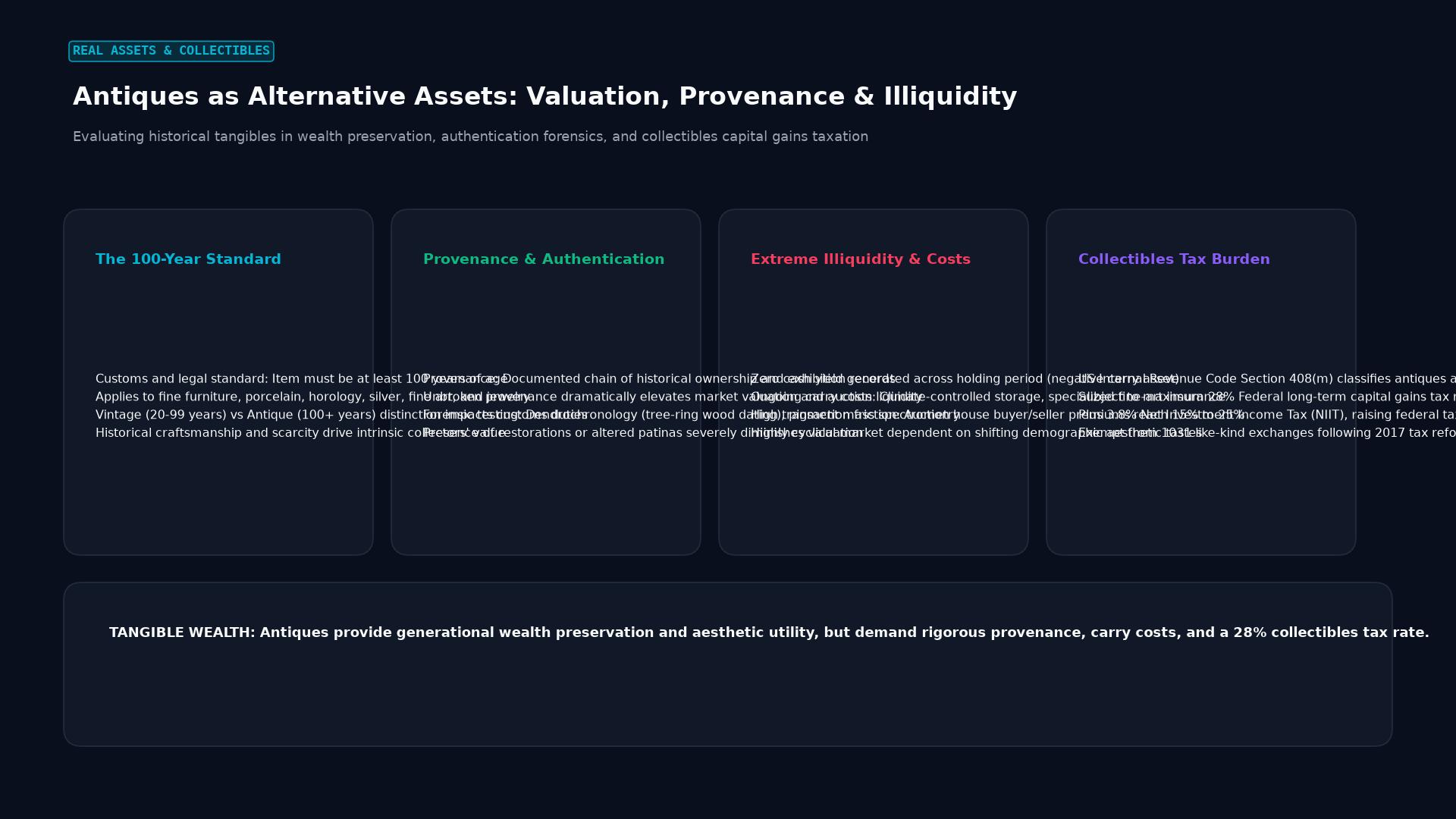 Figure: Evaluating historical tangibles in wealth preservation, authentication forensics, and collectibles capital gains taxation
Legal and Customs Definition: The 100-Year Rule
The 100-year statutory threshold was formalized in the US Tariff Act of 1930 (Smoot-Hawley Act), which established that items produced more than 100 years prior to the date of importation are exempt from standard customs duties:
- Harmonized Tariff Schedule (HTS) Chapter 97: Categorizes authentic antiques under heading 9706.00.00 (“Antiques of an age exceeding one hundred years”). Importers can bring qualified antiques into the United States duty-free, provided historical documentation and scientific provenance certify the item’s age.
- Exceptions for Fine Art: Under HTS Chapter 97, original paintings, drawings, and sculptures created entirely by hand are admitted duty-free regardless of age, separating pure fine art from decorative antiques.
Tax Treatment: The Collectibles Capital Gains Rate (IRC § 1(h))
For investors and collectors subject to US federal taxation, antiques face punitive capital gains tax rates compared to traditional stocks and bonds:
| Asset Class | Standard Long-Term Capital Gains Rate | Net Investment Income Tax (NIIT) | Maximum Federal Capital Gains Tax |
|---|---|---|---|
| Public Equities & Bonds | 15% to 20% | 3.8% | 23.8% |
| Antiques & Collectibles | Up to 28% (IRC § 1(h)) | 3.8% | 31.8% |
                 TAX DRAG ON ANTIQUE GAINS (IRC § 1(h))
Realized Capital Gain: $100,000 on Rare Antique Clock (Held > 1 Year)
- Standard Public Equity Long-Term Tax: $20,000 (20.0%)
- Collectibles Tax Rate under § 1(h):   $28,000 (28.0%)
- Plus Net Investment Income Tax (3.8%):$3,800
Total Federal Tax Due:                 $31,800 (31.8% Top Rate)
Under Internal Revenue Code Section 408(m), holding physical antiques or collectibles inside self-directed IRAs or 401(k) accounts is strictly prohibited. The IRS treats the purchase of an antique using IRA funds as an immediate deemed distribution, triggering full ordinary income taxes and a 10% early withdrawal excise penalty.
Valuation Factors and Market Microstructure
Unlike public equities that trade continuously on automated electronic exchanges with transparent bid-ask spreads, the antique market is highly fragmented, opaque, and illiquid.
Valuation is established through four institutional pillars:
- Provenance: The documented, verifiable chain of custody and ownership history. An 18th-century French commode once owned by European royalty commands a substantial multiple over an identical craftsman piece lacking historical documentation.
- Condition and Conservation: Original surface finishes, undisturbed patinas, and intact mechanical movements are paramount. Injudicious restoration (such as chemically stripping an antique desk’s original lacquer or polishing a historic coin) can instantly destroy up to 80% of its market value.
- Authentication and Scientific Testing: High-end transactions rely on radiocarbon dating, dendrochronology (tree-ring analysis of furniture wood), and X-ray fluorescence (XRF) spectroscopy to detect counterfeit materials or modern pigments.
- Auction House Transaction Friction: Buying and selling through premier auction houses (such as Christie’s or Sotheby’s) incurs massive liquidity haircuts:
- Buyer’s Premium: An additional fee (typically 20% to 26%) added to the winning hammer price paid by the purchaser.
- Seller’s Commission: A deduction (typically 5% to 15%) subtracted from proceeds paid to the consignor.
                 AUCTION TRANSACTION FRICTION SPREAD
Hammer Price (Bid Price):        $100,000
Buyer Pays (Hammer + 25% Premium): $125,000 Total Outlay
Seller Receives (Hammer - 10% Fee): $90,000 Net Proceeds
Effective Bid-Ask Spread Friction: $35,000 (28% Friction on Capital)
Investment Role in Ultra-High-Net-Worth Portfolios
Institutional wealth managers treat antiques not as yield-generating growth engines, but as specialized capital preservation vaults:
- Zero Counterparty Risk: A physical piece of antique furniture or rare gold coinage has no counterparty solvency risk, immune to commercial bank failures, sovereign debt restructuring, or digital network disruptions.
- Portability and Discretion: Museum-grade pocket watches or jewelry can store millions of dollars in wealth in a compact physical footprint that can be privately transported across international jurisdictions.
- Aesthetic Utility: Unlike a digital share of an index fund, an antique provides the collector with tangible aesthetic enjoyment in a private residence while acting as a store of capital.
Frequently Asked Questions
Can an investor execute a Section 1031 like-kind exchange on antiques?
No. The Tax Cuts and Jobs Act of 2017 amended IRC Section 1031, restricting tax-deferred like-kind exchanges exclusively to real property (real estate). Prior to 2018, collectors could trade high-end art and antiques tax-deferred; today, any sale or exchange of an antique immediately triggers capital gains tax.
How are antiques protected against insurance losses?
Standard homeowners insurance policies provide minimal coverage for fine art and antiques, typically capping payouts at $1,000 to $2,500. Serious collectors purchase specialized Inland Marine Floater Policies or Fine Art Insurance with “agreed value” endorsements, requiring professional appraisals updated every three to five years.
What is the difference between an antique and an antiquity?
While an antique must be at least 100 years old, an antiquity refers to artifacts originating from ancient historical civilizations (typically Classical Greece, Ancient Rome, Egypt, Mesopotamia, or pre-Columbian Mesoamerica), dating back more than 1,000 to 2,000 years. Antiquities face stringent international provenance laws under UNESCO treaties to prevent illegal trafficking in cultural patrimony.
Ready to trade forex?
Open a free demo account with a regulated broker. Practice with virtual funds before risking real money.