Asset
An asset is a resource of economic value owned or controlled by an individual, corporation, or government with the expectation that it will generate future cash flows or economic utility.
What Is an Asset in Finance?
An asset is any economic resource possessing measurable monetary value that is owned or legally controlled by an individual, corporation, or sovereign entity, with the expectation that it will yield future economic utility or positive cash flows. In corporate financial accounting, assets represent the economic deployment of capital raised from shareholders and lenders, forming the foundational debit side of the balance sheet.
Under both US GAAP (FASB Conceptual Framework) and IFRS (IASB Framework), an item qualifies as an asset only if it satisfies three statutory criteria:
- It embodies a probable future economic benefit (generating cash inflows or reducing expenditures).
- The reporting entity obtains the legal right to control the benefit and restrict third-party access.
- The underlying transaction or event generating the control has already occurred.
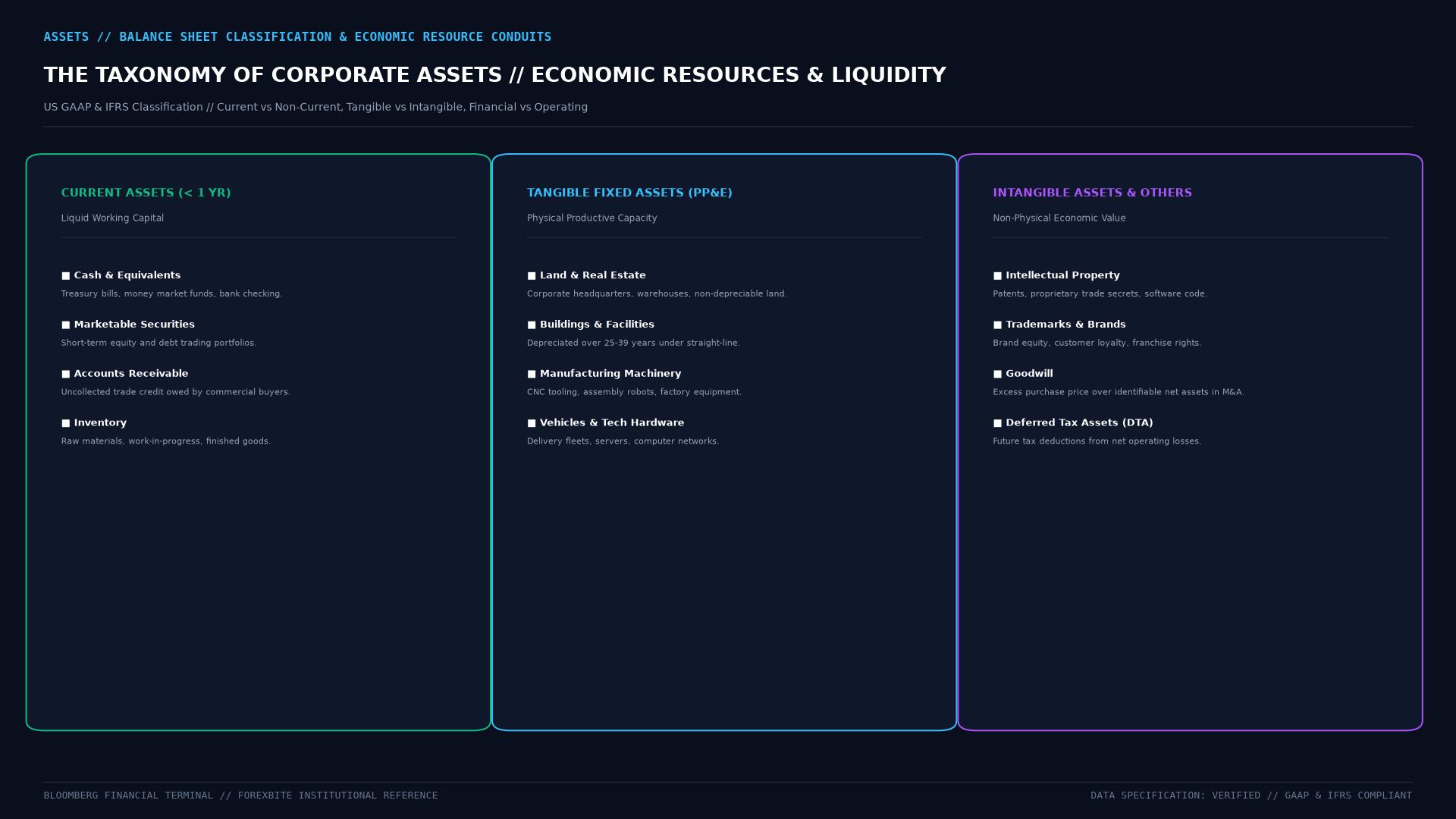 Figure: Comprehensive asset taxonomy spanning Current Liquid Assets, Property Plant & Equipment (PP&E), Intangibles, and Long-Term Financial Investments arranged across the liquidity and risk spectrum.
The Classification of Corporate Assets
On a standard corporate balance sheet, assets are categorized according to their liquidity conversion cycles and physical characteristics:
| Asset Class | Definition & Liquidity Profile | Primary Accounting Standards | Representative Balance Sheet Line Items |
|---|---|---|---|
| Current Assets | Expected to be converted to cash, sold, or consumed within 12 months | ASC 210 / IAS 1 | Cash and cash equivalents, marketable securities, accounts receivable, inventory |
| Non-Current (Fixed) Assets | Long-term physical resources used in operations across multiple years | ASC 360 / IAS 16 | Property, Plant, and Equipment (PP&E), manufacturing machinery, logistics fleets |
| Intangible Assets | Identifiable non-physical legal rights with finite economic utility | ASC 350 / IAS 38 | Patents, proprietary software, trademarks, customer relationship lists |
| Goodwill | Unidentifiable premium paid in corporate acquisitions above net fair value | ASC 350 / IAS 36 | Acquired enterprise goodwill (tested annually for impairment, never amortized) |
| Financial (Investment) Assets | Contractual claims to receive cash or equity instruments from another entity | ASC 320 / IFRS 9 | Equity holdings, government bonds, interest rate swap contracts |
Operating vs. Non-Operating Assets
In corporate valuation and mergers and acquisitions (M&A), equity research analysts segregate assets based on their operational necessity:
                 OPERATING VS. NON-OPERATING ASSETS
+-----------------------------------------------------------------------+
|                             TOTAL ASSETS                              |
+-----------------------------------------------------------------------+
              │                                      │
              ▼                                      ▼
+-------------------------------+      +-------------------------------+
|       Operating Assets        |      |     Non-Operating Assets      |
| - Core to daily revenue engine|      | - Incidental / Redundant      |
| - Working Capital (A/R, Inv)  |      | - Excess unallocated cash     |
| - Production plants & patents |      | - Vacant land / Marketable sec|
| - Drives Net Operating Profit |      | - Added to EV in DCF models   |
+-------------------------------+ +-------------------------------+- Operating Assets: Resources strictly required to produce the company’s daily commercial goods or services. These generate Net Operating Profit After Tax (NOPAT) and drive Free Cash Flow to Firm (FCFF).
- Non-Operating Assets: Excess or non-essential holdings that could be liquidated without interrupting daily operations. In Discounted Cash Flow (DCF) valuation, analysts calculate Enterprise Value from operating cash flows and add back the fair market value of non-operating assets (such as excess cash balances or discontinued investment properties) to determine total implied equity value.
Asset Valuation Frameworks: Historical Cost vs. Fair Value
Financial accounting standards enforce specific valuation rules depending on the asset category:
- Historical Cost Less Accumulated Depreciation: Physical property, plant, and equipment are recorded at their original cash acquisition price plus direct installation expenses, systematically depreciated downward over their useful economic lifespans.
- Fair Value (Mark-to-Market): Liquid financial assets (such as publicly traded equities or derivatives) are revalued at the close of every reporting period based on prevailing secondary market prices under ASC 820 / IFRS 13.
- Lower of Cost or Net Realizable Value (NRV): Under ASC 330, corporate inventories are carried at cost, but must be written down immediately if market obsolescence or price declines reduce their net realizable value below book value.
Asset Efficiency Metrics in Fundamental Analysis
Wall Street analysts track asset utilization ratios to evaluate how productively executive management deploys shareholder capital:
1. Asset Turnover Ratio
Measures the revenue generated per dollar of asset base:
$$\text{Asset Turnover} = \frac{\text{Total Revenue}}{\text{Average Total Assets}}$$
A higher ratio signifies lean, highly efficient capital allocation, characteristic of software and asset-light technology enterprises.
2. Return on Assets (ROA)
Measures net profitability generated across the entire asset base:
$$\text{ROA} = \frac{\text{Net Income}}{\text{Average Total Assets}}$$
Through the DuPont Analysis Framework, ROA is decomposed into profit margin and asset efficiency:
$$\text{ROA} = \left( \frac{\text{Net Income}}{\text{Revenue}} \right) \times \left( \frac{\text{Revenue}}{\text{Average Total Assets}} \right) = \text{Net Profit Margin} \times \text{Asset Turnover}$$
Impairment of Assets (ASC 360 & IAS 36)
When economic shifts, technological obsolescence, or adverse legal rulings permanently diminish an asset’s earning power, accounting rules prohibit carrying the asset at inflated book values:
- Impairment Test: If the undiscounted future cash flows expected from an asset group drop below its current carrying value, an impairment has occurred.
- Income Statement Charge: The asset’s carrying value is written down directly to its fair market value, recognizing an immediate non-cash operating impairment loss that reduces reported net income.
Frequently Asked Questions
Can human capital or employees be listed as assets on a balance sheet?
No. Under standard accounting frameworks, human beings cannot be bought, sold, or legally owned by an enterprise. While executive commentary routinely refers to employees as “our greatest asset,” compensation paid to personnel is expensed as operating payroll on the income statement, not capitalized as an asset.
What is the difference between a tangible asset and an intangible asset?
A tangible asset possesses physical substance that can be seen and touched (such as real estate, machinery, precious metals, and inventory). An intangible asset lacks physical form, deriving economic value entirely from legal rights, intellectual property protections, or contractual privileges (such as patents, trademarks, software code, and customer contracts).
Why is goodwill considered an unidentifiable intangible asset?
Goodwill represents the excess purchase price paid during an acquisition over the net fair value of all identifiable tangible and intangible assets acquired. Because goodwill cannot be severed, sold independently, or transferred separately from the business as a whole, it is classified as an unidentifiable intangible asset and cannot be amortized under public US GAAP rules.
Ready to trade forex?
Open a free demo account with a regulated broker. Practice with virtual funds before risking real money.