Assignment
In options trading and contract law, assignment is the mandatory notification served to an option writer by a clearinghouse, obligating them to fulfill the underlying delivery or purchase terms following an option exercise.
What Is Assignment in Financial Markets?
In securities trading and financial contract law, assignment carries two specialized institutional meanings:
- In Options and Derivatives Trading: Assignment is the formal notification issued by a central clearinghouse (such as the Options Clearing Corporation - OCC) to an option seller (writer), obligating them to fulfill the underlying contract terms. If a short call is assigned, the writer is forced to deliver physical shares at the strike price; if a short put is assigned, the writer is obligated to purchase the underlying shares at the strike price.
- In Commercial Contract Law: Assignment is the legal transfer of a party’s contractual rights, financial claims, or title to property (such as the assignment of accounts receivable in factoring) to a third party under the Uniform Commercial Code (UCC Article 9).
In derivatives microstructure, assignment is the direct counterpart to exercise: when an option buyer exercises their contractual right, an option seller is randomly selected to receive the assignment obligation.
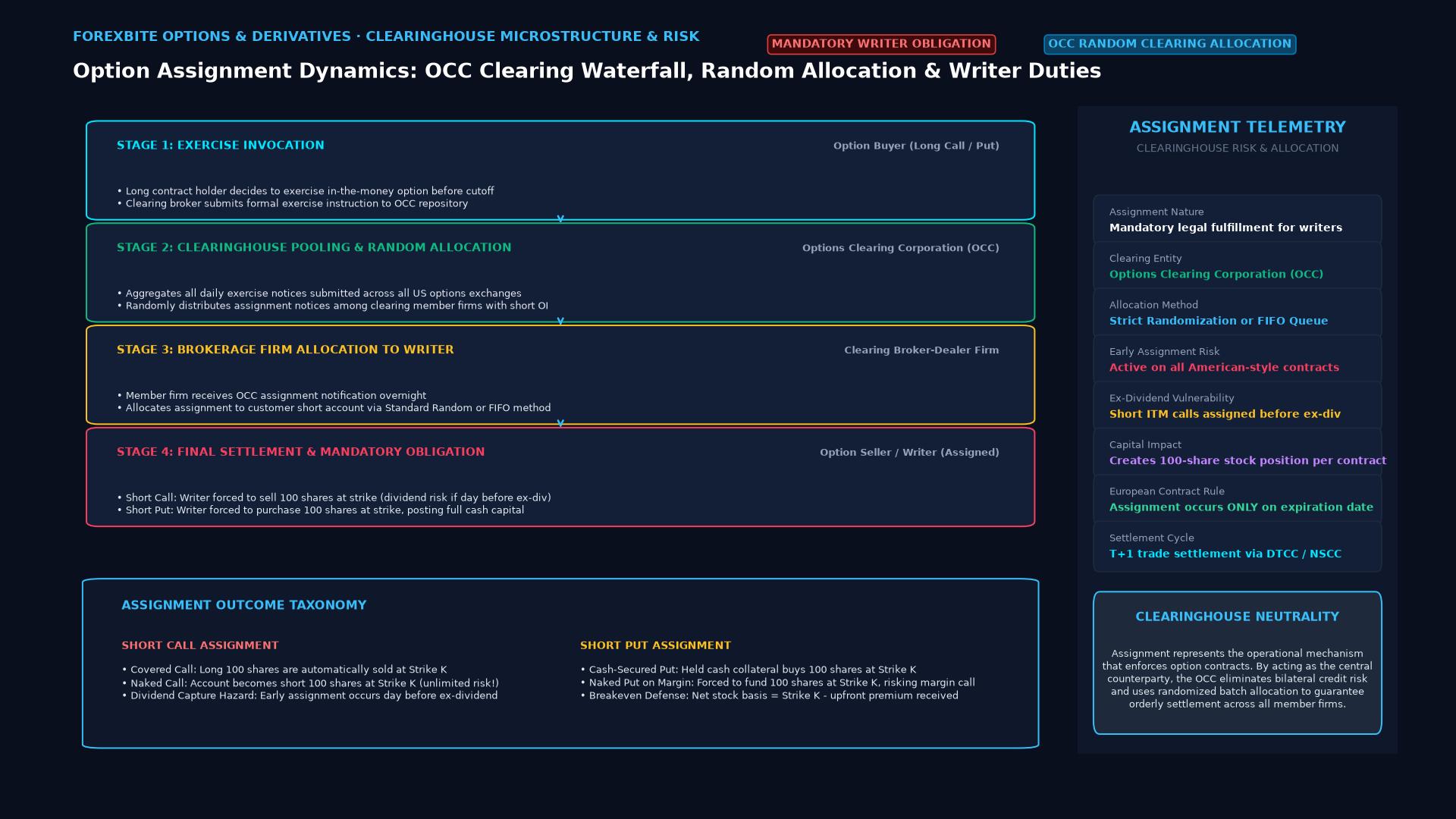
The OCC Assignment Mechanism
In the United States, all exchange-traded equity and index options clear through the Options Clearing Corporation (OCC), which acts as the buyer to every seller and seller to every buyer.
When an option buyer submits an exercise instruction prior to the daily cut-off time (typically 5:30 PM Eastern Time on trading days):
- Clearinghouse Pooling: The OCC consolidates all exercise instructions submitted that afternoon across all brokerages.
- Random Member Allocation: The OCC matches the exercise notices against all clearing member brokerages holding net short positions in that exact option series using a purely automated random lottery algorithm.
- Broker Customer Allocation: Once a brokerage receives an assignment notice from the OCC, it assigns the obligation to one of its short customers using a fair allocation method approved by FINRA (Rule 2360):
- Random Allocation: Every open short contract has an equal mathematical probability of being selected.
- FIFO (First-In, First-Out): Accounts that wrote the short option earliest are assigned first.
Assignment Obligations by Option Position
The operational requirements imposed upon the assigned option writer depend on whether the short position was a call or a put:
| Short Option Position | Assignment Action Required | Cash Flow Impact | Resulting Portfolio Position |
|---|---|---|---|
| Short Call (Covered) | Delivers 100 shares of underlying stock already held | Receives cash proceeds equal to $(\text{Strike Price} \times 100)$ | Long stock position is liquidated at the strike price |
| Short Call (Naked / Uncovered) | Must borrow and deliver 100 shares | Receives cash proceeds equal to $(\text{Strike Price} \times 100)$ | Short stock position established; exposed to unlimited upside risk |
| Short Put (Cash-Secured) | Buys 100 shares of stock at strike price | Surrenders cash equal to $(\text{Strike Price} \times 100)$ | Holds 100 long shares of stock; cash balance reduced |
| Short Put (Margin) | Buys 100 shares using broker margin | Margin debt increases; margin interest charges begin | Holds 100 long shares on margin credit |
Early Assignment Risk on American-Style Options
Because American-style equity options can be exercised at any point prior to expiration, sellers face early assignment risk:
                 EARLY ASSIGNMENT RISK IN DIVIDEND CALLS
Stock Price:                $105.00
Short Call Strike Price:    $100.00 (Deep In-the-Money)
Ex-Dividend Date:           Tomorrow morning ($1.20 Cash Dividend)
Extrinsic (Time) Value:     $0.15 remaining on the short call
Decision for Call Holder:   SURRENDER $0.15 extrinsic value to CAPTURE $1.20 dividend!
Outcome for Short Seller:   GUARANTEED EARLY ASSIGNMENT on the afternoon before ex-date!
Ex-Dividend Call Assignment
As illustrated above, deep in-the-money calls are assigned aggressively the afternoon before an ex-dividend date. If an option trader holds a short vertical call spread, the short lower-strike call is often assigned while the long higher-strike call remains unassigned, creating an unexpected overnight short stock position and exposing the trader to dividend payout liabilities.
Deep ITM Put Assignment
Deep in-the-money puts face early assignment during elevated interest rate environments. The put buyer exercises early to collect the cash strike price immediately, allowing them to reinvest the cash proceeds at prevailing risk-free money market yields rather than holding an option with negligible time value.
Legal Assignment in Corporate Finance
Outside of derivative exchanges, assignment represents a foundational legal tool in corporate restructuring, banking credit facilities, and asset-backed lending:
- Assignment of Receivables: In commercial factoring, a business assigns its unpaid customer invoices to a factoring bank, granting the lender the lawful right to collect payments directly from the corporate debtors.
- Assignment of Leases and Rents: In commercial real estate mortgages, the borrower assigns all future tenant rental payments to the lending bank as secondary collateral in the event of debt service default.
- Anti-Assignment Clauses: Commercial contracts frequently include covenants prohibiting parties from assigning rights or obligations to third parties without prior written consent, preventing hostile corporate competitors from acquiring contractual claims.
Frequently Asked Questions
Can an option seller choose not to accept an assignment?
No. Writing an option contract creates an unconditional legal obligation. In exchange for collecting the upfront option premium, the seller contractually surrenders all control over the exercise decision. Once assigned, the seller cannot decline or dispute the obligation.
What happens if an option trader is assigned without enough cash to buy the stock?
If a short put is assigned and the trader lacks sufficient cash or margin buying power to purchase the underlying shares, the brokerage issues an immediate margin call. The broker retains full legal authority to liquidate the assigned shares on the open market at the market open, passing any resulting execution losses directly to the trader.
Does assignment occur on Saturday mornings?
Yes. Although options stop trading at 4:00 PM Eastern Time on Friday expiration dates, brokerages and the OCC process exercise requests and run assignment allocation algorithms throughout Friday night. Traders receive formal electronic assignment notifications in their accounts early Saturday morning.
Ready to trade forex?
Open a free demo account with a regulated broker. Practice with virtual funds before risking real money.