Back-end load
A back-end load is a sales charge or redemption fee incurred by an investor when selling mutual fund shares, typically structured as a Contingent Deferred Sales Charge (CDSC) that decreases the longer shares are held.
What Is a Back-End Load?
A back-end load is an exit commission, redemption fee, or sales charge assessed against an investor upon selling or redeeming shares in an open-end mutual fund. Unlike a front-end load (which deducts an upfront sales charge from the investor’s initial deposit before purchasing shares), a back-end load allows 100% of the investor’s capital to be deployed into the market immediately, deferring fee collection until liquidation.
In modern fund distribution, back-end loads are structured almost exclusively as a Contingent Deferred Sales Charge (CDSC). Associated historically with Class B mutual fund shares, the percentage fee starts at its highest level if shares are sold within the first year of purchase and systematically declines by one percentage point each year, eventually phasing out to 0% after a multi-year holding period.
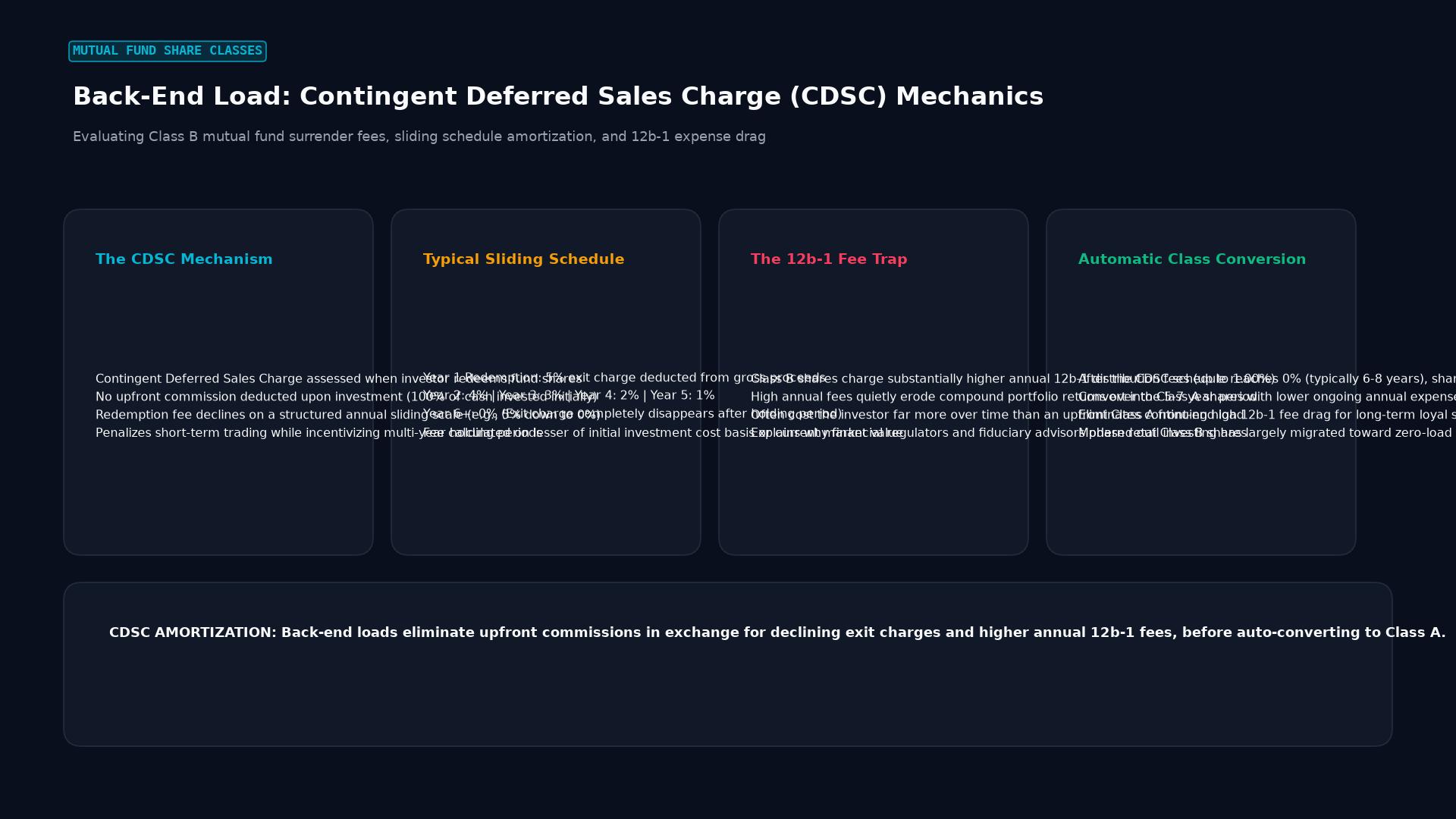 Figure: Evaluating Class B mutual fund surrender fees, sliding schedule amortization, and 12b-1 expense drag
How the Contingent Deferred Sales Charge (CDSC) Operates
The primary financial objective of a back-end load is to compensate the selling broker-dealer upfront while incentivizing the retail investor to maintain their capital in the fund over a long-term horizon.
When an investor buys Class B shares:
- Broker Compensation: The mutual fund sponsor pays the selling financial advisor an upfront commission (typically 4.0% to 5.0%) out of the fund distributor’s own capital.
- The Recovery Mechanism: To recoup that advance commission, the fund charges higher ongoing annual operating expenses (specifically higher 12b-1 distribution fees, typically 0.75% higher than Class A shares).
- The Exit Penalty: If the investor redeems their shares prematurely before the fund sponsor has recouped its advance commission through 12b-1 fees, the CDSC back-end fee is deducted directly from the redemption check.
Calculation Base: Purchase Price vs. Redemption Value
Under standard SEC Rule 2830 (FINRA Conduct Rules), the back-end load percentage is applied to the lower of the original purchase price or the current net asset value (NAV) at redemption.
Example: An investor purchases $10,000 in Class B shares with a 5.0% Year-1 CDSC:
- If market appreciation drives the account balance to $12,000 and the investor sells in Year 1, the 5.0% fee is applied to the original $10,000 cost basis ($500 fee), not the $12,000 balance. All capital appreciation is exempt from the load fee.
- If a market decline drops the balance to $8,000 and the investor sells, the 5.0% fee is applied to the $8,000 current NAV ($400 fee), ensuring the investor is never penalized for paper losses.
Mutual Fund Share Classes Compared: Class A, B, and C
To understand where back-end loads fit into asset allocation, investors compare fee structures across mutual fund share classes:
| Share Class | Load Structure | Ongoing 12b-1 Distribution Fee | Conversion Feature | Best Suited Investor |
|---|---|---|---|---|
| Class A | Front-End Load (typically 2.5% to 5.75% upfront) | Low (typically 0.25% per year) | None | Large lump-sum investments; long-term holding horizon |
| Class B | Back-End Load (CDSC) (declining from 5% to 0%) | High (typically 0.75% to 1.00% per year) | Automatically converts to Class A after 6 to 8 years | Phased out by most modern asset managers |
| Class C | Level Load (typically 1.0% CDSC in Year 1 only) | High (1.00% per year continuously) | Rarely converts | Short-to-medium holding horizons (1 to 3 years) |
| Class I / Clean | Zero Load (No-Load) | Zero 12b-1 fees (pure advisory fee) | None | Fee-only Registered Investment Advisors (RIAs) |
                 CLASS B AUTOMATIC SHARE CONVERSION
Year 1 to Year 6:       Class B Shares pay high 12b-1 fee (~1.0%) + CDSC exit fee.
End of Year 6 to 8:     CDSC drops to 0.0%.
Conversion Event:       Shares AUTOMATICALLY CONVERT to lower-expense Class A shares,
                        permanently lowering ongoing annual expense drag!
Why Class B Shares and Back-End Loads Have Declined
Over the past two decades, mutual fund complexes (such as American Funds, Franklin Templeton, and Fidelity) have largely phased out Class B back-end load shares due to structural and regulatory headwinds:
- Fee Drag: Because Class B shares levy an additional 0.75% in annual 12b-1 fees throughout the 6-to-8-year lockup window, an investor who holds Class B shares for seven years frequently pays far more in cumulative fees than if they had paid an upfront Class A front-end load with breakpoint discounts.
- Breakpoints Unavailable on Back-End Loads: Class A front-end loads offer statutory breakpoint discounts (e.g., upfront fees drop to 3.5% at $50,000, 2.5% at $100,000, and 0% at $1,000,000). Class B back-end load shares offer zero breakpoints, making them uneconomic for larger wealth allocations.
- Regulatory Scrutiny: FINRA and the SEC initiated major enforcement actions against broker-dealers who steered clients into high-expense Class B shares without disclosing that Class A breakpoint discounts would have produced lower total cost of ownership.
- The Rise of ETFs and Zero-Commission Platforms: The explosive growth of low-cost, zero-commission exchange-traded funds (ETFs) and fee-only fiduciary RIA advisory accounts has rendered traditional back-end load mutual funds largely obsolete.
Frequently Asked Questions
What happens to dividend reinvestments under a back-end load?
Shares acquired through the automatic reinvestment of mutual fund dividends or capital gains distributions are exempt from back-end loads. When shares are redeemed, accounting software liquidates reinvested dividend shares first on a tax-free, load-free basis.
Can a back-end load be waived?
Yes. Fund prospectuses outline statutory waiver conditions. Common exemptions where back-end loads are waived include the death or permanent disability of the account owner, mandatory Required Minimum Distributions (RMDs) taken from retirement accounts, or redemptions executed pursuant to an automated systematic withdrawal plan.
How does a back-end load differ from an early redemption fee?
A back-end load (CDSC) is a sales commission paid to the distributor to compensate the selling broker. An early redemption fee (typically 1.0% to 2.0% on shares held less than 30 to 90 days) is not a sales commission; it is paid directly back into the fund’s net asset pool to protect remaining shareholders against the transaction trading costs caused by short-term market timers.
Ready to trade forex?
Open a free demo account with a regulated broker. Practice with virtual funds before risking real money.