Back-to-back loan
A back-to-back loan, also known as a parallel loan, is a cross-border debt arrangement where two multinational corporations in different countries lend equal value to each other's local subsidiaries in their domestic currencies to circumvent currency exchange controls and eliminate foreign exchange risk.
What Is a Back-to-Back Loan?
A back-to-back loan (frequently termed a parallel loan) is an institutional cross-border financing structure where two multinational corporations located in different sovereign nations agree to lend domestic currency directly to each other’s overseas operating subsidiaries. The arrangement involves two separate, concurrent loan agreements of equal economic value denominated in two distinct currencies, sharing an identical maturity date.
Developed extensively in the 1970s, back-to-back loans allowed multinational corporations to finance overseas expansions while legally bypassing stringent sovereign capital controls, punitive foreign currency transaction taxes, and high commercial bank lending spreads. In financial history, the parallel loan structure served as the direct operational predecessor that inspired the creation of the multi-trillion-dollar modern currency swap market.
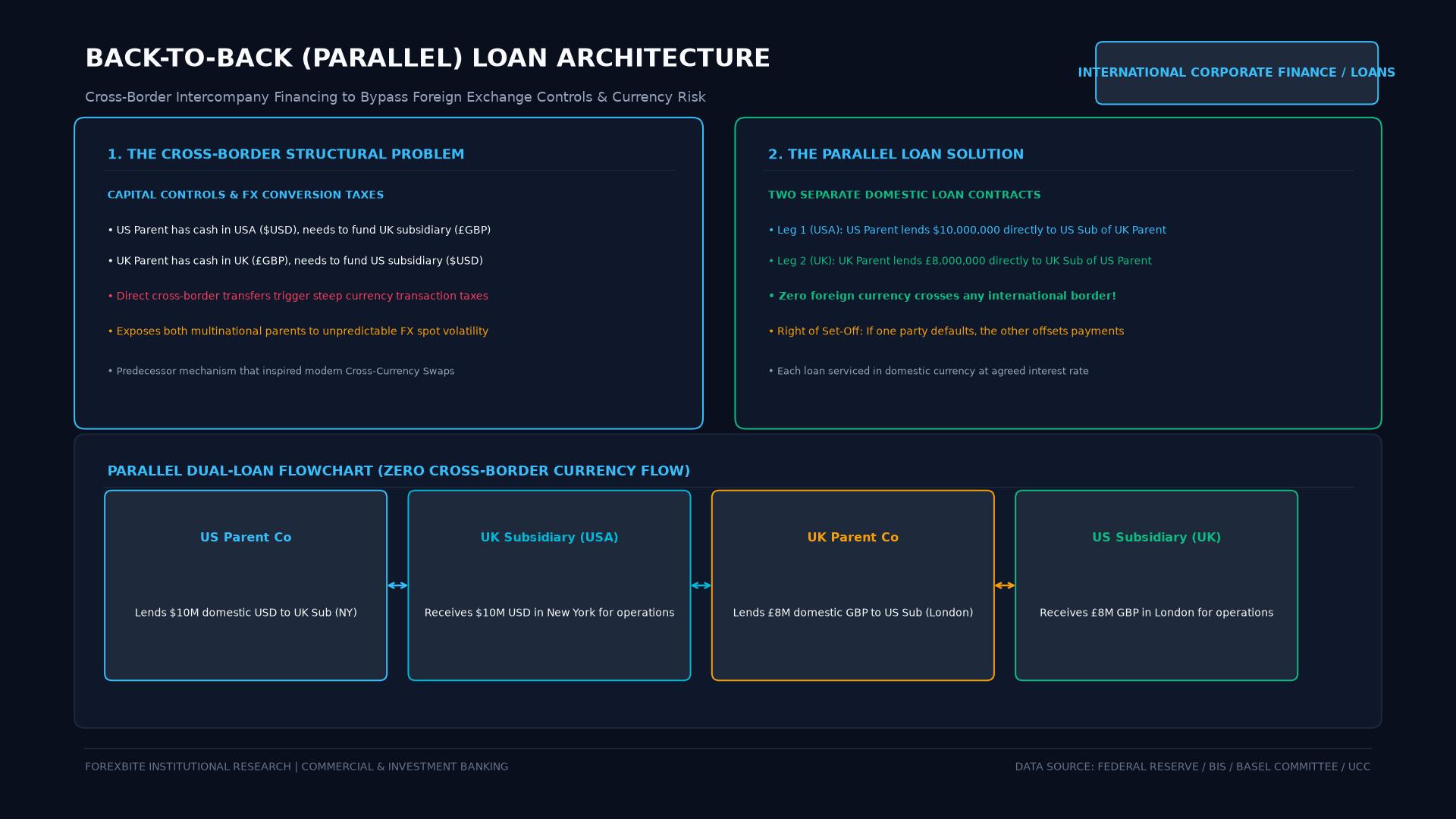 Figure: Cross-border corporate borrowing structure: two parent firms issuing bilateral domestic currency loans to bypass foreign exchange controls and sovereign transfer risks.
Operating Mechanics and Workflow
Consider a classic commercial scenario between an American enterprise and a British corporation:
- The US Problem: An American automaker wishes to build a manufacturing facility in Birmingham, England, requiring £50,000,000 in financing. If the US parent exchanges dollars for pounds in the open FX market, it assumes massive currency risk if sterling depreciates before the investment pays off.
- The UK Problem: A British pharmaceutical company wishes to build research laboratories in New Jersey, requiring $65,000,000 in financing, facing reciprocal currency risk.
The Parallel Loan Execution
- Agreement: At prevailing spot exchange rates (£1.00 = $1.30), both parties agree to execute parallel loans of equal monetary value: £50,000,000 and $65,000,000 across a 5-year term.
- Local Disbursements:
- The US parent lends $65,000,000 directly to the UK company’s American subsidiary in New York.
- The UK parent lends £50,000,000 directly to the US company’s British subsidiary in London.
- No Cross-Border Funds Transfer: Zero capital crosses international borders. Neither company executes a spot foreign exchange conversion, entirely sidestepping commercial bank currency conversion spreads and sovereign foreign exchange licensing taxes.
- Periodic Debt Service:
- The UK subsidiary pays periodic interest in British pounds directly to the UK parent in London.
- The US subsidiary pays periodic interest in US dollars directly to the US parent in New York.
- Maturity Settlement: After five years, both subsidiaries repay their respective borrowed principal in local currency, terminating the parallel loan agreements simultaneously.
Structural Advantages of Parallel Loans
For multinational treasurers, back-to-back loans unlocked several operational efficiencies:
| Strategic Benefit | Operational Mechanism |
|---|---|
| Elimination of FX Conversion Risk | Operating subsidiaries borrow, generate revenues, and repay debt in the identical domestic currency, insulating the corporate balance sheet from currency swings |
| Circumventing Sovereign Capital Controls | Historically bypassed British foreign exchange restrictions (the UK “Dollar Premium” system) and capital export embargoes |
| Direct Wholesale Cost of Capital | Corporations bypass commercial intermediary banks, borrowing at institutional wholesale rates rather than paying commercial bank loan spreads |
| Balance Sheet Hedge | The foreign subsidiary’s localized asset value is perfectly offset by a localized debt liability, stabilizing reported GAAP consolidated net worth |
The Fatal Flaw: Asymmetric Default and Counterparty Risk
Despite their theoretical elegance, back-to-back loans suffered from a severe structural defect: the lack of legal offset in bankruptcy.
                   THE ASYMMETRIC DEFAULT RISK TRAP
+-----------------------------------------------------------------------+
| Loan Agreement 1: US Parent lends $65M to UK Subsidiary in New York   |
| Loan Agreement 2: UK Parent lends £50M to US Subsidiary in London     |
+-----------------------------------------------------------------------+
                                   │
       UK Parent enters sudden corporate insolvency & bankruptcy
                                   │
                                   ▼
+-----------------------------------------------------------------------+
| Result under historic insolvency law:                                 |
| - UK Bankruptcy Trustee DEMANDS full loan repayment from US Subsidiary|
| - BUT US Parent is listed as an UNSECURED CREDITOR in the UK,         |
|   recovering only pennies on the dollar on its $65M loan!             |
+-----------------------------------------------------------------------+
Because parallel loans were executed as two legally independent loan contracts, the default of one party did not automatically terminate or relieve the other party’s obligation. If the UK parent defaulted or entered liquidation, the British bankruptcy trustee had the lawful right to demand that the US subsidiary continue repaying its £50,000,000 loan in full, while the US parent was treated as an unsecured creditor in the UK bankruptcy court, suffering devastating capital losses.
Evolution into Modern Currency Swaps
To eliminate the asymmetric default risk of back-to-back loans, Wall Street investment banks (led by Salomon Brothers and the World Bank in their landmark 1981 currency swap with IBM) engineered the Currency Swap:
| Dimension | Historical Back-to-Back Loan | Modern Cross-Currency Swap |
|---|---|---|
| Legal Documentation | Two separate, unlinked loan agreements | Single unified contract under an ISDA Master Agreement |
| Right of Offset | None; default by one does not cancel the other | Mandatory Right of Setoff; default terminates the entire contract |
| Balance Sheet Footprint | Recorded as gross corporate debt liabilities | Off-balance sheet derivative; reported as net replacement value |
| Intermediary Role | Bilateral negotiation between corporate peers | Cleared through global investment banks serving as market makers |
Under the ISDA Master Agreement, cross-currency swaps include explicit close-out netting and offset covenants: if Counterparty A defaults on its currency leg, Counterparty B is immediately relieved of all reciprocal payment obligations, entirely resolving the structural flaw that plagued back-to-back loans.
Frequently Asked Questions
Are back-to-back loans still used today?
While standard institutional currency swaps have replaced parallel loans between major currencies (such as USD, EUR, GBP, and JPY), back-to-back loans are still utilized in frontier and emerging markets that maintain strict capital controls, non-convertible currencies, or lack access to standardized ISDA derivative clearing.
What is a “Right of Setoff” in a back-to-back loan?
A right of setoff is a specialized legal clause inserted into modern parallel loan agreements stating that if one borrower fails to make a debt service payment, the non-defaulting party has the contractual right to withhold equivalent payments on the reciprocal loan, preventing one-sided bankruptcy exploitation.
How do tax authorities view interest payments in back-to-back loans?
Tax revenue authorities (such as the IRS and HMRC) review back-to-back loans under transfer pricing and thin capitalization rules. If the interest rates charged between the corporate entities diverge significantly from arm’s-length market rates, tax authorities can reclassify interest deductions as constructive dividends, assessing substantial back taxes and penalties.
Ready to trade forex?
Open a free demo account with a regulated broker. Practice with virtual funds before risking real money.