Backdoor listing
A backdoor listing, also known as a reverse takeover (RTO) or reverse merger, is a corporate transaction in which a private company obtains public exchange listing status by merging into or acquiring an existing publicly traded shell corporation.
What Is a Backdoor Listing?
A backdoor listing (formally termed a reverse takeover, reverse merger, or RTO) is a corporate finance maneuver whereby a privately held operating company becomes a publicly traded enterprise without conducting a conventional Initial Public Offering (IPO). Instead of hiring investment banks to underwrite an IPO roadshow, the private company acquires, or is acquired by, a publicly listed company, frequently a dormant “shell corporation” that possesses an active exchange ticker symbol but maintains no substantial commercial operations or assets.
Through the transaction, the private operating company’s owners exchange their private equity for a controlling supermajority (typically 80% to 95%) of the public entity’s shares. The newly merged entity changes its corporate name, replaces the board of directors, appoints private company executives to leadership, and updates its stock exchange ticker symbol, achieving public listing status through the “back door.”
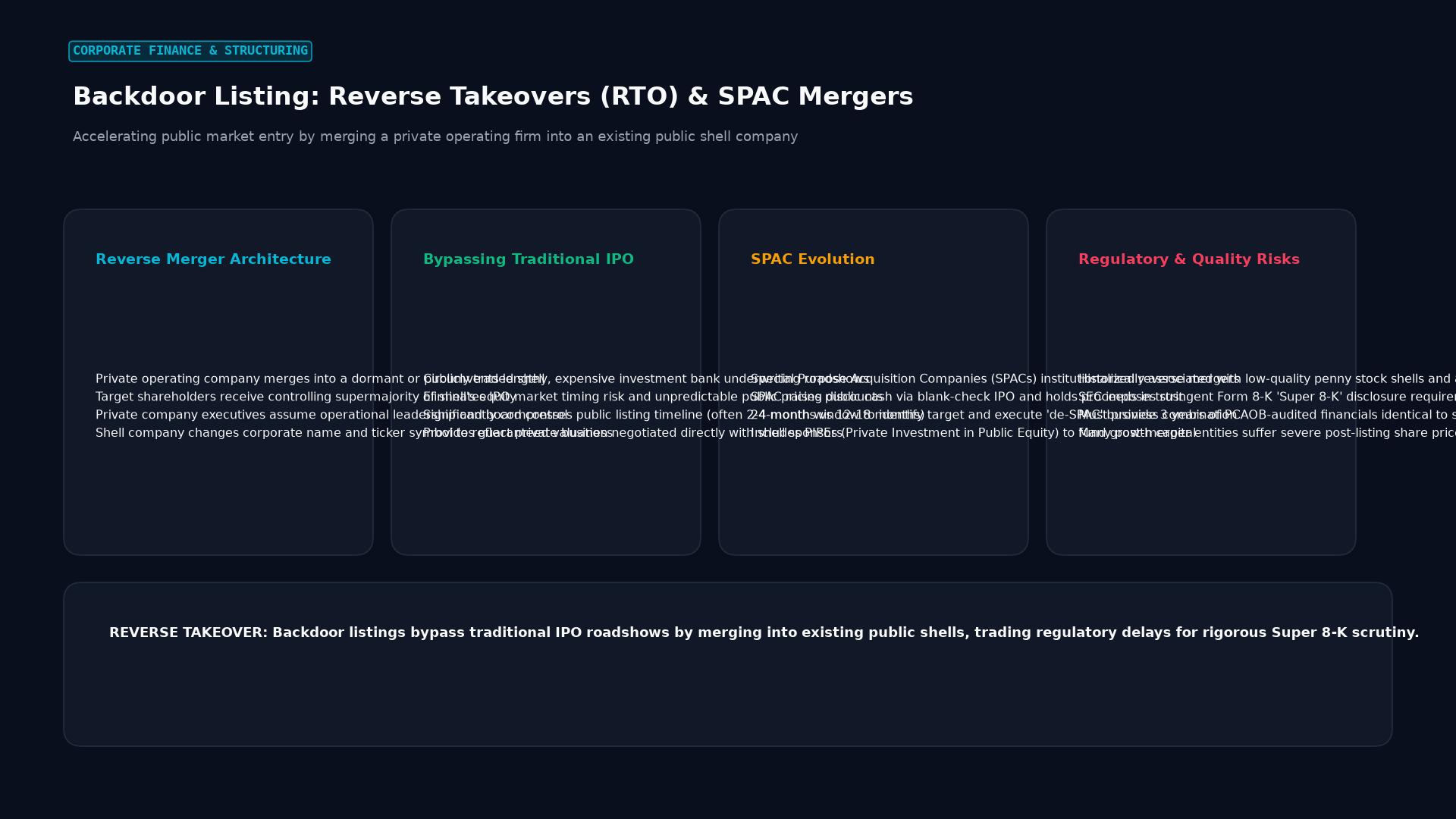 Figure: Accelerating public market entry by merging a private operating firm into an existing public shell company
Traditional IPO vs. Backdoor Listing vs. SPAC
Understanding where backdoor listings fit into corporate capital formation requires contrasting the three primary pathways to public equity markets:
| Dimension | Traditional Underwritten IPO | Backdoor Listing (Reverse Merger) | Special Purpose Acquisition Company (SPAC) |
|---|---|---|---|
| Time to Market | Extended (6 to 12 months) | Fast (1 to 3 months) | Moderate (3 to 6 months) |
| Capital Raised at Listing | Guaranteed capital from underwriters | Zero cash by default (Requires a concurrent PIPE) | Trust account capital ($100M–$500M+) |
| Valuation Certainty | Subject to volatile market pricing at launch | Contractually pre-negotiated | Contractually pre-negotiated |
| Underwriting Fees | High (5% to 7% gross spread) | Low (Legal, accounting, shell acquisition) | High (5.5% underwriter fee + sponsor promote) |
| Regulatory Scrutiny | Comprehensive SEC S-1 review | SEC Form 8-K (“Super 8-K”) disclosure | SEC Form S-4 / Proxy registration |
Operating Mechanics: Acquiring the Public Shell
The execution of a backdoor listing involves several distinct legal and financial phases:
1. Identifying the Shell Corporation
The private enterprise locates a suitable public vehicle:
- Zombie / Distressed Shells: Formerly operating public companies that liquidated their business or sold their primary assets following bankruptcy, leaving a clean public corporate registration.
- Form 10 Blank Check Companies: Public reporting entities formed strictly under SEC Rule 419 with zero historical operations, established solely to merge with an operating private enterprise.
2. The Share Exchange Agreement
The private enterprise negotiates a Reverse Triangular Merger or share exchange. Because the private operating company’s assets are worth vastly more than the dormant shell, the public shell issues a massive block of newly minted common shares to the private business owners in exchange for 100% of their private company stock.
3. The “Super 8-K” Regulatory Mandate
To prevent fraudulent backdoor schemes, the Securities and Exchange Commission (SEC) enforces Exchange Act Rule 13a-11:
- Within four business days of completing a reverse merger with a shell company, the surviving entity must file a comprehensive “Super Form 8-K”.
- This filing must contain the identical comprehensive disclosure data (including three years of audited GAAP financial statements, executive biographies, related-party transactions, and MD&A analysis) that would have been required in a full-scale Form S-1 IPO registration prospectus.
The Role of Concurrent PIPE Financing
Because a dormant public shell company contains negligible cash on its balance sheet, a backdoor listing achieves listing status but raises zero new expansion capital on its own.
To solve this, private companies pair backdoor listings with a Private Investment in Public Equity (PIPE):
                 BACKDOOR LISTING WITH CONCURRENT PIPE
+-----------------------------------------------------------------------+
| Step 1: Private Company executes Reverse Takeover with Public Shell   |
+-----------------------------------------------------------------------+
                                   │
                                   ▼
+-----------------------------------------------------------------------+
| Step 2: Concurrent PIPE Closing                                       |
| - Institutional accredited investors (hedge funds, private equity)     |
|   purchase newly issued restricted public shares at a slight discount |
| - Injects $25M - $100M of fresh cash directly into the company treasury|
+-----------------------------------------------------------------------+
                                   │
                                   ▼
+-----------------------------------------------------------------------+
| Step 3: Company emerges as a capitalized, exchange-listed enterprise  |
+-----------------------------------------------------------------------+
Institutional Risks and Market Controversies
While backdoor listings offer speed and cost savings, institutional investors often view them with caution due to historical abuses:
- Undisclosed Legacy Shell Liabilities: When acquiring a zombie shell, the private enterprise risks inheriting forgotten tax assessments, pending shareholder lawsuits, toxic convertible debt warrants, or environmental tort liabilities from the shell’s prior operations.
- The “Seasoning Rule” for Major Exchanges: Following accounting scandals involving foreign reverse mergers in 2010–2011, the SEC and major exchanges (NYSE and NASDAQ) instituted the Reverse Merger Seasoning Rule:
- A reverse merger company is barred from applying for an exchange listing until it has traded on the Over-the-Counter (OTC) market for at least one year.
- It must timely file all required annual reports (Form 10-K) and maintain a minimum qualifying closing price ($4.00) for a sustained period before uplisting.
- Analyst and Institutional Boycott: Mainstream Wall Street investment banks frequently decline to provide equity research coverage on companies that went public via reverse takeovers, resulting in lower daily trading liquidity and depressed valuation multiples relative to IPO peers.
Frequently Asked Questions
Why do companies choose a backdoor listing over an IPO?
A backdoor listing bypasses the extended underwriting cycle, executive roadshow travel, market volatility timing risks, and massive investment banking underwriting fees associated with traditional IPOs. It allows founders to achieve a public listing with pre-negotiated valuation terms in as little as 30 to 60 days.
Is a backdoor listing legal?
Yes. Reverse mergers and reverse takeovers are fully legal corporate transactions recognized under state corporate law and federal securities regulations, provided the surviving enterprise complies with all SEC reporting rules, including the timely filing of a “Super 8-K.”
How does a SPAC differ from a backdoor listing?
A traditional backdoor listing involves acquiring a pre-existing, often defunct public shell company that previously operated in another industry. A Special Purpose Acquisition Company (SPAC) is a purpose-built public investment vehicle formed specifically by seasoned private equity sponsors, which raises hundreds of millions of dollars in a formal IPO and holds the proceeds in a blind trust strictly to acquire an operating business within two years.
Ready to trade forex?
Open a free demo account with a regulated broker. Practice with virtual funds before risking real money.