Backup withholding
Backup withholding is a mandatory US tax compliance mechanism requiring banks, brokerages, and businesses to withhold a statutory flat percentage of non-wage payments made to taxpayers who fail to provide a certified Taxpayer Identification Number.
What Is Backup Withholding in Tax Law?
Backup withholding is a mandatory tax enforcement mechanism codified under Internal Revenue Code (IRC) Section 3406. It requires financial institutions, brokerage firms, digital payment settlement entities, and commercial businesses to withhold a flat statutory percentage of taxable non-wage payments and remit those funds directly to the Internal Revenue Service (IRS).
Unlike standard payroll wage withholding (which is calculated based on personal allowances on Form W-4), backup withholding applies strictly to reportable non-wage income (such as stock sales proceeds, mutual fund distributions, corporate dividends, bank interest, royalties, and independent contractor compensation). It serves as an emergency compliance backstop, ensuring that the federal government captures income tax on payments made to taxpayers who fail to identify themselves or who have a verified history of underreporting income.
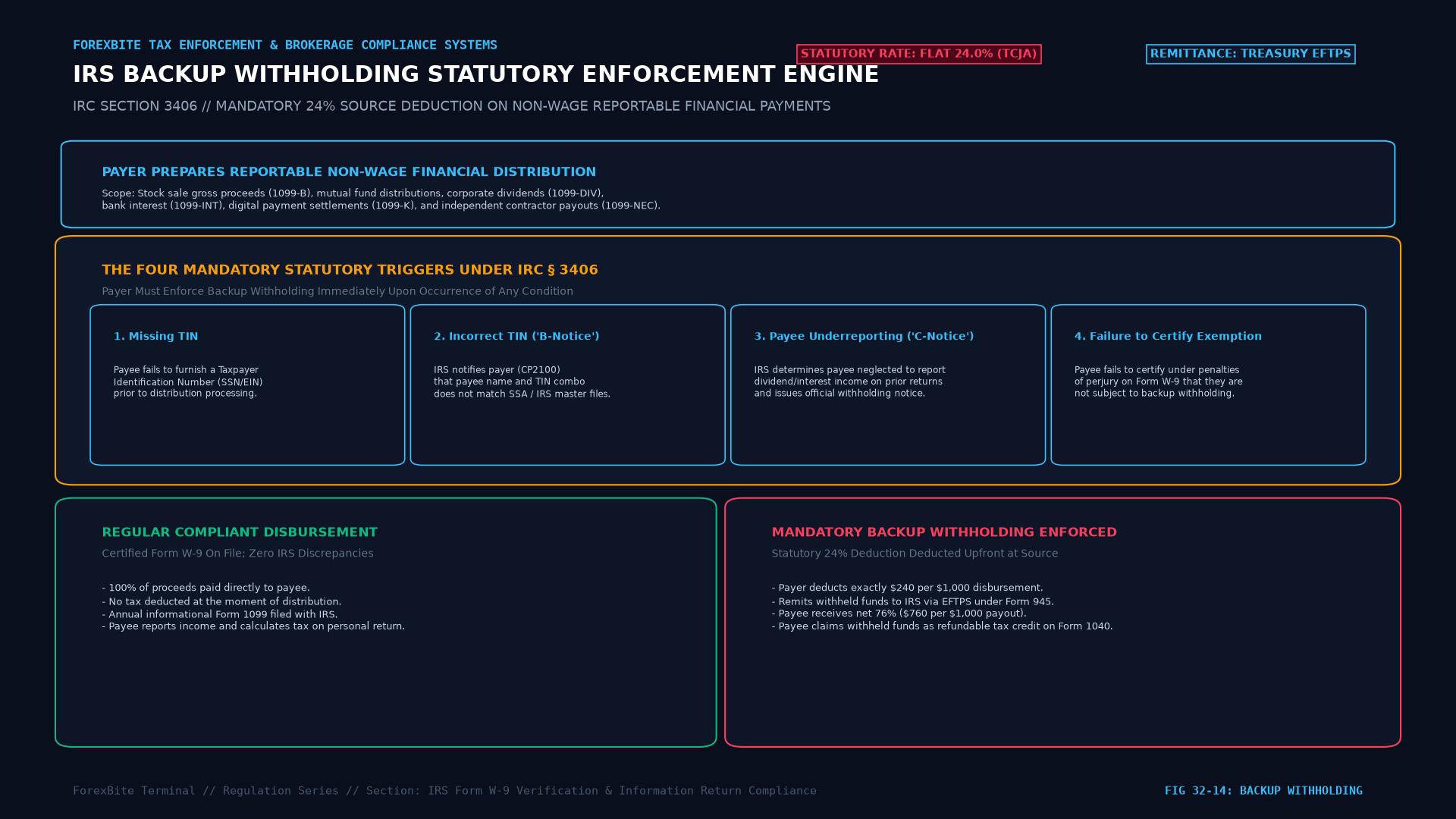 Figure: The IRS backup withholding enforcement workflow under IRC § 3406, showing mandatory 24% deductions triggered by missing TINs, B-Notices, or C-Notices.
Statutory Rates and the Tax Cuts and Jobs Act (TCJA)
The backup withholding rate is established by federal tax statutes tied to the fourth lowest individual income tax bracket under IRC § 1(i)(2):
- Historical Rate (Pre-2018): Historically set at 28.0%.
- Current Statutory Rate (2018–Present): The Tax Cuts and Jobs Act of 2017 (TCJA) lowered the backup withholding rate to a flat 24.0%, where it remains anchored today.
Every time a financial institution or business processes a reportable payment to an individual or unincorporated vendor subject to backup withholding, it must deduct exactly $240 from every $1,000 disbursement, remitting the withheld funds electronically to the US Treasury via the Electronic Federal Tax Payment System (EFTPS).
Statutory Triggers: When Does Backup Withholding Apply?
Under IRC Section 3406, an entity paying reportable income must enforce backup withholding under any of the following four legal conditions:
- Failure to Furnish TIN: The payee fails to provide their Taxpayer Identification Number (Social Security Number - SSN, or Employer Identification Number - EIN) to the payer before payments commence.
- Incorrect TIN (IRS “B-Notice”): The IRS notifies the payer via a formal “CP2100” or “B-Notice” that the name and TIN combination reported on prior Form 1099 filings does not match official IRS/Social Security Administration databases.
- IRS Underreporting Notice (“C-Notice”): The IRS notifies the payer that the taxpayer has failed to report taxable interest or dividend income on their Form 1040 tax return in prior years, mandating immediate backup withholding on all future payments.
- Failure to Certify Non-Exempt Status: The payee fails to sign a Form W-9 under penalty of perjury certifying that they are not subject to backup withholding.
Payments Subject to Backup Withholding
Backup withholding applies across a broad spectrum of federal information return forms:
| Income Type | Primary IRS Reporting Form | Typical Financial Source |
|---|---|---|
| Brokerage Capital Gains | Form 1099-B | Gross proceeds from equity, bond, or commodity sales |
| Ordinary & Qualified Dividends | Form 1099-DIV | Corporate stock dividends and mutual fund capital gains |
| Bank Interest | Form 1099-INT | Savings accounts, certificates of deposit, bond coupons |
| Non-Employee Compensation | Form 1099-NEC | Freelance contractor fees and independent consulting |
| Miscellaneous Income | Form 1099-MISC | Commercial rents, royalties, legal awards, prize winnings |
| Digital Settlement Transactions | Form 1099-K | Payment card networks, merchant acquiring, crypto platforms |
Critical Note for Forex and Securities Traders: On brokerage accounts, backup withholding on Form 1099-B applies to gross transaction proceeds, not net trading profits. If a day trader sells $1,000,000 worth of stock to capture a $5,000 net profit, being subject to backup withholding means the broker will seize $240,000 in cash (24% of the $1,000,000 gross proceeds), wiping out the account’s liquidity.
Form W-9 vs. Form W-8BEN: Preventing Withholding
To prevent the initiation of backup withholding, market participants file certified tax documentation:
                 PREVENTING BACKUP WITHHOLDING AT ONBOARDING
+-----------------------------------------------------------------------+
|  Domestic US Persons & Entities (US Citizens, Green Cards, US LLCs)   |
|  - File IRS Form W-9 (Request for Taxpayer Identification Number)     |
|  - Certifies correct SSN/EIN and absence of IRS backup withholding    |
+-----------------------------------------------------------------------+
                                    OR
+-----------------------------------------------------------------------+
|  Foreign Individuals & Non-US Entities (International Traders)        |
|  - File IRS Form W-8BEN (Individuals) or Form W-8BEN-E (Entities)     |
|  - Certifies non-US status; establishes statutory tax treaty rates    |
+-----------------------------------------------------------------------+
Foreign individual forex and equity traders who maintain accounts with US brokerage institutions are exempt from domestic 24% backup withholding, provided they submit an active, valid Form W-8BEN every three years. Foreign accounts are instead subject to standard nonresident alien withholding rules (typically 30%, or reduced treaty rates like 15% on dividends).
How Taxpayers Recover Withheld Funds
Backup withholding is not a permanent penalty or excise tax; it represents an advance prepayment of income tax:
- Form 1099 Box Reporting: At the end of the tax year, the payer issues Form 1099 reporting total gross payments in Box 1 and the cumulative backup withholding deducted in the designated “Federal Income Tax Withheld” box (Box 4).
- Form 1040 Credit: When filing their annual individual tax return, the taxpayer enters the total backup withholding amount on Form 1040, Line 25b.
- Reconciliation: The withheld cash offsets the taxpayer’s actual calculated tax liability dollar-for-dollar. If the 24% backup withholding exceeds the taxpayer’s true effective tax liability, the IRS issues an immediate cash refund for the difference.
Frequently Asked Questions
What should a taxpayer do upon receiving a “B-Notice”?
A taxpayer who receives an IRS B-Notice from a bank or broker must immediately complete and return an updated Form W-9 with their certified name and correct SSN or EIN within 30 business days. If the second B-Notice within three calendar years is received, the taxpayer must obtain an official Social Security Number verification printout (Form SSA-7028) or IRS Letter 147C to prevent the bank from initiating mandatory 24% withholding.
Are corporations subject to backup withholding?
Generally, no. Under IRC § 3406, corporations, tax-exempt 501(c)(3) entities, and government agencies are classified as “exempt payees.” Payers are not required to enforce backup withholding on payments made to incorporated entities, provided the corporation checks the appropriate exempt payee code on Form W-9.
Does backup withholding apply to real estate transactions?
Real estate sales proceeds reported on Form 1099-S are generally exempt from standard backup withholding under Section 3406. However, foreign sellers of US real property are subject to a separate, mandatory withholding regime known as FIRPTA (Foreign Investment in Real Property Tax Act), which withholds 15% of gross sales proceeds.
Ready to trade forex?
Open a free demo account with a regulated broker. Practice with virtual funds before risking real money.