Base market value
The aggregate market capitalization of an index's constituent basket at a designated starting baseline date, serving as the denominator to measure cumulative price appreciation or total return.
What is Base Market Value?
Base market value is the total aggregate market capitalization of all component securities in a market-capitalization-weighted financial index at its initial launch date or reference period. When index providers such as S&P Dow Jones Indices, MSCI, or FTSE Russell construct an equity benchmark, they establish an arbitrary baseline index level (such as 10, 100, or 1,000) that corresponds to this starting pool of aggregate equity value.
In quantitative index calculation, base market value functions as the mathematical anchor. Subsequent shifts in the index level reflect percentage changes in the current aggregate market value relative to the original base market value. By anchoring the calculation to an established base, market participants can evaluate whether the collective asset class has expanded, contracted, or outperformed competing investment vehicles over multi-decade economic cycles.
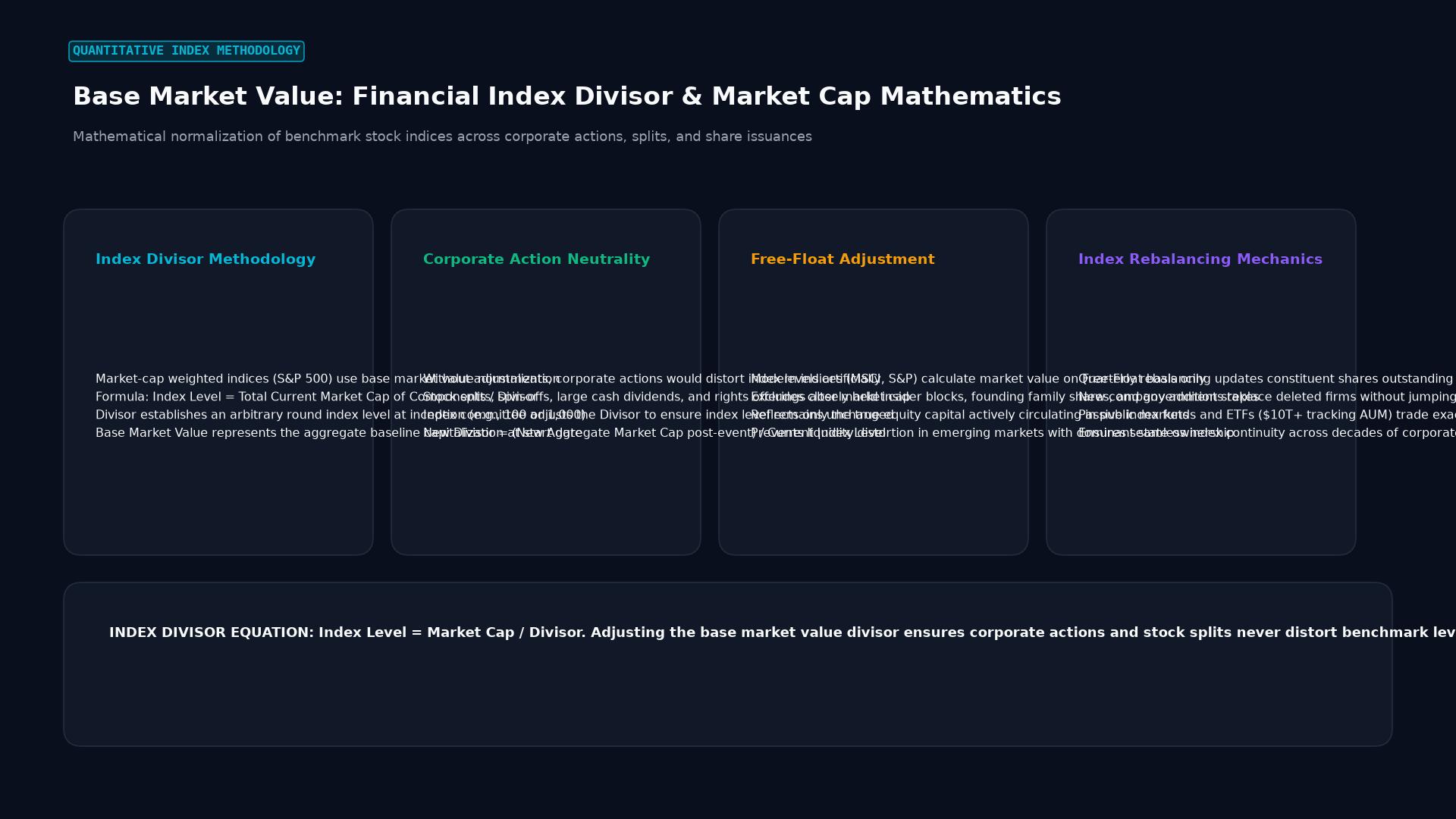 Figure: Mathematical normalization of benchmark stock indices across corporate actions, splits, and share issuances
Mathematical Formulation and Index Mechanics
Equity benchmarks generally follow a modified Laspeyres price index formula. The classic index equation expresses current index value ($I_t$) in relation to base market value:
$$I_t = \frac{\sum_{i=1}^{N} (P_{i,t} \times Q_{i,t})}{\text{Base Market Value}} \times \text{Base Index Level}$$
Where:
- $P_{i,t}$ is the current trading price of constituent stock $i$ at time $t$.
- $Q_{i,t}$ is the total outstanding shares (or free-float shares) of constituent stock $i$.
- $\text{Base Market Value} = \sum_{i=1}^{N} (P_{i,0} \times Q_{i,0})$ at reference period $t=0$.
- $\text{Base Index Level}$ is the chosen baseline figure (e.g., 100.00).
The Index Divisor Approach
Maintaining the original base market value over decades becomes mathematically cumbersome because corporate actions (share issuances, stock buybacks, mergers, spin-offs, and bankruptcies) constantly alter share counts independently of genuine market price fluctuations. To solve this, index calculators collapse the base market value and base index level into a dynamic variable known as the index divisor ($D_t$):
$$I_t = \frac{\sum_{i=1}^{N} (P_{i,t} \times Q_{i,t})}{D_t}$$
At inception, the initial divisor is calculated directly from the base market value:
$$D_0 = \frac{\text{Base Market Value}}{\text{Base Index Level}}$$
When corporate actions take place, the divisor is adjusted so that the index level remains identical immediately before and immediately after the event. The divisor adjustment absorbs non-market capital changes, preserving the continuity of historical performance comparisons.
Free-Float Weighting and Investable Market Value
Early index designs multiplied nominal share count by market price to determine base market value. Modern methodology recognizes that large blocks of shares are held by governments, founding families, or corporate insiders and are unavailable to public investors.
Major index providers adjust the base market value calculation using an Investable Weight Factor (IWF) or Free-Float Factor ($F_i$):
$$\text{Investable Market Value} = \sum_{i=1}^{N} (P_{i,t} \times Q_{i,t} \times F_{i,t})$$
+------------------------------------+------------------------------------+
| Full Market Capitalization         | Free-Float Market Capitalization   |
+------------------------------------+------------------------------------+
| Includes 100% of issued shares,    | Excludes locked shares, government |
| including insider and state stakes.| holdings, and cross-shareholdings. |
|                                    |                                    |
| Distorts weightings toward firms   | Reflects actual shares available   |
| with large illiquid blocks.        | for institutional trading.         |
|                                    |                                    |
| Vulnerable to severe tracking      | Standard methodology for S&P 500,  |
| error for passive ETF funds.       | MSCI World, and FTSE 100.          |
+------------------------------------+------------------------------------+
By excluding non-circulating shares from both the base market value and daily market calculations, the index accurately mirrors the investable liquidity available to institutional portfolio managers and exchange-traded funds (ETFs).
Historical Examples of Base Selection
Index creators deliberately select initial base periods to facilitate intuitive visual interpretation:
  Index Name       Inception / Base Date    Base Period Value    Base Index Level
  -------------------------------------------------------------------------------
  S&P 500          1941 - 1943 Average      Calculated Cap       10.00
  Nasdaq-100       January 31, 1985         Calculated Cap       250.00 (Split: 125)
  FTSE 100         January 3, 1984          Calculated Cap       1,000.00
  MSCI Emerging    December 31, 1987        Calculated Cap       100.00
  Russell 2000     December 31, 1986        Calculated Cap       135.00
When the S&P 500 was officially introduced in March 1957, the designers used the aggregate market value of 500 large United States corporations averaged across the years 1941 to 1943 as the base market value, equating it to an index value of 10.00. This low starting point ensured that future index quotes would remain practical numbers for news tickers and financial analysts.
Divisor Adjustments for Corporate Actions
When a company in an index issues new shares to fund a multibillion-dollar acquisition, aggregate market capitalization rises overnight. However, the price of individual shares has not appreciated; new capital has merely entered the basket. If left unadjusted, the index level would jump, creating a false signal of market appreciation.
Index providers maintain mathematical integrity by adjusting the divisor:
$$D_{\text{new}} = D_{\text{old}} \times \frac{\text{Market Value}{\text{after}}}{\text{Market Value}{\text{before}}}$$
Consider an index with a pre-event market value of $1,000,000,000 and an index divisor of 10,000,000, yielding an index level of 100.00:
- A constituent issues $50,000,000 of new stock in a rights offering.
- Market Value after event: $$1,050,000,000$.
- The new divisor is calculated: $10,000,000 \times \frac{1,050,000,000}{1,000,000,000} = 10,500,000$.
- Post-event index calculation: $\frac{1,050,000,000}{10,500,000} = 100.00$.
The index level remains completely stable at 100.00. The change in capital size is absorbed entirely by the updated divisor, isolating pure price performance from corporate restructuring.
Implications for Passive Investing and ETFs
Trillions of dollars in mutual funds, pension assets, and exchange-traded products track capitalization-weighted indexes. A clear understanding of base market value and divisor mechanics is critical for market participants:
- Creation and Redemption Baskets: Authorized Participants (APs) assembling ETF creation units rely on precise constituent weightings derived from current market value divided by total index market value.
- Rebalancing Turnover: When index committees replace an insolvent constituent with a new entrant, the base values and divisors are recalibrated. Fund managers must trade billions of dollars to realign tracking portfolios without generating excessive tracking error.
- Price-Weighted Contrasts: In price-weighted indexes like the Dow Jones Industrial Average (DJIA), market capitalization is disregarded; the index simply sums share prices and divides by a price divisor. In market-cap indices, base market value ensures that a 2% move in a $3 trillion technology firm exerts vastly more influence than a 2% move in a $30 billion utility.
Frequently Asked Questions
Does the base market value ever change after an index is launched?
The original base market value recorded at inception remains a fixed historical constant. However, for daily calculations, index providers manage the index divisor, which dynamically evolves to reflect share issuances, index additions, and constituent bankruptcies. This divisor evolution functions as an ongoing normalization of the effective base.
What is the difference between a price return index and a total return index regarding base value?
A price return index calculates its current market value based solely on regular closing prices, ignoring ordinary cash dividends. A total return index (TRI) reinvests all cash dividends back into the constituent portfolio at the close of the ex-dividend date, effectively increasing the index market value and compounding performance above the original base level.
How does a forward stock split affect base market value and the index level?
A stock split doubles or triples the share count while proportionally cutting the share price (for example, a 2-for-1 split cuts a $100 stock to $50). Because the product of price and share count remains unchanged, the constituent market capitalization is unaltered. Consequently, neither the base market value, the index divisor, nor the index level requires adjustment.
Ready to trade forex?
Open a free demo account with a regulated broker. Practice with virtual funds before risking real money.