CDI
A multi-market financial acronym representing CREST Depository Interests in the United Kingdom, CHESS Depository Interests in Australia, and Certificado de Depósito Interbancário in Brazilian fixed income.
What Does CDI Stand For in Finance?
In international capital markets, banking, and securities settlement, the acronym CDI represents three distinct, institutionally significant concepts depending on the financial market:
- CREST Depository Interest (United Kingdom & Ireland): A specialized electronic security issued by Euroclear UK & International (CREST) that enables foreign non-UK equities and debt instruments to trade, transfer, and settle electronically within the domestic UK settlement system.
- CHESS Depository Interest (Australia): An instrument created by the Australian Securities Exchange (ASX) under the Clearing House Electronic Subregister System (CHESS), permitting shares of foreign corporations to trade on the ASX with full electronic settlement.
- Certificado de Depósito Interbancário (Brazil): The benchmark interbank deposit rate and wholesale debt instrument in Brazilian financial markets, functioning as the primary reference rate for domestic fixed-income securities, investment funds, and corporate debentures.
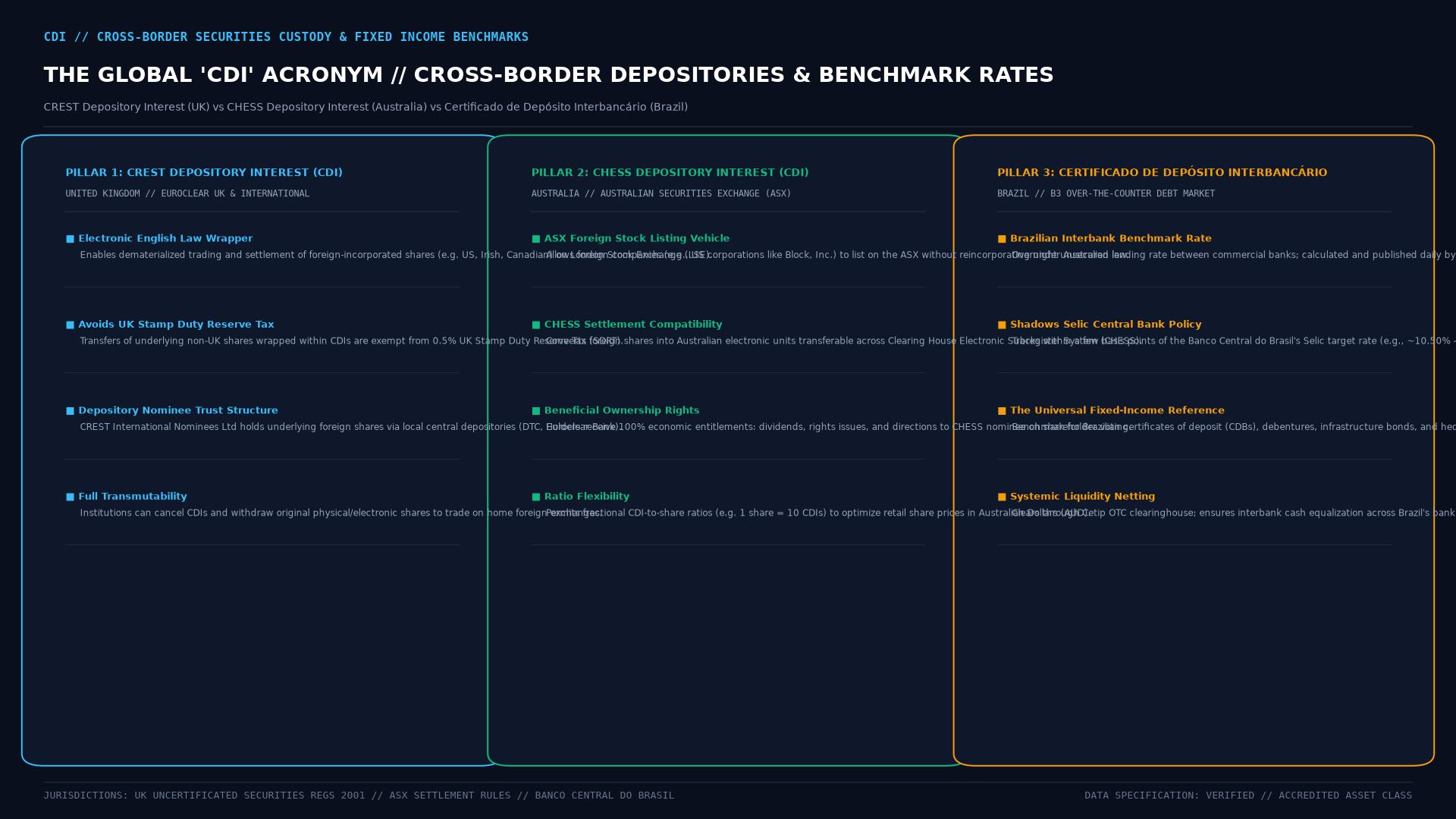 Figure: Global disambiguation of the CDI acronym: UK CREST Depository Interests and Australian CHESS Depository Interests for cross-border securities listing vs. Brazil’s Certificado de Depósito Interbancário benchmark rate.
1. CREST Depository Interests (UK Market Infrastructure)
In the United Kingdom, the central securities depository, Euroclear UK & International (formerly CREST), is legally governed by English and Irish property law. Under these legal regimes, securities held within CREST must be issued by companies organized under jurisdictions that permit electronic dematerialized title.
Many foreign jurisdictions (including the United States and parts of continental Europe) require share transfers to be executed on local corporate registries or through specific domestic clearing houses (such as the Depository Trust Company / DTC in the US).
To allow UK institutional investors and retail brokers to trade these foreign shares on the London Stock Exchange (LSE) without manual physical transfers, Euroclear UK creates a CREST Depository Interest (CDI):
            CROSS-BORDER CREST DEPOSITORY INTEREST (CDI) CREATION

     Foreign Home Market (US / Europe)                UK Capital Market (LSE / CREST)
  ┌─────────────────────────────────────┐         ┌─────────────────────────────────────┐
  │ Foreign Underlying Shares (e.g. US) │         │ CREST Depository Interest (CDI)     │
  │ Registered on Home Transfer Register│         │ Dematerialized UK Security          │
  └──────────────────┬──────────────────┘         └──────────────────▲──────────────────┘
                     │                                               │
                     ▼                                               │
  ┌─────────────────────────────────────┐         ┌──────────────────┴──────────────────┐
  │ CREST DEPOSITARY NOMINEE            │         │ CREST SETTLEMENT SYSTEM             │
  │ (Holds Legal Title as Custodian     │ <=====> │ Trades Settle Electronically in GBP │
  │ in Local Home Depository / DTC)     │         │ Beneficial Ownership with Investor  │
  └─────────────────────────────────────┘         └─────────────────────────────────────┘
Mechanical Structure of CREST CDIs
- Legal vs. Beneficial Ownership: The legal title to the underlying foreign shares is held by a specialized custodian nominee (CREST International Nominees Limited) inside the foreign home market depository. The UK investor holds the beneficial economic ownership represented by the electronic CDI in their CREST account.
- Transmutability: A CDI is 100% backed by underlying shares on a 1:1 ratio. Institutional market makers can freely transmute shares: delivering US shares to the CREST nominee in New York to mint new CDIs in London, or cancelling CDIs in London to release underlying US shares back into DTC.
- Stamp Duty Avoidance: Transferring CDIs within CREST does not trigger the standard 0.5% UK Stamp Duty Reserve Tax (SDRT), provided the underlying company does not maintain a register in the UK.
2. CHESS Depository Interests (Australia ASX)
On the Australian Securities Exchange (ASX), the settlement clearing engine is the Clearing House Electronic Subregister System (CHESS). Australian corporate law requires companies to maintain a share register that records legal ownership directly in the name of the shareholder. However, corporations domiciled in foreign jurisdictions (such as Delaware in the US, or the Cayman Islands) are bound by their home legal codes, which often do not recognize direct foreign electronic title registration on CHESS.
To bridge this cross-border legal conflict, the ASX utilizes CHESS Depository Interests (CDIs):
- Issuance Mechanics: Foreign corporations (such as Block Inc. / SQ2, ResMed Inc., or mining multinationals) deposit common shares with a designated Australian depository nominee (such as CHESS Depositary Nominees Pty Limited / CDN).
- Proportionality: CDIs may trade at a 1:1 ratio or a multi-unit ratio (e.g., 1 underlying foreign share equals 5 CDIs) to ensure the Australian trading price matches domestic retail share price conventions.
- Shareholder Rights: Holders of CDIs receive all economic dividends (converted to Australian Dollars / AUD) and can direct CDN on how to vote their underlying shares via voting instruction forms at shareholder meetings.
3. Certificado de Depósito Interbancário (Brazilian Interbank CDI)
In Brazilian financial markets, CDI refers to the Certificado de Depósito Interbancário. CDIs are short-term, unsecured wholesale debt instruments issued and traded exclusively between licensed commercial and investment banks to settle daily liquidity surpluses and deficits:
+------------------------------------+------------------------------------+
| Feature: Brazilian CDI Rate        | Operational Characteristics        |
+------------------------------------+------------------------------------+
| Governing Market Engine:           | Cleared and settled electronically |
| B3 (Brasil, Bolsa, Balcão).        | through B3 Cetip systems.          |
|                                    |                                    |
| Benchmark Reference Link:          | Closely tracks the Selic Over      |
| Shadows Banco Central do Brasil.   | rate (typically within a few basis |
|                                    | points of the central bank target).|
|                                    |                                    |
| Universal Financial Benchmark:     | The universal reference rate for   |
| Domestic investment yields.        | bank CDBs, debentures, and mutual  |
|                                    | fund performance benchmarks.       |
+------------------------------------+------------------------------------+
The CDI Daily Compounding Algorithm
Brazilian financial markets use an annualized 252-business-day compounding convention. The daily CDI factor ($F_{\text{CDI}, t}$) is derived from the annualized percentage rate ($R_{\text{CDI}}$):
$$F_{\text{CDI}, t} = \left( 1 + \frac{R_{\text{CDI}}}{100} \right)^{\frac{1}{252}}$$
$$\text{Cumulative CDI Return} = \prod_{t=1}^{N} F_{\text{CDI}, t} - 1.0$$
In Brazilian wealth management, retail and institutional fixed-income instruments are quoted as a direct percentage of the CDI rate (e.g., a Certificate of Bank Deposit / CDB paying “105% of CDI”, or an infrastructure debenture yielding “CDI + 2.50%”).
Cross-Jurisdictional Comparison
  Metric                CREST CDI (UK)                 CHESS CDI (Australia)         Brazilian CDI
  ---------------------------------------------------------------------------------------------------
  Financial Domain      Securities Depository Receipt  Securities Depository Receipt Wholesale Interbank Debt
  Primary Exchange      London Stock Exchange (LSE)    Australian Securities (ASX)   B3 / Cetip OTC Market
  Asset Class           Cross-Border Equity & Bonds    Cross-Border Listed Shares    Unsecured Short-Term Debt
  Core Function         Enables UK clearing of foreign Enables ASX listing of non-AU Benchmarks national
                        assets within CREST            corporate securities          fixed income & bank rates
Frequently Asked Questions
Can an investor holding Australian CDIs convert them into direct overseas shares?
Yes. An investor holding ASX-listed CDIs can submit a formal conversion request through their broker to CHESS Depositary Nominees (CDN). CDN cancels the Australian CDIs and instructs the foreign transfer agent to issue common shares in the investor name on the home foreign exchange (such as the NYSE or Nasdaq).
How are foreign dividends paid to holders of CREST Depository Interests?
When the underlying foreign corporation distributes a cash dividend, the gross dividend is paid in home currency (such as USD or EUR) to the CREST international nominee. The nominee converts the funds into British Pounds Sterling (GBP) or passes the payment through in foreign currency to the beneficial owner’s CREST account, net of any applicable foreign withholding taxes.
Why do Brazilian investment funds measure performance against the CDI rather than inflation?
In Brazil, decades of historical high interest rates established the interbank CDI rate as the fundamental opportunity cost of capital. Because safe, overnight bank deposits earn the CDI rate with negligible credit risk, fund managers must beat the CDI benchmark to justify active management fees.
Ready to trade forex?
Open a free demo account with a regulated broker. Practice with virtual funds before risking real money.