CDSL
A premier financial acronym for Central Depository Services (India) Limited, one of India's two licensed central securities depositories maintaining electronic dematerialized accounts under SEBI regulation.
What Does CDSL Stand For in Finance?
In capital markets, electronic securities settlement, and retail investing, the acronym CDSL stands for Central Depository Services (India) Limited. Operating under the statutory framework of the Depositories Act of 1996 and supervised by the Securities and Exchange Board of India (SEBI), CDSL is one of the two premier central securities depositories licensed to operate in India.
Headquartered in Mumbai and initially promoted by the Bombay Stock Exchange (BSE) alongside leading public and private sector commercial banks, CDSL maintains the electronic registry for dematerialized (demat) equity shares, corporate debentures, government bonds, exchange-traded funds (ETFs), and mutual fund units. By converting paper certificates into electronic book-entry records, CDSL provides the operational foundation for real-time securities settlement, trade clearing, and electronic corporate actions across the Indian financial system.
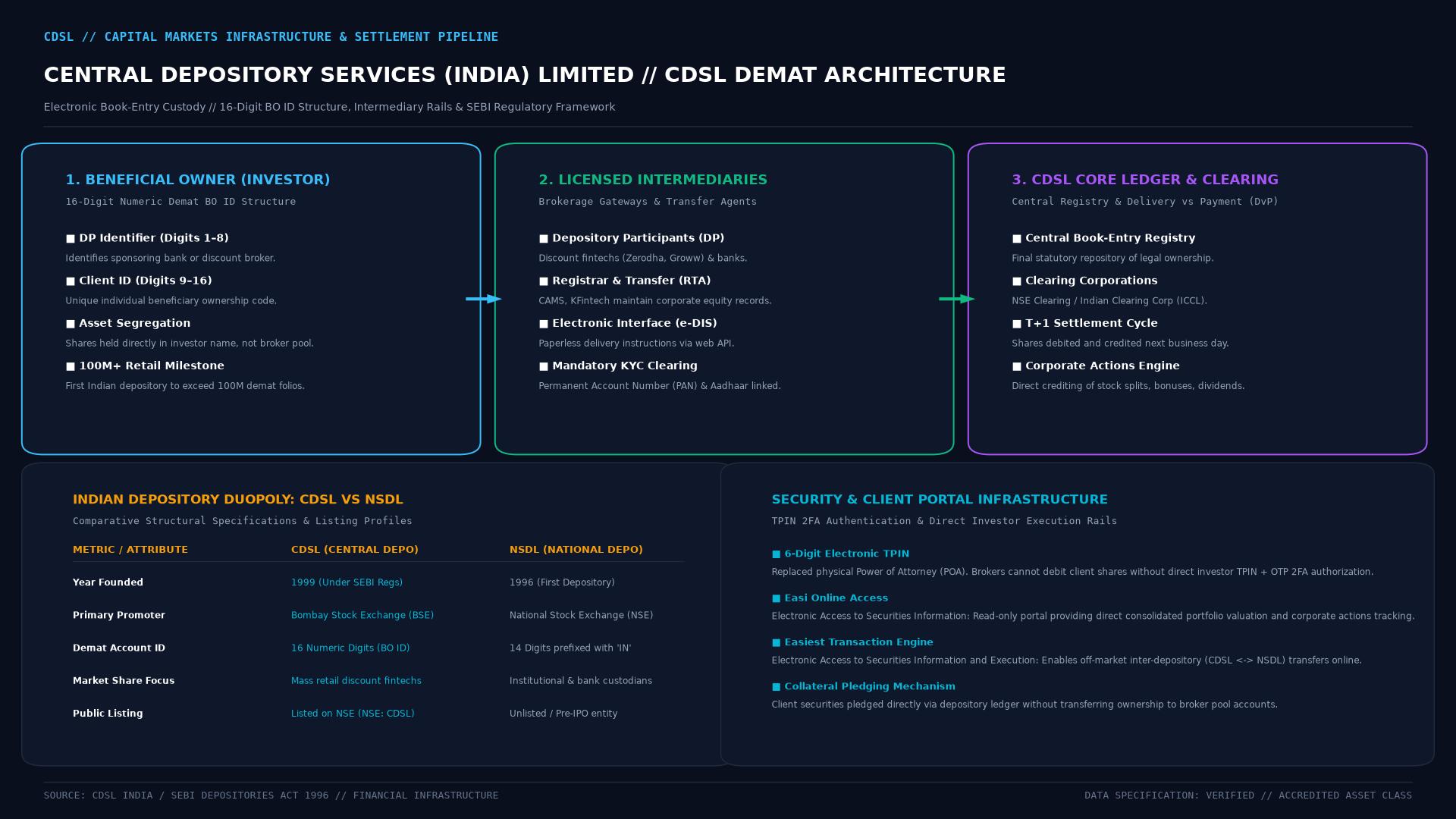 Figure: Institutional architecture of Central Depository Services (India) Limited (CDSL), illustrating the 16-digit Beneficiary Owner ID (BO ID), intermediary routing through Depository Participants and Registrars (RTAs), core ledger custody, and the comparative duopoly landscape versus NSDL under SEBI regulation.
The Indian Depository Duopoly: CDSL vs. NSDL
India operates a duopoly depository market structure composed of CDSL and the National Securities Depository Limited (NSDL):
+------------------------------------+------------------------------------+
| Depository Attribute               | CDSL (Central Depository Services) | NSDL (National Securities Depo)    |
+------------------------------------+------------------------------------+
| Inception Year:                    | February 1999                      | August 1996                        |
| Primary Sponsor:                   | Bombay Stock Exchange (BSE)        | National Stock Exchange (NSE)      |
| Public Listing Status:             | Listed on National Stock Exchange  | Privately held / preparing IPO     |
| Demat Account Identifier:          | 16-Digit Purely Numeric BO ID      | 14 Digits prefixed with "IN"       |
| Key Broker Relationships:          | Dominates discount fintech brokers | Strong in institutional custodians |
|                                    | (Zerodha, Groww, Angel One).       | and traditional banking brokers.   |
+------------------------------------+------------------------------------+
Through aggressive partnerships with digital-first discount brokerages, CDSL experienced explosive retail growth during the post-2020 retail investing expansion, becoming the first depository in India to surpass 100 million active demat accounts.
Demat Account Numbering and Beneficiary Owner Identification
A central function of CDSL is maintaining distinct beneficiary ownership records. Every investor holding assets within CDSL is assigned a unique Beneficiary Owner Identification (BO ID) composed of 16 numeric digits:
$$\text{CDSL BO ID (16 Digits)} = \underbrace{\text{XXXX XXXX}}{\text{Depository Participant ID (8 Digits)}} + \underbrace{\text{YYYY YYYY}}{\text{Client Beneficiary ID (8 Digits)}}$$
- Depository Participant ID (First 8 Digits): Identifies the licensed intermediary (brokerage firm or custodian bank) through which the account was opened.
- Client ID (Last 8 Digits): Represents the unique, individual account code assigned to the investor.
When an investor sells shares on an exchange, clearing corporations debit this specific 16-digit BO ID ledger and credit the clearing pool account of the executing broker for settlement.
Security Infrastructure: TPIN, Easi, and Collateral Pledging
To prevent unauthorized manipulation of investor portfolios, CDSL engineered specialized digital authentication protocols:
1. Electronic Transaction PIN (TPIN)
Historically, investors signed physical, paper-based Power of Attorney (POA) agreements granting brokers legal authority to debit shares from their demat accounts upon order execution. Following regulatory reforms by SEBI to curb unauthorized broker transfers, CDSL introduced the TPIN system:
- When a client places a sell order through their online brokerage, CDSL issues or prompts for a secure, 6-digit electronic TPIN.
- The investor verifies the transaction via Two-Factor Authentication (2FA) using a Time-Based One-Time Password (OTP) routed directly to their registered mobile number and email.
- This protocol ensures that brokers cannot withdraw client shares without direct investor authorization.
2. Easi and Easiest Online Portals
CDSL provides direct web and mobile access to beneficial owners:
- Easi (Electronic Access to Securities Information): A read-only portal allowing investors to view consolidated portfolio holdings, track corporate action credits, and monitor transaction histories across multiple demat accounts.
- Easiest (Electronic Access to Securities Information and Execution of Secured Transactions): An advanced execution portal enabling investors to execute off-market transfers, inter-depository share transfers (moving shares from CDSL to NSDL), and institutional delivery instructions online.
3. Margin Pledge and Re-Pledge Protocol
Under SEBI mandatory collateral guidelines, when a trader pledges shares to a broker to secure intraday or derivative trading margins, the securities never leave the investor demat account. Instead, CDSL places a formal lien (margin pledge) on the shares within the investor own BO ID. The broker re-pledges that lien to the clearing corporation, ensuring client assets remain segregated and protected if the brokerage firm enters bankruptcy.
Regulatory and Market Operations
CDSL functions as a critical market infrastructure institution, maintaining compliance with rigorous SEBI standards:
- Capital Adequacy & Net Worth Mandates: As a core market institution, CDSL must maintain substantial minimum net worth reserves and contribute to statutory Core Settlement Guarantee Funds.
- KYC Registration Agency (CDSL Ventures Limited / CVL): A wholly owned subsidiary of CDSL, CVL operates as the largest SEBI-registered KYC Registration Agency (KRA) in India, maintaining centralized digital Know Your Customer records for millions of mutual fund and equity investors.
- Electronic Insurance Repository (CDSL Insurance Repository): CDSL operates an electronic platform enabling policyholders to store life, health, and general insurance policies in a single digital e-Insurance Account (eIA).
Frequently Asked Questions
Can an investor transfer shares from a CDSL demat account to an NSDL demat account?
Yes. This transaction is known as an Inter-Depository Transfer (IDT). An investor can execute an IDT either online through the CDSL Easiest portal or by submitting a physical Delivery Instruction Slip (DIS) marked as an inter-depository transfer to their Depository Participant. The shares debit from CDSL and credit to the recipient NSDL account within the standard clearing window.
What happens to shares held in CDSL if the discount broker shuts down?
Shares are held in the investor name directly inside the CDSL central registry, not on the broker balance sheet. If a brokerage firm closes, is suspended by SEBI, or declares bankruptcy, the investor securities remain safe within CDSL. The investor can transfer their holdings to a demat account with another active broker using CDSL Easiest or direct instructions to CDSL.
How does CDSL handle cash dividend payouts from listed corporations?
CDSL does not process physical cash transfers directly to investors. Instead, on the announced corporate record date, CDSL provides a verified digital list of beneficial owners (including share counts and registered bank account numbers) to the issuing company and its Registrar and Transfer Agent (RTA). The company then initiates direct electronic credit (via NACH or NEFT) directly into the investor bank account.
Ready to trade forex?
Open a free demo account with a regulated broker. Practice with virtual funds before risking real money.