CEC
A multi-faceted financial acronym referring to the historical Commodity Exchange Center in New York, the Commission for Environmental Cooperation in North American trade, and Community Economic Development entities.
What Does CEC Stand For in Finance?
In financial market history, derivatives microstructure, and international trade, the acronym CEC primarily refers to the Commodity Exchange Center, Inc., the landmark joint physical trading floor and shared clearing facility located at 4 World Trade Center in New York City from 1977 until 2001.
In broader international finance and multilateral trade governance, CEC also designates the Commission for Environmental Cooperation, a trilateral organization created under the environmental side agreement to the North American Free Trade Agreement (NAFTA, succeeded by USMCA) to monitor cross-border trade, green financing, and industrial compliance across the United States, Canada, and Mexico.
Within commodity trading and futures markets, however, CEC is celebrated as the crucible of modern physical futures trading, where iconic open-outcry pits for crude oil, gold, silver, copper, coffee, sugar, and cotton operated under a unified roof.
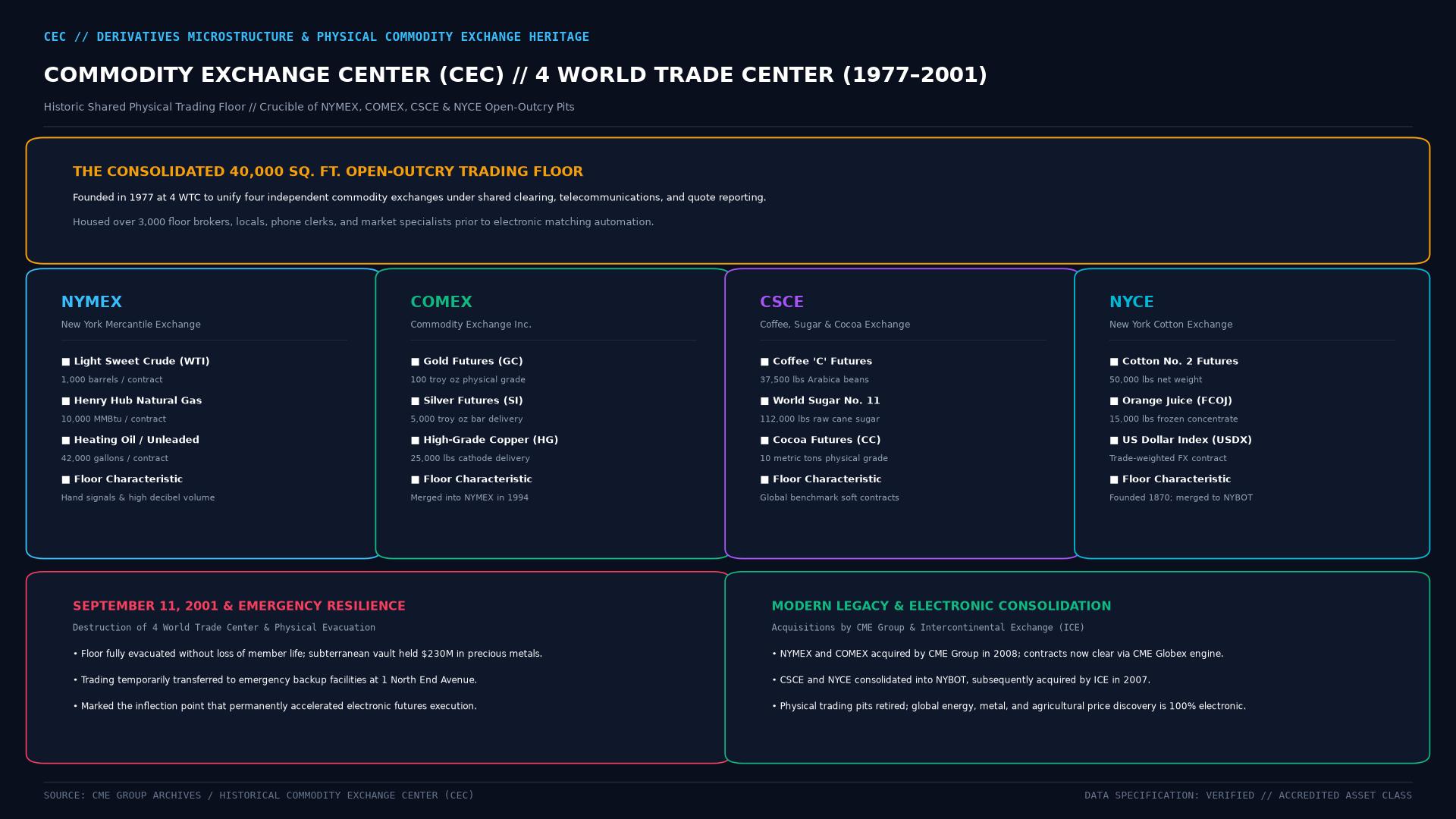 Figure: Architectural and market microstructure overview of the historic Commodity Exchange Center (CEC) at 4 World Trade Center (1977–2001), detailing the open-outcry pits of NYMEX, COMEX, CSCE, and NYCE, the 2001 emergency relocation, and the subsequent consolidation into CME Globex and ICE.
1. The Commodity Exchange Center (4 World Trade Center)
Before 1977, New York commodity futures exchanges operated out of disparate, cramped, and obsolete trading rooms scattered across lower Manhattan. As trading volume in industrial commodities and precious metals expanded, the leadership of four independent, self-regulatory exchanges agreed to pool their resources to create a modern joint facility.
In 1977, they formed Commodity Exchange Center, Inc., leasing an expansive 40,000-square-foot column-free trading floor inside the newly constructed Nine-Story building at 4 World Trade Center:
+------------------------------------+------------------------------------+
| Constituent Exchange               | Core Physical Futures Contracts    |
+------------------------------------+------------------------------------+
| New York Mercantile Exchange       | Light Sweet Crude Oil (WTI),       |
| (NYMEX): Founded in 1872.          | New York Harbor Heating Oil,       |
|                                    | Unleaded Gasoline, Henry Hub Gas.  |
|                                    |                                    |
| Commodity Exchange, Inc.           | Gold, Silver, High-Grade Copper,   |
| (COMEX): Formed in 1933 via merger.| Aluminum futures and options.      |
|                                    |                                    |
| Coffee, Sugar and Cocoa Exchange   | Sugar No. 11 (World Sugar),        |
| (CSCE): Founded in 1882.           | Coffee "C", Cocoa futures.         |
|                                    |                                    |
| New York Cotton Exchange           | Cotton No. 2, Frozen Concentrated  |
| (NYCE): Founded in 1870.           | Orange Juice (FCOJ), US Dollar Idx.|
+------------------------------------+------------------------------------+
Market Microstructure: Shared Infrastructure and Pit Trading
The CEC was an engineering achievement for financial microstructure in the late 1970s. The facility consolidated essential shared services:
- Unified Floor Telecommunications: Thousands of direct private phone lines connecting floor brokers in tiered wooden octagonal pits directly to retail brokerage desks and commercial commodity merchants globally.
- Consolidated Computerized Price Feeds: High-speed electronic quote boards mounted along the perimeter walls, displaying real-time trade ticks captured by exchange pit reporters.
- Shared Clearing and Floor Security: Standardized badge access systems, shared runner corridors, and coordinated clearing linkages to process hundreds of thousands of daily paper trade tickets.
The Turning Point: September 11, 2001 and Electronic Transition
The fate of the physical Commodity Exchange Center was permanently altered on the morning of September 11, 2001.
Destruction of 4 World Trade Center
When the South Tower (2 World Trade Center) collapsed following the terrorist attack, debris crashed directly into 4 World Trade Center, destroying the building and crushing the CEC trading floor. Although emergency evacuations saved the vast majority of exchange floor personnel, all physical trading operations, terminal connections, and localized physical records were obliterated.
The Emergency Pivot and Relocation
Within days of the disaster, the exchanges demonstrated remarkable institutional resilience:
- NYMEX and COMEX (which had merged in 1994) activated emergency contingency operations at their secondary facility at One North End Avenue in Battery Park City, resuming floor trading for crude oil and precious metals within a week.
- The New York Board of Trade (NYBOT, formed by the merger of CSCE and NYCE) established temporary trading pits at the Queens backup facility before leasing floor space at the NYMEX building.
The Acceleration of Electronic Trading
The physical destruction of the CEC dealt a fatal blow to the supremacy of open-outcry pit trading. Institutional market makers, multinational oil companies (BP, Shell, ExxonMobil), and global investment banks recognized the systemic fragility of centralized physical trading floors.
Market liquidity rapidly migrated to automated electronic order-matching engines:
- NYMEX ACCESS and CME Globex: NYMEX partnered with the Chicago Mercantile Exchange (CME) in 2006 to list energy and metal contracts on CME Globex, rendering pit trading obsolete. CME Group acquired NYMEX Holdings for $11 billion in 2008.
- ICE Acquisition of NYBOT: In 2007, the Intercontinental Exchange (ICE) acquired the New York Board of Trade, migrating trading in soft commodities (coffee, sugar, cocoa, cotton) onto ICE electronic execution platforms.
2. Commission for Environmental Cooperation (CEC Trade Governance)
In trade agreements and cross-border commercial policy, CEC represents the Commission for Environmental Cooperation.
Headquartered in Montreal, Canada, the CEC was established in 1994 under the North American Agreement on Environmental Cooperation (NAAEC), an environmental side accord negotiated alongside NAFTA and updated under the United States-Mexico-Canada Agreement (USMCA):
  CEC Environmental Governance Mandate
  ──────────────────────────────────────────────────────────────────────────
  1. Preventing Regulatory Dumping:
     Investigates allegations that a member state is failing to effectively
     enforce its domestic environmental laws to gain an unfair trade advantage.

  2. Submissions on Enforcement Matters (SEM):
     Maintains an open citizen petition mechanism where non-governmental
     organizations and citizens can challenge environmental enforcement failures.

  3. Green Supply Chain Tracking:
     Tracks cross-border movements of hazardous industrial waste, evaluates
     carbon intensity across North American trade corridors, and promotes green finance.
Comparative Summary of CEC Acronyms
  Metric                Commodity Exchange Center (NYC)               Commission for Environmental Cooperation
  ---------------------------------------------------------------------------------------------------------------
  Field of Operation    Commodity futures and options trading         Multilateral trade & environmental oversight
  Geographic Base       4 World Trade Center, New York City           Montreal, Quebec, Canada
  Key Stakeholders      Floor brokers, commercial hedgers, FCMs       Governments of USA, Canada, and Mexico
  Historical Horizon    Active 1977–2001 (Floor destroyed on 9/11)    Active 1994–Present (Governed by USMCA)
  Successor Entity      CME Group / Intercontinental Exchange (ICE)   Active trilateral ministerial council
Frequently Asked Questions
What was the trading style used on the floor of the Commodity Exchange Center?
Trading at the CEC was conducted exclusively through open outcry. Floor brokers and local traders stood in tiered, multi-sided pits, shouting bids and offers while utilizing specialized hand signals to indicate buy or sell intentions, contract quantities, and price fractions.
Did any physical commodities get delivered to 4 World Trade Center?
No. The CEC was purely a financial exchange facility where futures and options contracts were traded and cleared. Physical delivery of the underlying commodities occurred at designated commercial delivery hubs across the United States, such as the Cushing, Oklahoma pipeline hub for WTI crude oil, or certified commercial bank vaults in New York City for COMEX gold and silver bars.
What happened to the COMEX gold vaults beneath 4 World Trade Center on 9/11?
Beneath 4 World Trade Center were massive underground, bomb-resistant vaults holding over $1 billion worth of physical gold and silver bars owned by COMEX clearing banks (including Scotiabank and HSBC) to back deliverable futures contracts. The subterranean vaults survived the collapse of the towers intact, and the precious metal bullion was recovered and transported under armed federal guard several weeks after the disaster.
Ready to trade forex?
Open a free demo account with a regulated broker. Practice with virtual funds before risking real money.