Hambrecht & Quist Technology Index
The Hambrecht & Quist Technology Index was a historic equity benchmark tracking approximately 200 leading American technology companies, created by boutique investment bank Hambrecht & Quist during the rise of Silicon Valley.
The Hambrecht & Quist Technology Index was a landmark capitalization-weighted equity benchmark created by the boutique San Francisco investment banking firm Hambrecht & Quist (H&Q). Comprising approximately 200 leading American companies spanning computer hardware, semiconductors, software engineering, telecommunications, and biotechnology, the index served as the premier institutional barometer of the emerging technology sector throughout the 1980s and 1990s. Before the Nasdaq-100 or specialized tech exchange-traded funds achieved global dominance, the H&Q Technology Index provided institutional portfolio managers with an essential analytical yardstick to measure high-beta innovation, venture-backed public offerings, and the structural birth of the digital economy.
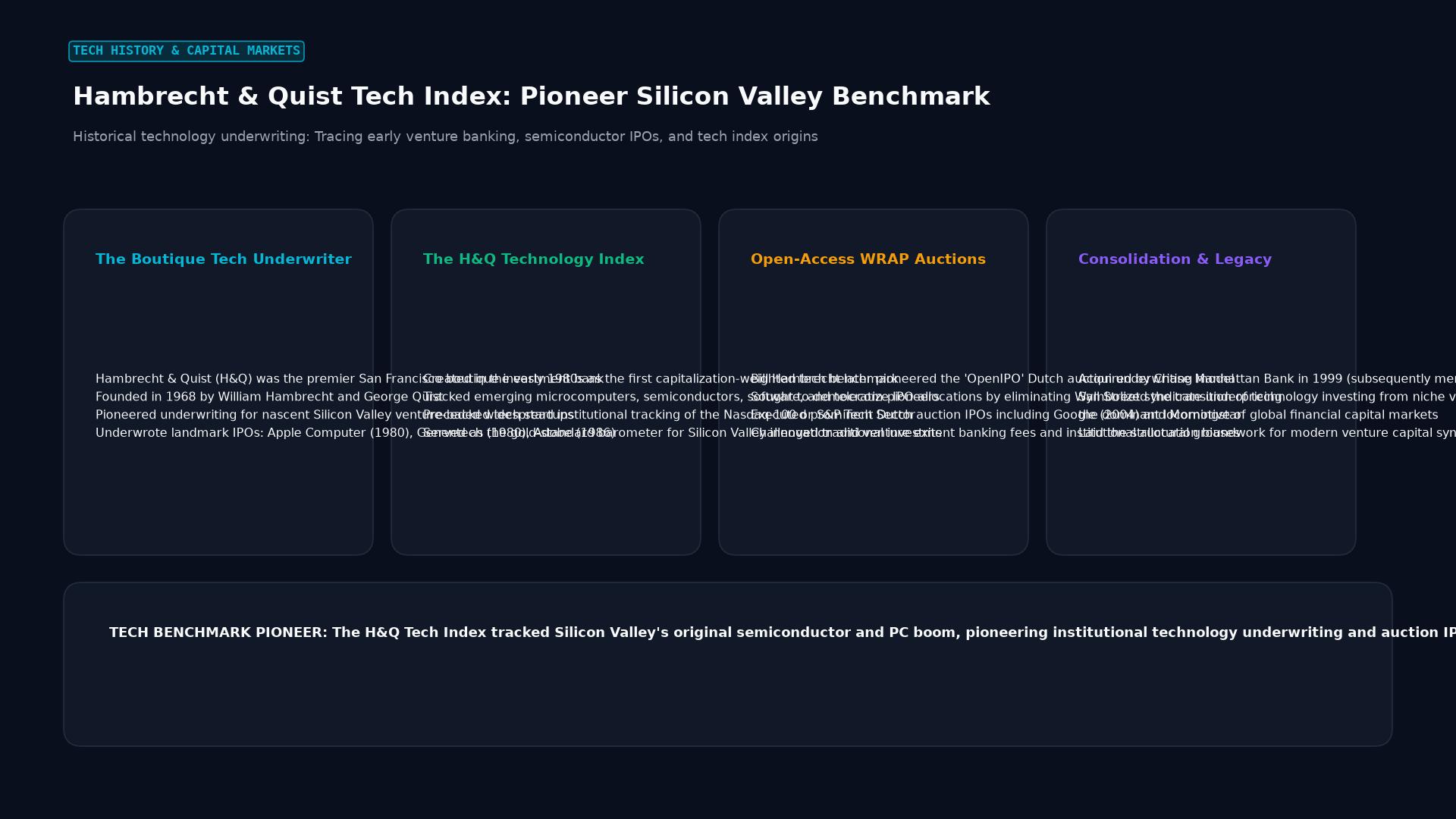 Figure: Historical technology underwriting: Tracing early venture banking, semiconductor IPOs, and tech index origins
Historical Context: The Four Horsemen of Tech Underwriting
To understand the institutional authority of the Hambrecht & Quist Technology Index, one must appreciate the financial landscape of Silicon Valley during the late twentieth century. In the 1970s, established Wall Street commercial banks and traditional white-shoe investment banking firms (such as Morgan Stanley and Goldman Sachs) viewed young microcomputer and semiconductor startups as speculative, unproven novelties, largely declining to underwrite their equity offerings.
A specialized group of four San Francisco- and Boston-based boutique investment banking firms stepped into the void, earning the legendary Wall Street moniker “The Four Horsemen”:
- Hambrecht & Quist (H&Q)
- Montgomery Securities
- Robertson Stephens
- Alex. Brown & Sons
Founded in 1968 by venture capitalist William Hambrecht and private equity pioneer George Quist, H&Q established deep relationships with early venture capital partnerships on Sand Hill Road. The firm became the lead or co-lead underwriter for the seminal initial public offerings (IPOs) that established the technological revolution:
- Apple Computer (1980): H&Q co-underwrote Apple’s historic IPO alongside Morgan Stanley, raising more capital than any public offering since Ford Motor Company in 1956.
- Genentech (1980): The first public biotechnology company, whose shares surged from $35 to $89 on its opening day of trading.
- Adobe Systems (1986): Defining the desktop publishing industry.
- Netscape Communications (1995): The watershed moment that launched the consumer internet boom.
Because traditional market gauges like the Dow Jones Industrial Average (dominated by industrial manufacturing, oil producers, and regulated utilities) failed to capture the explosive, high-risk dynamics of venture-backed firms, H&Q launched its own proprietary Technology Index to fill the analytical void.
Composition, Methodology, and Subsector Weightings
The Hambrecht & Quist Technology Index tracked approximately 200 companies selected for their direct participation in commercial research, development, and delivery of advanced technology products. The index utilized a market-capitalization weighting methodology:
$$\text{Index Market Value} = \sum_{i=1}^{200} P_{i,t} \times Q_{i,t}$$
The index was subdivided into five specialized sub-indices, reflecting the operational architecture of the computing era:
- Semiconductor and Equipment Manufacturers: Foundries and component designers such as Intel, Applied Materials, and Micron Technology.
- Computer Hardware and Systems: Microcomputer makers and workstation developers, including Apple, Sun Microsystems, Silicon Graphics, and Compaq.
- Enterprise Software and Infrastructure: Operating system providers and database pioneers, including Microsoft, Oracle, and Novell.
- Data Storage and Peripherals: Magnetic disk drive innovators such as Seagate Technology, Quantum Corporation, and Western Digital.
- Telecommunications and Networking: Early internet routing and optical hardware leaders, notably Cisco Systems and 3Com.
By isolating these sectors from industrial capital goods, the H&Q Index revealed that technology companies exhibited unique fundamental characteristics: high gross margins (often exceeding 60 to 70 percent), rapid product obsolescence cycles, heavy reinvestment into research and development (R&D), and zero regular dividend yields, with enterprise values driven almost entirely by projected terminal growth.
| Historical Benchmark | Focus / Universe | Underlying Market Character | Role in Late 20th Century |
|---|---|---|---|
| H&Q Technology Index | 200 Pure-Play Tech Stocks | High-Beta, Pure Technology & Biotech | Definitive Silicon Valley growth benchmark |
| Nasdaq Composite | All Nasdaq-Listed Securities | Broad; included financials & retail | General exchange performance metric |
| S&P 500 Index | 500 Large-Cap US Corporations | Low tech weighting historically (heavy industrial) | Core institutional defensive benchmark |
| Russell 2000 | 2,000 Small-Cap US Firms | Diverse small-cap across all industries | Broader domestic small-cap risk barometer |
The 1999 Peak, Chase Acquisition, and Evolution
At the height of the dot-com boom in September 1999, commercial banking giant Chase Manhattan Corporation agreed to acquire Hambrecht & Quist for 1.35 billion dollars in stock, seeking to capture H&Q’s lucrative tech IPO underwriting revenues.
Following the acquisition, the index was temporarily rebranded as the Chase H&Q Technology Index. In 2000, Chase Manhattan merged with J.P. Morgan & Co. to form JPMorgan Chase, leading to the gradual integration of H&Q’s research operations into JPMorgan Securities.
Over the ensuing decade, the structural dominance of the Nasdaq-100 Index (popularized globally by the launch of the Invesco QQQ trust in 1999) and the emergence of standardized sector benchmarks, such as the Technology Select Sector SPDR Fund (XLK) based on S&P Dow Jones Indices, superseded firm-specific proprietary indices like the H&Q Index.
The Long-Term Heritage of Hambrecht & Quist
The intellectual legacy of Hambrecht & Quist extends far beyond the historical index:
- Pioneering Open-Access IPOs: Following the sale of H&Q, founder Bill Hambrecht founded WR Hambrecht + Co, inventing the OpenIPO system. Utilizing a modified Dutch auction format, the system aimed to democratize public offerings by allowing retail investors to bid alongside Wall Street institutions, eliminating underpricing and private allocations. Google (Alphabet) famously utilized this Dutch auction mechanism for its landmark IPO in August 2004.
- Technology Sector Categorization: H&Q’s original subsector divisions established the structural framework later codified by standard classification frameworks, such as the Global Industry Classification Standard (GICS).
Frequently Asked Questions
Why did Wall Street need the H&Q Technology Index when the Nasdaq Composite already existed?
While the Nasdaq Composite tracked securities listed on the Nasdaq stock exchange, its composition historically included thousands of small regional banks, insurance brokers, and commercial trucking firms that had chosen Nasdaq over the New York Stock Exchange. The H&Q Technology Index filtered out non-tech entities, providing institutional investors with a concentrated, pure-play gauge of the technology industry.
What happened to the other “Four Horsemen” investment banks?
All four boutique technology underwriters were acquired during the wave of financial sector consolidation in the late 1990s:
- Montgomery Securities was acquired by NationsBank (which became Bank of America) in 1997.
- Robertson Stephens was acquired by BankBoston in 1998, passed to FleetBoston, and was liquidated in 2002.
- Alex. Brown & Sons was purchased by Bankers Trust in 1997, which was acquired by Deutsche Bank in 1999.
- Hambrecht & Quist was bought by Chase Manhattan in 1999, merging into JPMorgan Chase.
How did the tech crash of 2000-2002 affect tech sector benchmarks?
During the dot-com collapse, the technology sector experienced one of the most violent drawdowns in modern financial history. Between March 2000 and October 2002, major technology indices plunged by more than 75 to 80 percent as hundreds of speculative, unprofitable internet startups failed. The surviving firms that formed the core of the H&Q Index (such as Apple, Microsoft, Intel, and Cisco) emerged to become the largest mega-cap corporations in the global economy.
Ready to trade forex?
Open a free demo account with a regulated broker. Practice with virtual funds before risking real money.